An international team led by researchers at the University of Waterloo has developed new material that can be used as flexible “artificial muscles” to replace rigid motors and pumps in robots and allow them to move more naturally and fluidly.
Soft robots differ from hard robots in that they are pliable and flexible, making them safe for interaction with people, but the materials currently used for components enabling their movement aren’t strong enough to be effective.
The Waterloo-led research group found a way to dramatically strengthen smart, rubber-like materials by mixing liquid crystals (LCs) - commonly found in displays for electronics and sensors - into promising building blocks for soft robots known as liquid crystal elastomers (LCEs).
“What we call artificial muscles are essential for unlocking the true potential of soft robots,” said Dr. Hamed Shahsavan, a professor of chemical engineering at Waterloo, who led the research group. “They allow robots to move flexibly, safely, and with precision. This is especially important for applications like micro-medical robots.”
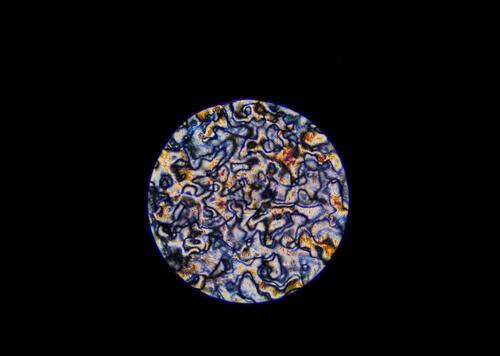
A look through a microscope at a liquid crystal used to make rubber-like materials stiffer and stronger for artificial muscles in soft robots. (University of Waterloo)
LCEs are rubbers that undergo massive shape change, in a reversible and programmable manner, when they are heated. Researchers discovered that mixing small amounts of LCs with LCEs made them much stiffer and up to nine times stronger.
“To put this in perspective, fibres from the new LCEs can, when heated, lift loads up to 2,000 times their own weight,” said Shahsavan, who is also director of the Smart Materials for Advanced Robotic Technologies (SMART) Lab at Waterloo.
The LCEs provide output work of almost 24 J/kg, about three times more than the average work provided by the muscles of mammals, he added.
X-ray analysis showed that LCs disperse inside LCEs and form small pockets, like chocolate chips in cookie dough. While still in liquid form, the LC pockets surprisingly behave like solids, holding their shape and making the LCEs around them feel stiffer when pulled or stretched.
The researchers expect LCEs with these improved mechanical properties to play a significant role in the emerging field of soft robotics by enabling extremely wide ranges of motion and powerful movements for everything from delivering drugs inside the human body to working alongside humans in manufacturing plants.
“Materials with such capabilities are highly desired in robotics as they can replace old-school, bulky, heavy actuators and electromotors with light, soft, artificial muscles without sacrificing performance,” Shahsavan said. “This is the simplest yet most robust strategy to stiffen LCEs and still maintain their programmable nature.”
The international research group also included: Dr. Tizazu Mekonnen, a chemical engineering professor at Waterloo, Sahad Vasanji and Matthew Scarfo, engineering graduate students at Waterloo, Dr. M.O. Saed of the University of Cambridge, and Dr. Antal Jakli of Kent State University.
Researchers are now focused on using the new materials as 3D-printing inks to create artificial muscles.
A study on the work, Stiffening Liquid Crystal Elastomers with Liquid Crystal Inclusions, was recently published in Advanced Materials.
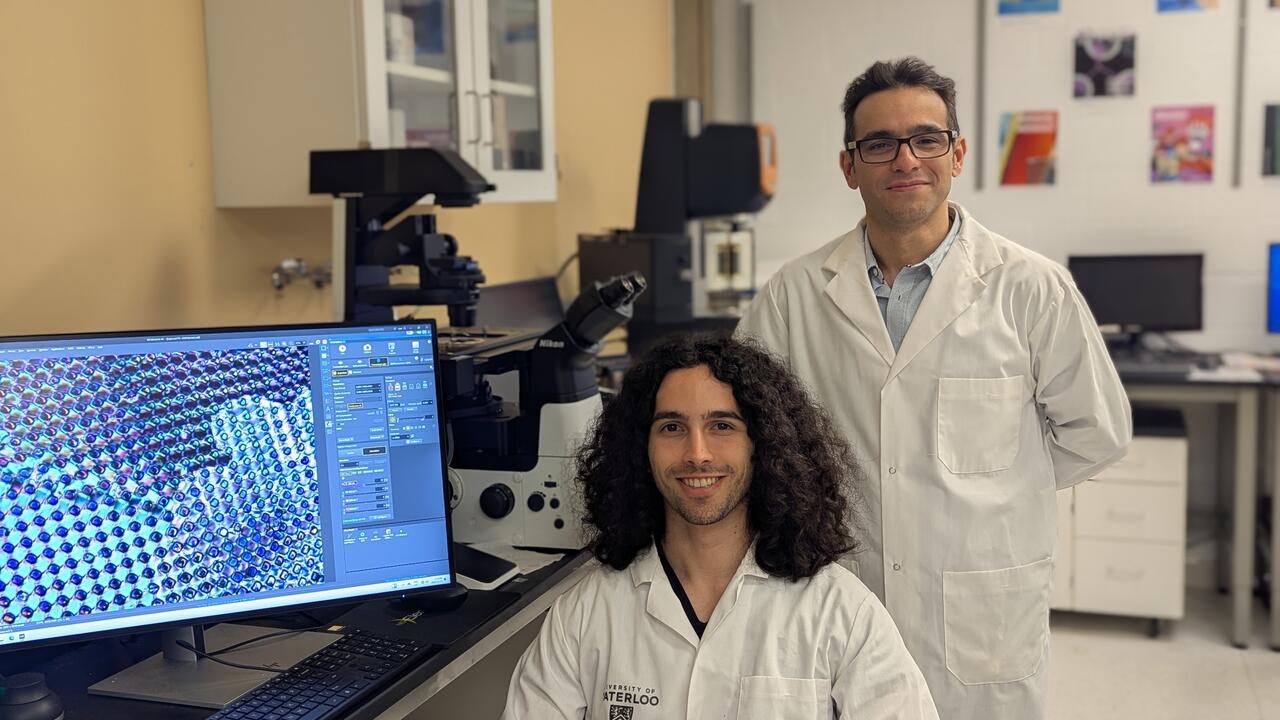
Feature image: Matthew Scarfo (left), a Waterloo engineering graduate student, and Dr. Hamed Shahsavan, professor of chemical engineering, both worked on the research that developed the flexible "artificial muscles" material that could replace rigid components in robots. (University of Waterloo)