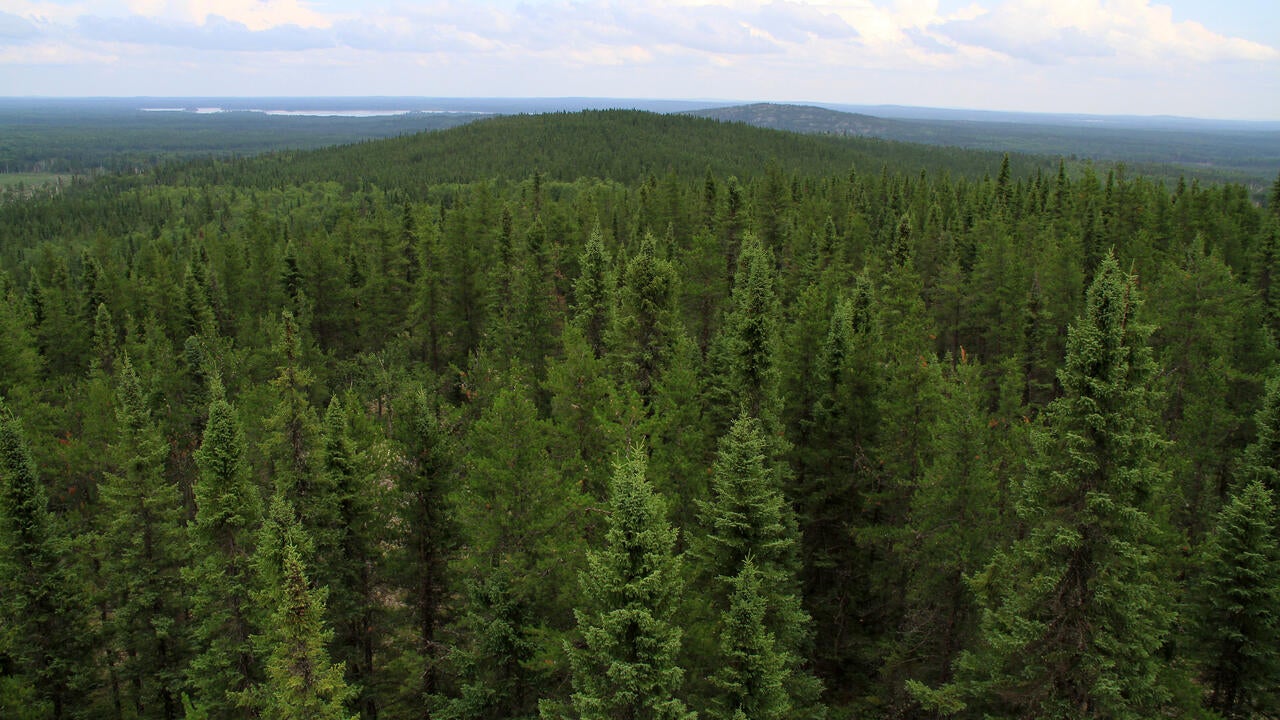
A new study finds that Canada could remove at least five times its annual carbon emissions with strategic planting of more than six million hectares of trees along the northern edge of the boreal forest.
Researchers at the University of Waterloo factored in satellite data, fire probabilities, loss of vegetation, and climate variables to estimate how much carbon the forests would remove. They found that planting about 6.4 million hectares of trees in that region could remove roughly 3.9 gigatonnes of CO₂ by 2100. Scaling up to the most suitable areas increased the potential to around 19 gigatonnes.
Reducing greenhouse gases is key to minimizing the worst effects of climate change. These results represent a significant step towards Canada’s goal of being carbon neutral by 2050 and meeting its commitments under the Paris Climate Agreement.
“We were surprised by how large the carbon-removal potential remained even with using conservative assumptions about available land and frequent fires, and by how strongly fire frequency and early seedling mortality can make or break the benefits of tree planting,” said Dr. Kevin Dsouza, postdoctoral researcher in the Department of Earth and Environmental Sciences at Waterloo and first author on the paper. “It was also striking that replanting on historically forested land was much more effective than planting on long-term non-forested areas, which suggests that filling in the gaps in the northern forest is often smarter than converting open lands.”
Large-scale tree planting has long been suggested as a climate solution in Canada, but before now, there weren’t any spatially detailed, realistic estimates of how much carbon could be stored in the northern boreal when considering fire, climate, and where trees can grow.
“We recognize that Canada’s 2 Billion Trees program faced major implementation challenges, and that experience shows why successful climate-mitigation planting is about more than planting more trees, but about selecting the right sites, the right species mixes, and the right management approach to maximize long-term carbon and ecological outcomes,” Dsouza said. “Well-planned afforestation can contribute to climate goals, especially when it’s targeted, ecologically appropriate, and supported by long-term stewardship.”
Further work will examine the effect of tree planting on permafrost and the amount of snow on the ground that reflects the sun's rays. Interventions will have to balance biodiversity, Indigenous priorities and local land uses.
The team comprised researchers from the Faculty of Science and Faculty of Environment at Waterloo. The paper, Substantial carbon removal capacity of Taiga reforestation and afforestation at Canada’s boreal edge, appears in Communications Earth & Environment.