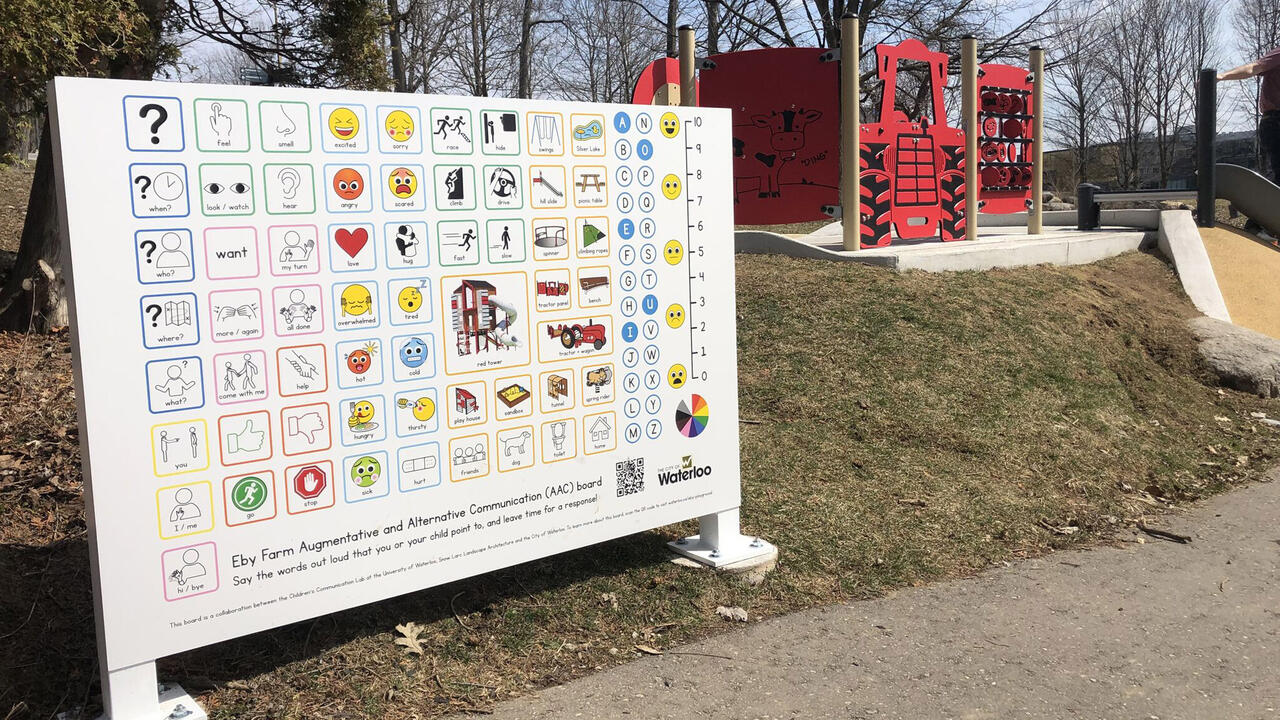
On your next trip to Waterloo Park, you’ll notice something unique in its newest Eby Farm playground: a large board with symbols and words arranged in a grid. Known as an Augmentative and Alternative Communication (AAC) board, it’s the result of a collaboration involving Dr. Daniela O’Neill and her students to help young children and children with complex communication needs communicate with family and friends.
Beginning in winter 2024, O’Neill, a professor of psychology and expert in child language development, and her class began a collaboration with landscape architect Stephanie Snow to design an AAC board to foster children’s conversation and exploration in the new playground. What started at a class project turned into a seminar course for four students, Olivia Vento, Maia Aurini, Catelyn Ritchie, and Aimee Landry, who continued to work with O’Neill and Snow on the AAC board.
“It became a much bigger project that provided a rare opportunity for the students to experience the collaborative process with Stephanie and the City of Waterloo, to be part of the whole design process, and to help write up the final report,” O’Neill says. “It was truly a very rewarding and rich experiential learning opportunity for us all.”
A design based in research and collaboration
AAC boards, which use a combination of symbols and visual cues to supplement or augment verbal communication, are usually designed for individuals who usually use them on tablets or print outs. Creating something that would be used by a diverse group of children in a public space required a large environmental scan of relevant research and information, along with consultation with experts.
“Every detail was thought through, whether it was through reading articles and finding research or getting feedback. The colour of everything, the size of everything, the words, the font, the instructions, nothing was done arbitrarily or accidentally,” says Vento, now working as the Children’s Communication Lab Outreach Manager.
“We wanted to create the best possible tool for as many people as possible,” notes Maia Aurini, who plans to pursue further studies in speech-language pathology.
The project brings together the fields of developmental and cognitive psychology, speech-language pathology, augmentative alternative communication, and children’s language development. The team also held a feedback session with families visiting the playground. They balanced budget and space constraints, as well as the needs and input of multiple stakeholders, including the City of Waterloo, the Grand River Accessibility Advisory Committee (GRAAC) and the Reconciliation, Equity, Accessibility, Diversity and Inclusion (READI) committee.
The organization of the symbols was essential for usability. The items, such as actions and feelings, are grouped together in a grid and colour coded using accessible colour combinations to make them easier to locate and to highlight categories of words such as nouns and verbs, and relationships between words. For instance, opposites such as “fast” and “slow” are placed side-by-side and beside the symbol for the playground spinner to help children form sentences. Words learned earlier in a child’s development and safety words (such as “help” and “stop”) are placed lower on the board so that younger children can reach them.
The AAC board has several unique features such as a smiley scale to help children communicate about emotions and preferences more easily, as well as a colour wheel based on something many children are familiar with: a 10 pack of Crayola markers.
“It's so common to learn colours when you're a little kid, it’s pretty early in development that you can recognize colours,” Vento says. Colours can help facilitate conversation, helping children identify a new friend by the colour of their shirt, for example.
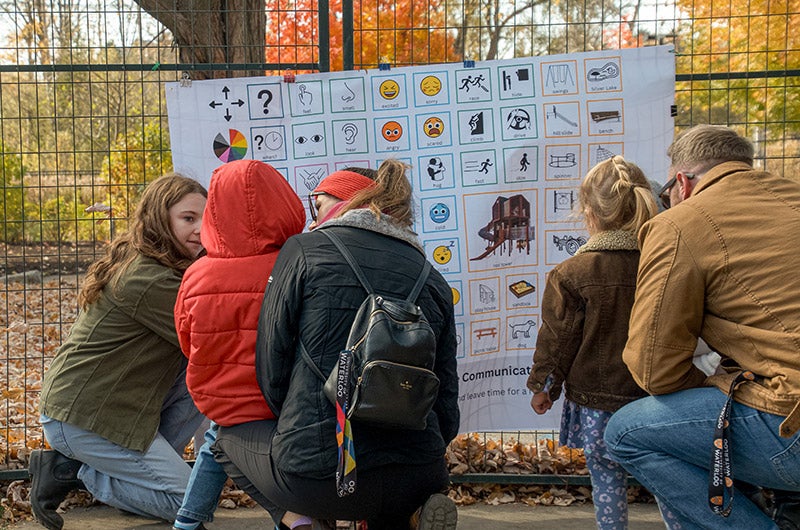
Maia Aurini gathers feedback on an early version of the AAC board layout from families visiting Waterloo Park
From the classroom to the community (and beyond)
Although the AAC board was designed for Waterloo Park, the project team hopes the work will extend beyond Waterloo Region. They authored a report about the full design process so that others can learn about what they did and why, and build on it.
The team shared the project at Psychology’s annual Discovery Day conference in April, and will be presenting the project at the Jean Piaget Conference in Ottawa in May 2026. Their work will also be featured in an upcoming issue of the Association of Ontario Landscape Architects’ Ground magazine.
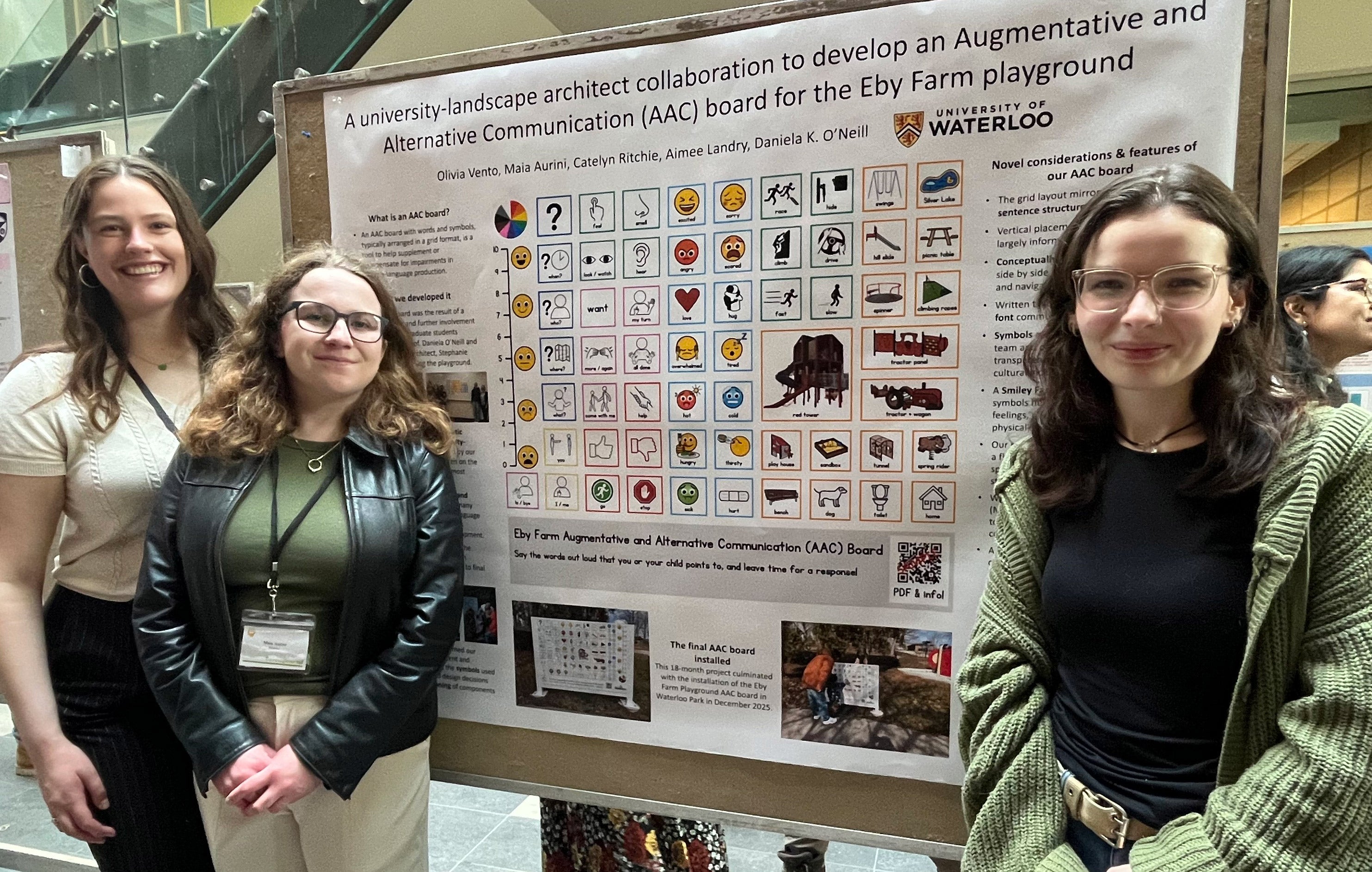
Olivia Vento, Maia Aurini and Aimee Landry present at the Psychology Discovery Day conference in Environment 3
For full details, visit the Children’s Communication Lab website and read the report about the AAC board design (PDF)