When Theatre Meets Polarization
What happens when a university course invites students to produce creative works that engage difference constructively? On the University of Waterloo campus, in fall 2025, fourteen undergraduate students chose to tackle division intentionally, through a new interdisciplinary course, PACS 302/THPERF 490: Relational Aesthetics Towards Dialogue. Created in collaboration with Professor Andrew Houston (Communication Arts) and Professor Reina Neufeldt (Peace and Conflict Studies), the course combined arts-based approaches to dialogue with performance studies.
“Dialogue relies on the spoken word, which can be limiting,” explained Neufeldt. “Arts-based approaches allow people to explore issues and concerns in ways that are embodied, fluid, and metaphorical. Performances can tap into an emotional registry as well as creativity and play. In these spaces, people hear and see perspectives differently, often with greater empathy and openness.”
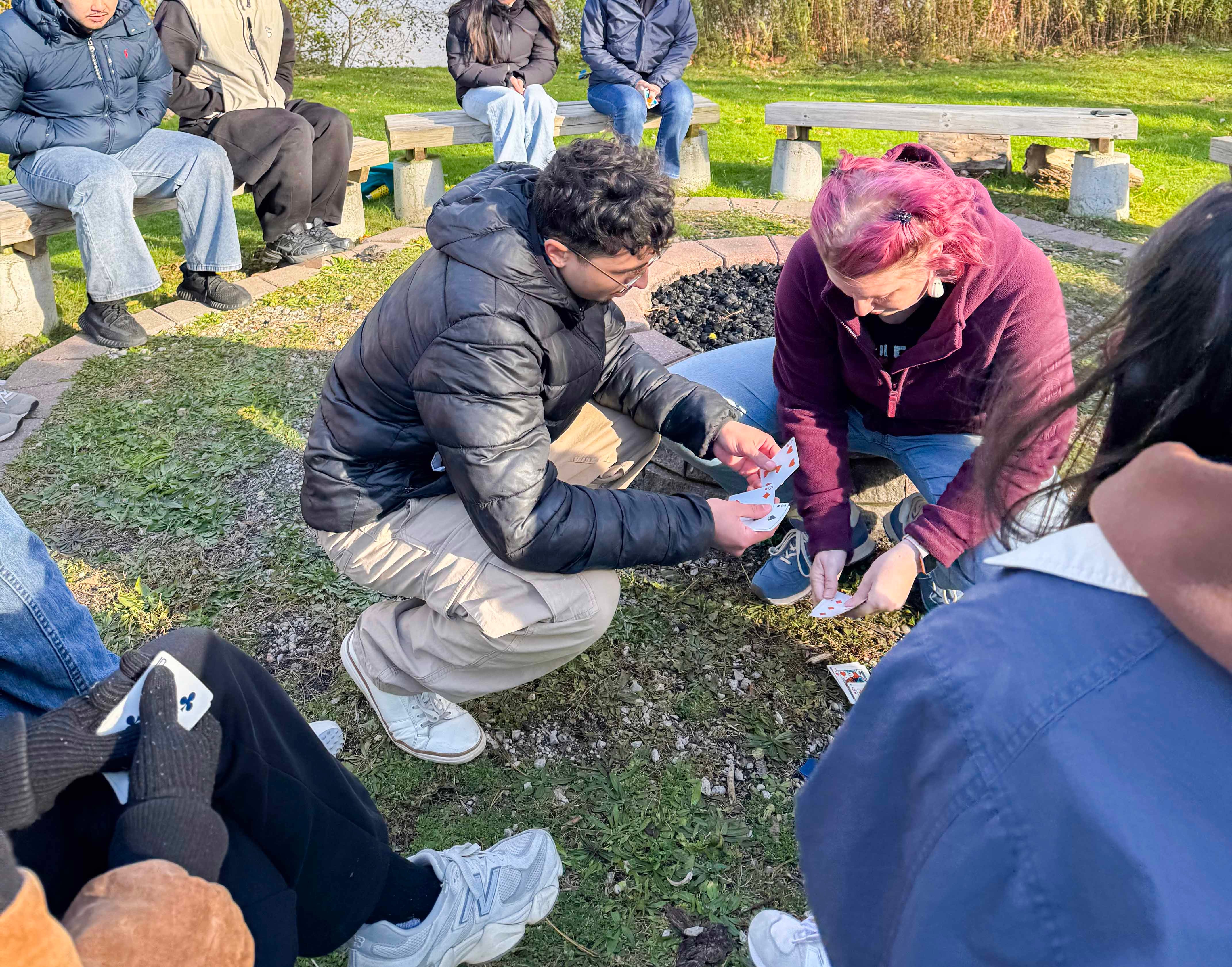
“Critical community making was central to the focus of the course,” said Houston, rather than technical skill development. Theatre concepts were introduced assuming little prior theatre knowledge. “The class blended hands‑on performance-making with ideas from Peace and Conflict Studies, looking at how creative processes can build trust and respect, and how performance itself can become a tool for listening, relationship‑building, and social change,” he added.
The course incorporated a range of experiential activities. Students began with a dialogue workshop structured as a “World Café,” where participants rotated through small-group discussions. “This hour-long conversation that covered every topic I could think of, exposed me to many different ideals and points of view which directly impacted how I interact with these subjects to this day,” student Omar Al Shawa explained. “Whether it was a more in depth version of my own thought process that I learned about, or it was a viewpoint completely opposite to my own, I believe that within that hour, I gained a deeper understanding of what political polarization meant, since I played a direct role in influencing, arguing, and learning.”
In an exercise called “Walking Talking Creature,” students visited the Student Life Centre and initiated conversations that leaned toward themes of polarization on campus. “After about an hour of random conversations, they came back with reports of remarkable encounters,” described Houston. “These random interactions revealed poignant and highly relevant information about how students are experiencing polarization on campus.”
“One way that THPERF 490/PACS 302 was innovative in approaching polarization on campus was in the applied way that Reina and I brought relational aesthetics and critical dialogue together,” Houston explained. Rather than asking students to debate difficult issues directly, the course encouraged them to engage those issues through embodied, creative processes.
“I constantly found myself doing things that I had never done before,” shared Al Shawa, who didn’t have a theatre background coming into the course. “However, since the class was so welcoming, that awkwardness translated into a super funny and charged environment where we all laughed with each other rather than at each other. This experience was a great lesson in how much positive energy from an outside source can shift how you feel about anything you do, and that discomfort is a necessary part of learning.”
“Before this course, I viewed polarization as simply two opposing sides in a given field,” said Al Shawa. “Now, I find myself having a much deeper understanding of what it means to be at odds and being exposed to different points of view and ideals.”