Flight lessons in the Velis Electro: It flies like a plane but has limited range
When an electric plane is designed for pilot training, one of the first questions is “Can you complete the standard lessons in the e-plane?”.
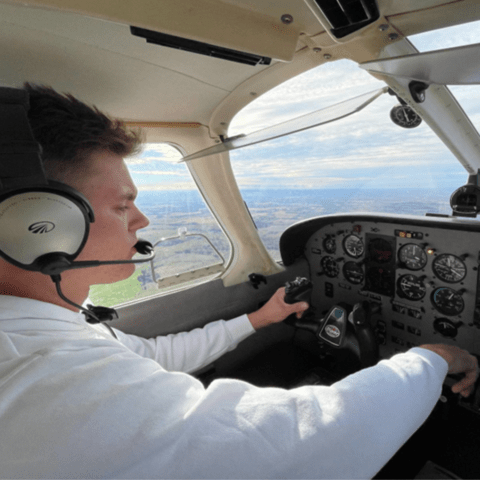
Circuit training is one of the core activities in learning to become a pilot. Pilots need to learn the skills to take-off, fly a standard circuit pattern, and land safely. Last year, we reported completing 5-7 circuits in a typical flight in the Velis Electro before landing with a reserve of at least 30% SOC, State of Charge, in the battery (equivalent to how much fuel remains in the tank).
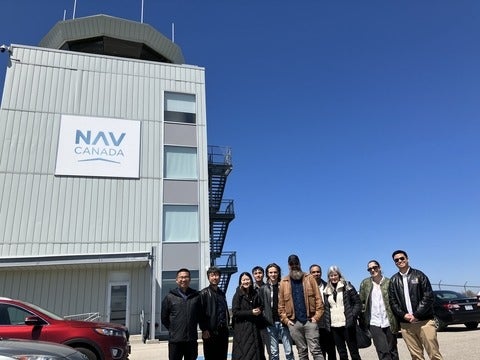
Collaborative Aeronautics Program (CAP) students who got to tour the Waterloo Air Traffic Control (ATC) tower.
The Pipistrel Velis Electro comes with a charger designed for the European 400-volt electrical system. This means that a special transformer needs to be installed at any North American airport where the Velis is to charge. (Note: Pipistrel is developing an adapter which will allow the Velis to be charged using CCS chargers, which will remove this hurdle. CCS is one of the most widely used electric vehicle charging standards.)
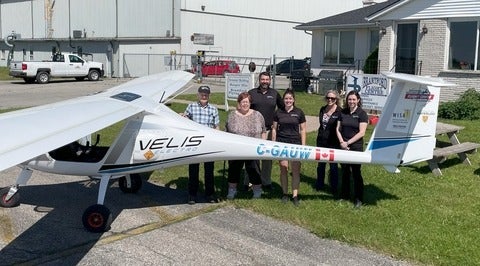
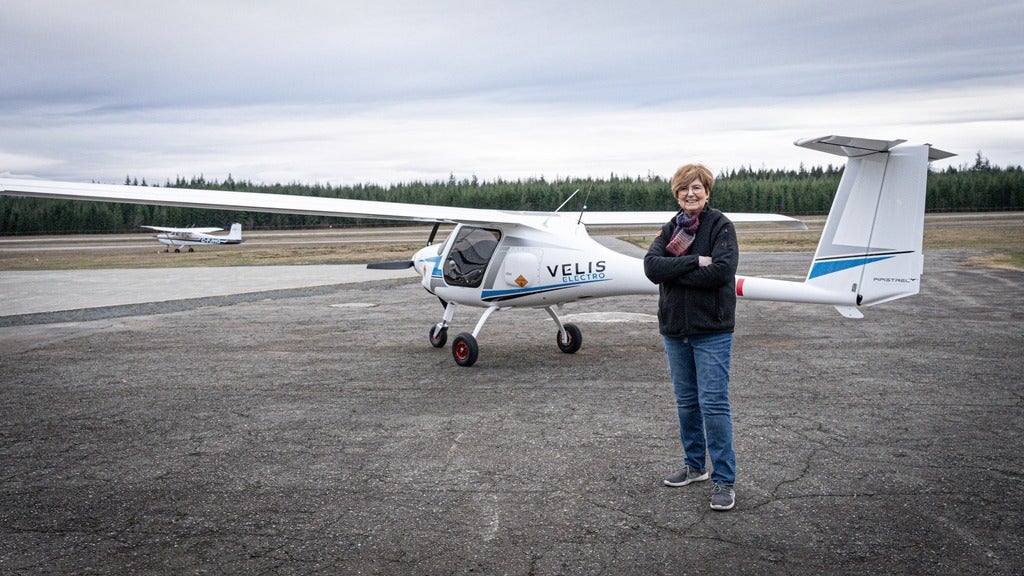
The electric plane fleet expanded across the country in 2024. Canada’s first Pipistrel Velis Electro was flown by Waterloo Institute for Sustainable Aeronautics (WISA) researchers and Waterloo Wellington Flight Centre (WWFC) personnel in 2023. Waterloo has added a second Velis Electro for 2024 (with financial support from the Federal Economic Development Agency for Southern Ontario) and a third Velis Electro was purchased by Sealand Aviation on Vancouver Island (with financial support from Clean BC)
Waterloo finance student Angelica Lee was nominated for a global aerospace award. She shares her journey and advice to inspire others in non-traditional career pathways.
A student in the Collaborative Aeronautics Program reflects on a recent visit to the NRC Flight Research Laboratory in Ottawa.
Cap Students at the University of Waterloo visited the National Research Council Flight Research Laboratory in Ottawa. Where they learned about research that is advancing sustainability in aerospace.
University of Waterloo student shares how they didn't have to choose between geography and aviation because the school offers a combined program that includes both.
Geography & Aviation student at the University of Waterloo gives their tips on how to have a successful first year in the aviation program.