News

Filter by:

Limit to news where the title matches:
Limit to items where the date of the news item:
Date range
Limit to news items tagged with one or more of:
Limit to news items where the audience is one or more of:

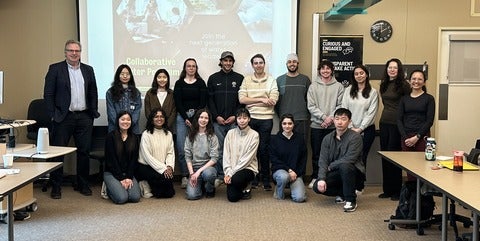
The WaterLeadership training series kicks off on October 22nd with the first of four skill-building workshops, Knowledge Mobilization 101. 

The training series cultivates essential professional skills in knowledge mobilization, research communication, leadership and innovation. Participants gain practical strategies and tips that enhance the impact of their research through clear writing, engaging presentations, and effective message development. 

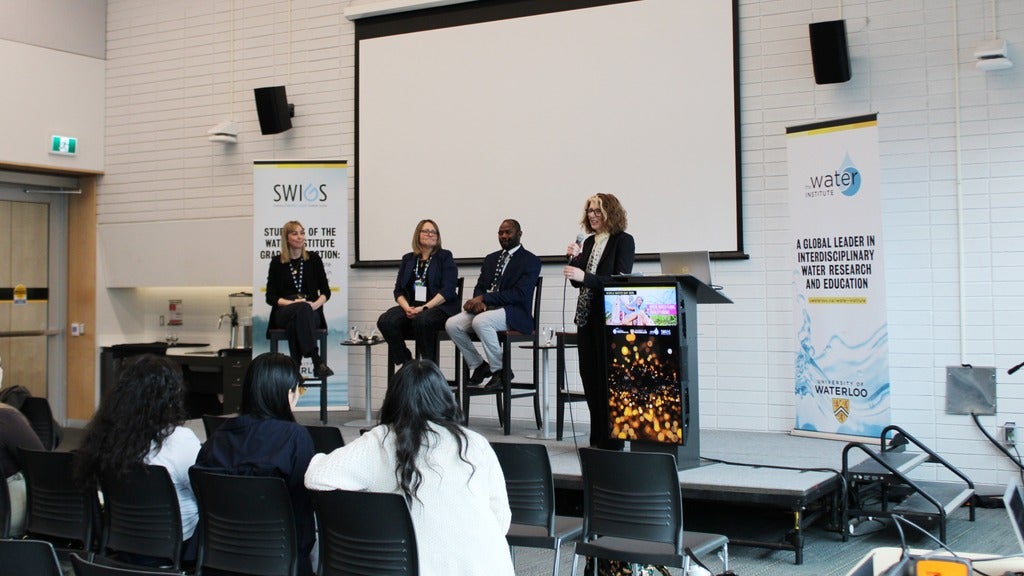
On Thursday, September 25, 2025, Water Institute member Dr. Nandita Basu, Canada Research Chair in Global Water Sustainability and Ecohydrology, joined leading experts speaking at the FLOW x Massey Freshwater Symposium, Ensuring the FLOW: Water Security in Canada and the World. Hosted by the Forum for Leadership on Water (FLOW) and Massey College, the invite-only gathering brought together fewer than 80 high-level participants, including scientists, policymakers, and leaders from national and international water organizations. Water Institute member Dr. Dustin Garrick, University Research Chair in Water and Development Policy and Director of the Collaborative Water Program, also attended alongside Dr. Basu.

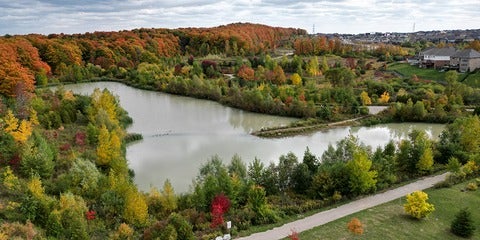
In September, the Water Institute’s Collaborative Water Program (CWP) once again took graduate students beyond the classroom and into the Grand River watershed for WATER 602: Integrated Water Management. Over three days, students travelled the length of the river from its headwaters near Luther Marsh, ON to Six Nations of the Grand River, to explore how water connects communities, ecosystems, and economies, and to grapple with the complex trade-offs inherent in water management.

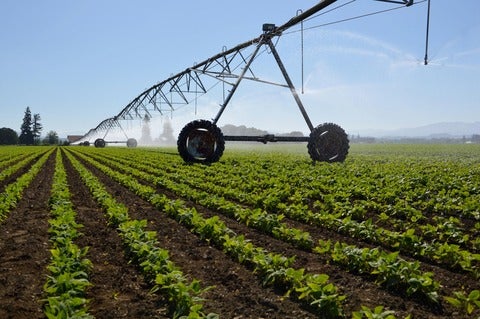
Groundwater plays an important role in global agriculture, sustaining crops that feed billions. But with rising populations and increasing food demands, this vital resource is under unprecedented pressure. By 2050, feeding the world’s projected population of 9.1 billion people will require a 70 per cent increase in food production compared to levels from 2005-2007. Without effective management, the future of farming—and food security—is at risk.

The Water Institute is pleased to launch its Fall 2025 WaterTalks, a three-part speaker series showcasing fresh perspectives on some of today’s most pressing water challenges. This year’s talks will span topics from groundwater use and the water–energy–food–poverty nexus in South Asia to advancing environmental justice and strengthening resilience to hydroclimate extremes.

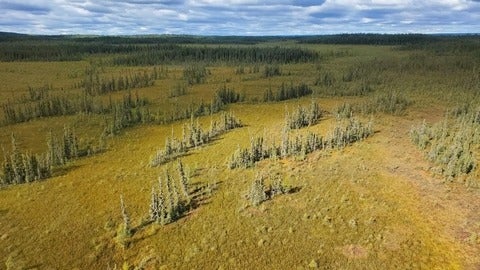
Dr. Bryan Grimwood, Professor in the Department of Recreation and Leisure Studies (RLS) in the Faculty of Health, has been awarded approximately $380,000 in funding from the Social Sciences and Humanities Research Council of Canada (SSHRC) to lead a new research initiative entitled Tourism, ruination, and regenerative futures that rethinks tourism’s role in landscapes marked by environmental and cultural ruination.

When devastating floods swept through Pakistan in 2022, millions were displaced, and more than 1400 lives were lost. For Malak Kamal, a graduate architecture student from Quetta, Pakistan, it was a turning point.

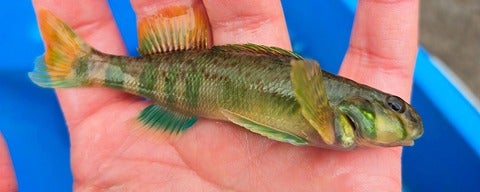
What happens to communities when the fish disappear? For millions of small-scale fishers (SSFs) worldwide, this isn’t just a question—it’s a daily reality. SSFs support the livelihoods of 120 million people globally, yet these vital ecosystems are on the brink of collapse due to declining water quality, pollution, and climate change.

What started as a personal curiosity during a California drought has become a global, interdisciplinary research journey for Isabel Jorgensen, PhD candidate, School of Environment, Resources, and Sustainability - Collaborative Water Program, Water Institute.