New online water economics seminar series launched
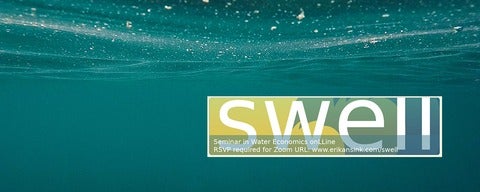
The editors of two leading international water economics journals, Water Resources and Economics and Water Economics and Policy, have joined forces to launch a new online seminar series named SWELL.
Grand Expressions is a remarkable collection of artwork by young Indigenous artists contributing to water research in the Grand River Watershed. In the exhibit, the youth – aged 10 to 26 – highlight water-related issues important to them and share traditional teachings using visual and written storytelling.
The International Water Association (IWA) has announced the creation of a COVID-19 Task Force. The Water Institute is delighted that External Advisory Board member Professor Joan Rose, Homer Nowlin Chair in Water Research at Michigan State University, will chair the Task Force.
Whether you’re looking to update your current online course or crafting one from scratch, the Water Institute has an impressive library of WaterTalks available online and on-demand. These lectures from an incredible range of recognized water scholars offer asynchronous content available today. We currently have 62 lectures available on the Water Institute YouTube channel, including recent talks from:

Read Water Institute member Sarah Wolfe’s op-ed, published in the Globe and Mail March 18. Professor Wolfe is an associate professor from the Faculty of Environment, School of Environment, Resources and Sustainability and is currently a visiting professor at Royal Roads University.
Students are encouraged to make arrangements to move out of residence by noon on Friday, March 20, 2020.
Until further notice, most employees are instructed to work from home.
Water Institute member Daniel Henstra, Associate Professor from the Department of Political Science and Senior Fellow, Centre for International Governance Innovation, discusses implications and types of states of emergency with Global News.
A state of emergency is “essentially a symbolic recognition that we’re in an extraordinary period,” said Daniel Henstra.
Researchers at the University of Waterloo have found an environmentally friendly way to explore life in the depths of the ocean.
Using a new application of a sampling technique called solid phase microextraction (SPME), researchers collected samples from deep-sea vent ecosystems to study the biological and ecological processes that occur there, without damaging the surrounding organisms.