Editor:
Brandon Sweet
University Communications
bulletin@uwaterloo.ca
University of Waterloo Campus Plan endorsed
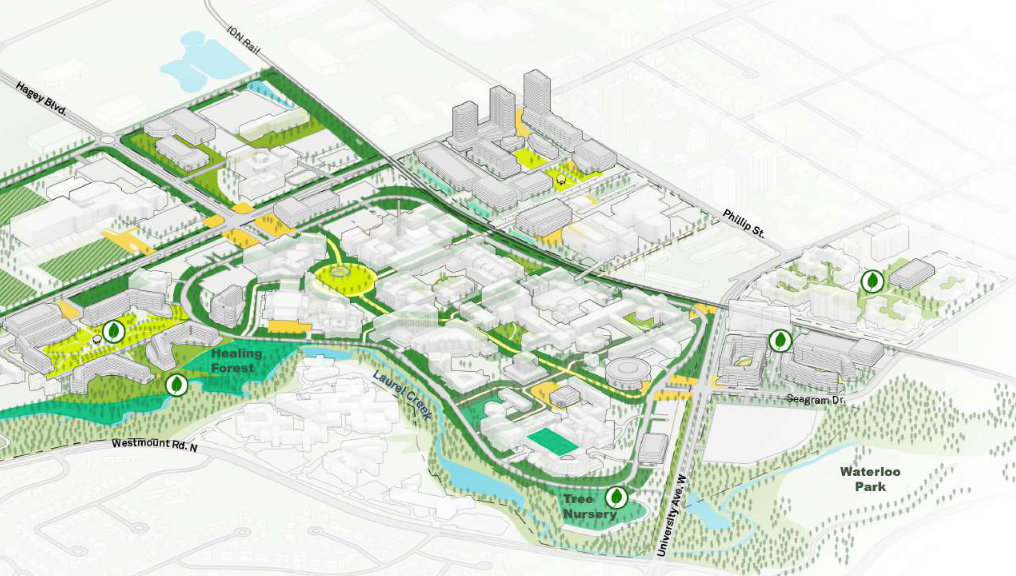
A message from Jacinda Reitsma, Vice-President, Administration and Finance.
On February 3, 2026, following the Senate’s January 26 endorsement, the University of Waterloo Board of Governors agreed to support the new Campus Plan's vision and guiding principles.
Just as cities use urban plans to guide growth over time, universities use campus plans to guide how physical spaces evolve. Waterloo’s Campus Plan is a long-term framework that shapes decisions about buildings, open space, mobility, sustainability, and accessibility. It supports the university’s academic mission and long-term priorities, including Waterloo at 100.
Explore the Campus Plan + learn how the plan will guide the evolution of Waterloo’s campus over time.
We needed a new Campus Plan because the university and the broader postsecondary landscape have changed significantly since the previous Campus Master Plan was approved in 2009. Changes in enrolment, research activity, teaching and learning, work patterns, and environmental conditions required an updated framework to guide campus development over the long term.
Now is the moment for a new Campus Plan because mounting financial pressures demand a clear, flexible framework to manage campus assets wisely—without it, future growth, deferred maintenance, and sustainability become more costly and less coordinated.
The Campus Plan was developed through a structured, multi-year process. Students, faculty, staff, and other community members contributed input at multiple stages. Engagement activities were designed to be accessible and inclusive, using a range of formats to gather perspectives and identify shared priorities. Oversight and stewardship were provided through established university governance structures.
The Campus Plan is not a construction schedule or list of approved projects. It does not commit the university to specific timelines or funding decisions. Inclusion in the plan does not mean a project is approved or imminent. All future decisions will continue to follow existing governance, budget, and approval processes.
A prime consultant with expertise in campus planning and urban design supported the university through this process. Working collaboratively with the institution, the consultant brought technical expertise and comparative insight while responsibility for the plan remained with the university.
With approval complete, the Campus Plan is now in effect. To view the Plan please find a fully accessible PDF on the Campus Plan Website.
Don’t Copy That Floppy: King’s Quest and the fight against piracy
By Mary-Ann Adebayo. This article originally appeared on the Waterloo Computer Museum website.
As the Computer Museum Assistant, I am surrounded by historical technology and early video games, which gives me the opportunity to experience software that I wouldn't have otherwise. One game that stood out to me recently was King’s Quest IV: The Perils of Rosella, which I played on the Atari 1040ST. This game is an adventure point and click game that focuses on narrative and puzzle solving. It follows Princess Rosella on her journey to the land of Tamir in search of a magical fruit that can save her father, King Graham, from a fatal illness.

As someone who has enjoyed many modern story-based games like The Last of Us, Life is Strange, and Dispatch, it was exciting to see an early version of this genre and experience how storytelling in games worked decades ago.
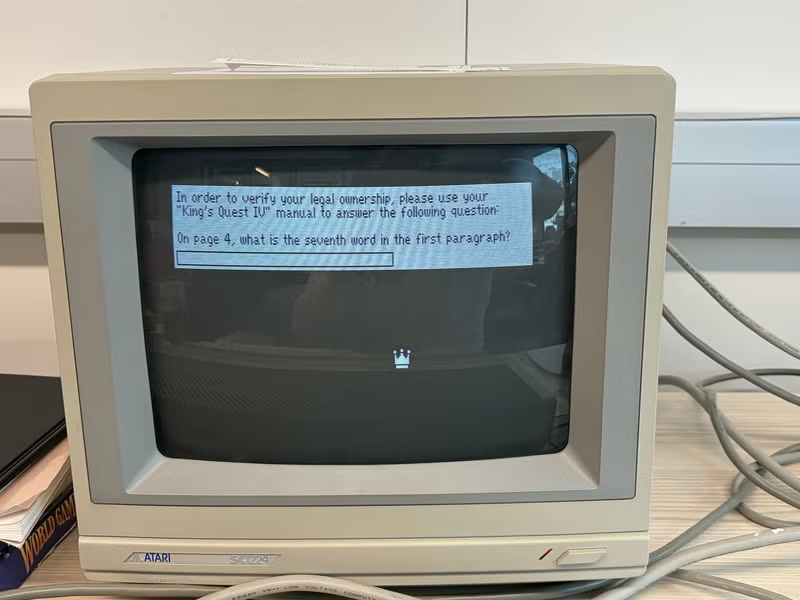
While loading the game to play, something unexpected happened. Before gameplay started, the game asked me to enter a specific word from the printed game manual. The prompt asked for the seventh word from the first paragraph on page four. Only after entering the correct word would the game start. This was very interesting to me because I hadn't seen a prompt like this in modern games. It felt unusual but also intentional, making the manual an important part of the experience.
Early game protection
It was interesting for me to learn that in the 1980s, there was not much digital protection for games at all. Most games were sold on floppy disks, which were very easy to copy and share with other people. For game companies, selling a game also meant trusting the player to not duplicate it and give it to others. Developers had to trust their players to not copy their games, even though many people still did.
Since they could not stop copying digitally, companies created simple ways to check if the player actually owned the game. Sierra, the company behind King’s Quest, did this by using the game manual. Players had to look up certain words, symbols, or spells in the manual before the game would start. If you didn't have the manual, you couldn't play the game. To me, this shows how important the physical parts of the game were at the time. The floppy disk by itself wasn't enough. The box, the manual, and the printed pages were all needed for the game to work properly. These methods also made players care more about the materials that came with the game, because they were necessary to play it.
Anti-piracy campaigns

The "Disk Protector" showing the title of the campaign during the rap portion of the "Don't copy that floppy" advertisment.
There was also a rise of public anti-piracy campaigns. In 1992, one of the most well known was the “Don’t Copy That Floppy” campaign, which was aimed largely at youth and home computer users. These campaigns framed piracy as a moral issue rather than just a legal one, encouraging people to view copying software as harmful to developers and the industry.
Some games attempted to discourage copying through creative in-game systems. The space trading game Elite is one example. Like King’s Quest, Elite used copy protection that required players to look up information from the printed manual before the game could be played. At the Computer Museum, Elite was recently found and loaded by the high school co-op student Joshua Ensley. In order to run the game on the Atari, he copied it onto a floppy disk so it could be played, which is quite ironic. A game originally made to prevent copying had to be copied in order to be preserved and experienced today. This made me think about the shift in how piracy and copying are understood. What was once regarded as theft is now sometimes necessary for preservation and access.
Why piracy exists
Piracy has existed since the early days of personal computing, mostly because copying software was simple and storage was physical. Today, piracy continues for different reasons, like preservation.
A study by the Video Game History Foundation found that 87 per cent of classic games released before 2010 are critically endangered and unavailable on modern platforms. This means that most older games are no longer sold digitally and can't be legally purchased without finding original hardware and physical copies. As a result, players who want these games often rely on piracy as the only option.
There's also a lack of availability in modern digital stores. Even popular systems like the PlayStation two or the Game Boy have only a small portion of their original libraries available today. Companies tend to re-release only their most successful titles, while many less popular but historically important games stay inaccessible. Physical deterioration adds another challenge. Cartridges and disks degrade over time, and the hardware required to play them becomes harder to maintain. Even if a player owns an original copy, there is no guarantee it will continue to function properly. Piracy has therefore become a way to preserve games that would otherwise disappear completely.
King's Quest IV in context
Learning more about piracy and early copy protection changed how I see King’s Quest IV. At first, I didn't think too much about being asked to enter a word from the manual, but now I see that it represents a history of how games were treated, shared, and protected in the past. It was interesting to look at how early developers tried to protect their work while still trusting players, and how those ideas of piracy have shifted over time.
AI Discovery Day tomorrow and other notes
Tomorrow marks the first AI Discovery Day, which will run from 8:45 a.m. to 4:30 p.m. in the Science Teaching Complex. Attendees will join colleagues from across campus for a full-day, interactive event designed to explore how artificial intelligence is already being used at Waterloo, and what opportunities and challenges lie ahead.
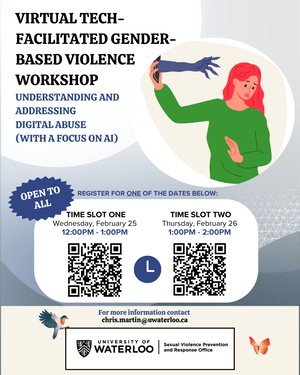
Speaking of AI: AI and deepfake technologies are rapidly evolving tools with significant potential for positive impact. However, they are increasingly being misused to create harmful and exploitative content. Join the Sexual Violence Prevention and Response Office for a 1-hour introductory workshop exploring how sexual violence intersects with technology and what we can do to take collective action against it. Register for one of two dates: Wednesday, February 25 from 12:00 to 1:00 p.m. or Thursday, February 26 from 1:00 to 2:00 p.m.
Join the W3+ group on Wednesday, February 18, for a free ballet-inspired lunchtime barre class. "All bodies and mobility levels are welcome!" says a note from W3+. "Please dress comfortably, and bring a yoga/Pilates mat if you have one (there are also some to borrow). You're also welcome to bring resistance bands if you have them."
Space is limited, so please register in advance.
Upcoming office closure
Campus Wellness locations will be closed on the morning of Thursday, February 19, due to all-staff training, and will reopen at 12 noon.
Link of the day
The Year of the Horse comes galloping in
When and where
The Campus Wellness Student Medical Clinic offers healthcare visits with Physicians and Nurse Practitioners to current undergraduate and graduate students. Services include: vaccinations, immunity testing, naturopathic services and more. Counselling Services offers appointments with counsellors in person as well as via phone and video. Students can book appointments for these services by calling Campus Wellness at 519-888-4096.
The privately-run Student Health Pharmacy (located in the lower level of the Student Life Centre) is now offering new COVID booster shots and flu shots. Covid booster shots are available by appointment only – please call ext. 33784 or 519-746-4500. The Student Health Pharmacy’s summer hours are Monday to Friday, 9:30 a.m. to 4:30 p.m. Naloxone kits are still available – pick them up in the pharmacy at no charge.
The Waterloo Eye Institute optometry clinics in Waterloo and downtown Kitchener offer comprehensive eye exams and eyewear, including glasses and contact lenses, with the Waterloo location offering various specialized services including urgent eye care. Discounts apply for University of Waterloo students and employees. The Waterloo Clinic is at a nearby interim location, 419C Phillip St, during construction at the School of Optometry and Vision Science. The Kitchener Clinic remains at the Health Sciences Campus, 10B Victoria St. S. Book online or by phone at 519-888-4062.
Warriors Winter Youth Camps, registration is now open for multi-sport and games, baseball, basketball, eSports, football and hockey camps for boys and girls ages 5 to 18. Register today!
Winter 2026 Student Experience Survey. The Winter SES is now open. Please check your @uwaterloo email or visit LEARN to see if you have been invited. Those that submit their responses will receive $5 on their WatCard. The survey is open until February 27.
Reading Week, Saturday, February 14 to Sunday, February 22.
Dissertation Boost Camp, Tuesday, February 17, 9:00 a.m. to 12 noon, SLC Grad Lounge (SLC 3216).
W3+ Barre with Katy, Wednesday, February 18, 12 noon to 1:00 p.m., Physical Activities Complex.
AI Discovery Day, Wednesday, February 18, 8:45 a.m. to 4:30 p.m., Science Teaching Complex.
Virtual-first, human-first: Reimagining primary care through innovation, Wednesday, February 18, 12 noon to 1:00 p.m., online.
Grade 10 Info Night, Thursday, February 19, 5:30 to 8:30 p.m., Hagey Hall.
Hagey Bonspiel, Saturday, February 21, Ayr Curling Club. Register by Friday, February 13.
Understanding PCOS and Endometriosis: Taking Charge of Your Reproductive Health, Monday, February 23, 12:00 p.m. to 1:00 p.m., online.
NEW - Dating and Neurodiversity, Tuesday, February 24, 2026 6:30 to 7:00 p.m.
Systematic and Scoping Reviews: Systematic and Scoping Review Methods, Tuesday, February 24, 10:00 a.m. to 12 noon, online.
Accessibility and GenAI - Online (CTE7554), Tuesday, February 24, 12 noon to 1:00 p.m., online.
GIS Speed Run: Essential Analysis Tools, Tuesday, February 24, 2:30 p.m. to 3:30 p.m.
CIGI Signature Lecture: Emerging Dual-Use Technologies in an Era of Strategic Competition, Tuesday, February 24, 5:30 p.m. to 7:30 p.m., CIGI Campus.
NEW - Fruit and Veg Market, Wednesday, February 25, 12 noon to 4:00 p.m., SLC lower atrium, PSE 1st floor, EV3 1st floor. $10 for a bag of assorted produce while supplies last.
NEW - AI & Tech Facilitated Deepfake Abuse Workshop, Wednesday, February 25, 2026 12:00 to 1:00 p.m. and Thursday, February 26, 2026 1:00 to 2:00 p.m.
Noon Hour Concert: Wondrous Winds, Wednesday, February 25, 12 noon, Conrad Grebel Chapel. Free admission.
NEW - February Book Club Meeting, Friday, February 27, 1:00 p.m. to 2:00 p.m., International Experience Lounge, Needles Hall
NEW - Systematic and Scoping Reviews: Systematic Search Methods, Tuesday March 3, 1:00 p.m. to 3:00 p.m., online.
NEW - Fruit and Veg Market, Wednesday, March 4, 12 noon to 4:00 p.m., SLC lower atrium, PSE 1st floor. $10 for a bag of assorted produce while supplies last.
Upcoming service interruptions
Stay up to date on service interruptions, campus construction, and other operational changes on the Plant Operations website. Upcoming service interruptions include:
-
STC main atrium scaffolding erection, Friday, February 6 to Saturday, February 21, 4:00 p.m. to 12:00 a.m., contractor will be erecting scaffolding during the evenings throughout the time period of this service interruption, which will partially impede pedestrian access in the area adjacent to the B1 building.
-
Modern Languages electrical shutdown, Wednesday, February 18 and Thursday, February 19 between 6:00 to 7:30 a.m.
-
UWP community boiler & power shutdown, Thursday, February 19 from 7:00 a.m. to 1:00 p.m.
-
East Campus Hall electrical shutdown, Sunday, February 22 from 7:00 to 7:30 a.m.
-
Earth Sciences and Chemistry electrical shutdown, Saturday, February 28 from 7:00 a.m. to 12:00 p.m.