Programs and courses

Student taking notes.

Where on Earth will your passion take you? 

Explore the natural world and follow your passion!

Choose from two undergraduate programs with five areas of specialization offered through both regular and co-op streams of study.

Programs

[Some copy text here to introduce the programs listed below. What's the difference between Earth Sciences and Environmental Sciences? Do I need to choose my program when I apply? Are there any other questions commonly ask or misconceptions about these programs?] 

Earth Sciences program

Geophysics specialization

Geophysics is a broad field where mathematics and physics are combined to study the many phenomena that happen inside, on the surface, and in the atmosphere of the Earth and other planets. In addition to mineral and energy exploration, geophysicists are involved in evaluating earthquake and volcano hazards, monitoring nuclear weapons treaties, assisting in managing and protecting groundwater resources, and studying geomagnetic phenomena, such as the Aurora Borealis. 

Possible careers: Oil, gas, and base metal exploration; environmental monitoring and management

Courses at a glance: The majority of courses you will take in your degree are Earth Science courses and program electives (MATH, CHEM, PHYS, AMATH, BIOL, CS). You must be comfortable with math and higher level physics. 

Example courses: (EARTH 460) Geophysics 2 (data processing, time series analysis, computer modelling), (EARTH 461) Geophysics 3 (field data collection and analysis, application of geophysical techniques)

Learn more about Earth Sciences - Geophysics

Geology specialization

Geology is the study of the Earth, its structure and composition, and the physical, chemical, and biological processes that have affected and continue to shape this planet over a variety of time scales. One aspect of geology is the analysis of the origin of rock formations, types, and their importance in areas such as construction. 

Possible careers: Exploration for natural resources (minerals, oil, and gas); environmental protection; identifying geological hazards; understanding global climate change

Courses at a glance: The majority of courses you will take in your degree are Earth Science courses. Geology is the least math intensive of the Earth Science specializations and offers the most Earth electives. This allows for flexibility to focus your studies in the areas of Earth Science that most interest you. 

Comparable program: If you are interested in taking biology courses in place of additional math and physics courses, Environmental Sciences - Geoscience may be of interest to you.  

Example courses: (EARTH 332) Metamorphic petrology, (EARTH 331) Volcanology and Igneous petrology, (EARTH 471) Mineral Deposits

Learn more about Earth Sciences - Geology

Hydrogeology specialization

Hydrogeology is an interdisciplinary field of study that integrates geological knowledge with the principles of subsurface fluid flow, contaminant migration, geochemistry, mathematics, and physics in order to understand and protect groundwater resources. It is a sub-discipline of hydrology and examines the relationship between geological materials and water flow, focusing on the storage and flow of water in soil, sediments, and rocks. 

Possible careers: Groundwater exploration; assessment and remediation of soil and groundwater contamination due to industrial, agricultural, and mining practices; assessment of urban and rural activities on watersheds

Courses at a glance: The majority of courses you will take in your degree are Earth Science courses. You must be comfortable with math and chemistry. During your degree, you will have the opportunity to take courses through multiple faculties, including engineering, to see the different applications of hydrogeology.    

Comparable program: If you are interested in focusing on the role of surface water, its interactions with the environment, and have an interest in biology, Environmental Sciences - Water Science may be of interest to you.  

Example courses: (EARTH 459) Chemical Hydrogeology, (EARTH 458/458L) Physical Hydrogeology, (EARTH 456) Numerical Hydrogeology, (CIVE 353) Geotechnical Engineering 1

Learn more about Earth Sciences - Hydrogeology

Environmental Sciences program

Water Science specialization

The Water Science program is designed to provide students with the skills and knowledge to address global challenges relating to water including scarcity, quality, and management. This unique program takes an integrative approach by combining earth sciences and the physical, chemical, biological, and management aspects of water to provide students with the breadth of knowledge required to meet multidisciplinary challenges. Water science focuses on the quantity, quality, distribution, and movement of water in the environment. 

Possible careers: Environmental water concerns; water source management

Courses at a glance: You will take an almost even amount of Earth Science and Biology courses as well as Geography courses (the highest amount out of all programs offered in the Earth and Environmental Sciences department).

Comparable program: If you are more interested in the physical processes relating to water transportation and geology and would like to take more math instead of biology, Earth Sciences - Hydrogeology specialization may be of interest to you.  

Example courses: (EARTH 221) Geochemistry, (EARTH 342) Geomorphology and GIS Applications, (EARTH 444) Applied Wetland Science

Learn more about Environmental Sciences - Water Science

Geoscience specialization

This program provides a basic quantitative background in science and mathematics while offering students greater opportunity to select courses in a wide range of environment-related subject areas, such as chemistry, ecology, microbiology, geography, and hydrogeology. Students will acquire the knowledge base required to assess the environmental impact of surface and subsurface contamination from industry, urbanization, agriculture, and mining.

Possible careers: Environmental issues and legislation in government; the environmental consulting industry

Courses at a glance: The majority of courses you will take in your degree are Earth Science courses (many of which are electives). Geoscience is the most similar to Earth Science out of the three Environmental Specializations. It offers an increase in Earth Science electives, which allows you to specialize in areas that interest you, as well as a decrease in required math/physics courses. Biology is a common minor pursued by students in this program, and students have the opportunity to take multiple biology courses throughout their studies.  

Comparable program: If you are interested in taking additional math and physics courses in place of biology courses, Earth Sciences - Geology may be of interest to you.  

Example courses: (EARTH 440) Quaternary Geology, (EARTH 390) Methods in Geological Mapping

Learn more about Environmental Sciences - Geoscience. 

Ecology specialization (offered through Biology)

Ecology is the scientific study of the relationships between living things and their environment with a focus on sustainability and biodiversity.

The Ecology specialization consists primarily of biology courses from second year onwards and is offered through the Biology department

Learn more about Environmental Sciences - Ecology

Universal first year in Earth Science

All students in Earth Sciences complete a universal first year before specializing in second year. This gives students a chance to gain a general understanding of the field before focusing on a specific program in second year and encourages a holistic view in the study of the Earth.

First-year courses cover foundational knowledge in all the sciences and emphasize the way Earth Sciences draws on all of them. Focus is on lab work and hands-on experience in local environments, such as the Earth Sciences Museum and Peter Russell Rock Garden.

A universal first year also helps to build a sense of community in each undergraduate cohort, which is carried through the program and helps build the tight-knit community the department is known for.

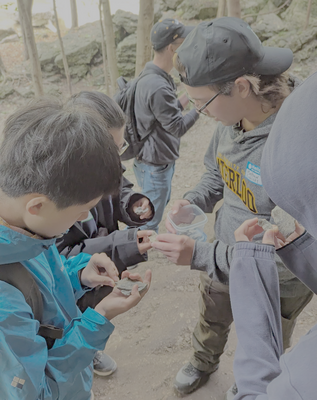
Students study rock samples in the field.

Course requirements

Below is a breakdown of the course requirements for each program, including Ecology (offered through the Biology department). Note that lab courses are weighted as 0.5 and lecture courses as 1. So, for example, a value of 2 can represent two lectures, one lecture and two labs, or four labs.

* These specific required courses must be selected from either EARTH or BIOL lists.

Program

BIOL

MATH

PHYS

CHEM

GEOG

EARTH Core

EARTH Electives

Sci/Math Electives

Unrestricted

Electives

Ecology

17.5

2

1

5

1

6

1

1*

7

Geoscience

3.5

2

1

3

1

18

4

5

4

Water Science

11.5

2

1

4.5

4

10

1

1*

7

Geology

0

4

3

3

0

20

6

2

4

Hydrogeology

0

5

3

3

0

21.5

4

2

3

Geophysics

0

6

3

3

0

20.5

5

4

1

Professional Geoscientist Ontario logo

Professional Geoscientists Ontario (PGO) certification

Each specialization in Earth and Environmental Sciences can fulfill the knowledge requirements for PGO certification.

  • All three Earth Sciences specializations have PGO requirements built in through a combination of required and elective courses.
  • Environmental Sciences, Geoscience can be designed to fulfill the necessary knowledge requirements through careful use of electives.
  • Environmental Sciences, Water Science can also be designed to fulfill PGO requirements, but additional courses may be required.

Need assistance?

Our advising team is here to answer your questions.