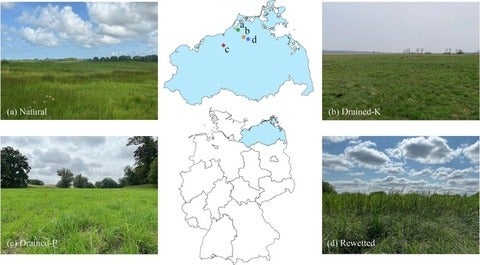
New publication Compares Modeled and Measured Carbon Dioxide Data in Canadian Peatlands During the Non-growing Season
New research highlights the critical role of the non-growing season in shaping Peatland carbon budgets.
On May 27 and 28, 2026, Ecohydrology Research Group members attended the 2026 Waterloo Wellington Children’s Groundwater Festival at Marden Park in Guelph.
From May 11 to 22, 2026, Philippe Van Cappellen and Fereidoun Rezanezhad offered EARTH 652: Reactive Transport Modelling at the University of Waterloo.
On May 7 and 8, the CLAWAVE team hosted an online workshop with practitioners and project partners to introduce the beta version of CLAWAVE, a new web-based tool for exploring chemical loads in river systems.
On Friday, May 8, Claudia presented a talk entitled "Nitrate Contamination in Urban Aquifers: Hydrogeological controls and implications for water management in São Paulo State, Brazil" as part of the Ecohydrology Seminar Series. Thank you to Claudia for the excellent talk! We all had a great time.
From April 21-24, 2026, Bhaleka participated in the Second Lead Author Meeting of the IPCC Working Group I contribution to the Seventh Assessment Report at the Universidad Católica in Santiago, Chile.
The Microplastics Fingerprinting research project has released a new impact report showcasing significant scientific advancements and societal contributions since the group’s launch, including ERG’s predictive work on how microplastics travel through the environment.
This morning, José presented a talk entitled "Closing the Phosphorus Loop: Technosphere and Environmental Considerations" as part of the Ecohydrology Seminar Series. Thank you to José for the excellent talk! We all had a great time.
ERG members attended the Sensing to Impact research symposium on April 17, joining University of Waterloo researchers with community partners to strengthen local environmental measurement and monitoring.
In a recent publication in the journal of Water Research, ERG members of the Microplastics Fingerprinting Project presented findings on the contribution of stormwater catchments to microplastic (MP) loads and yields in urban areas.