Current undergraduate students
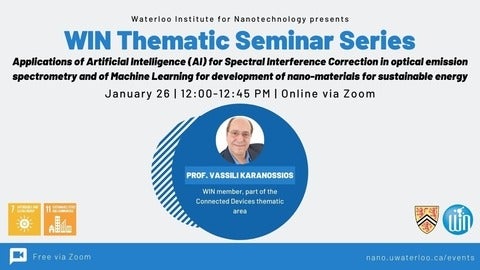
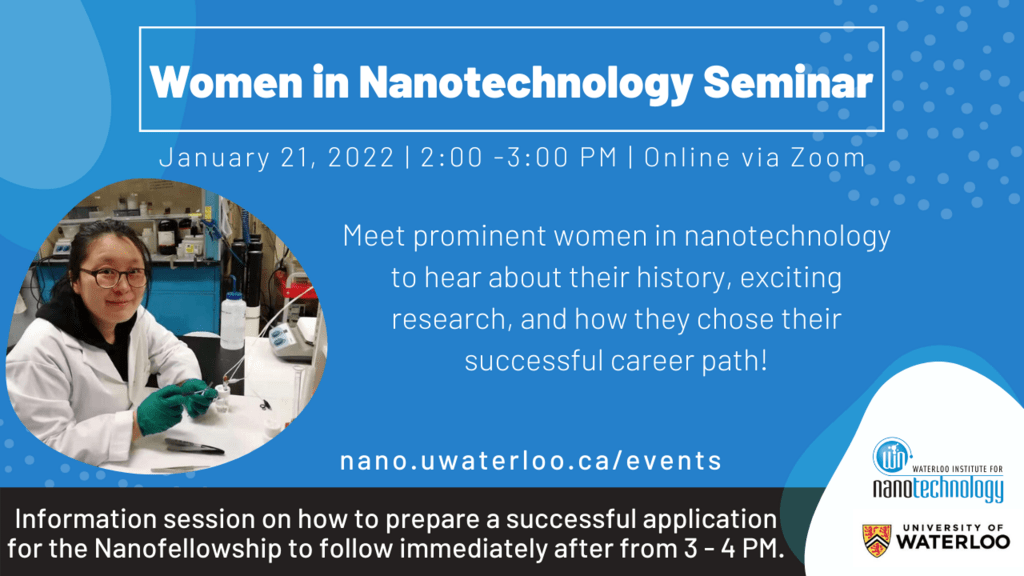
The Waterloo Institute for Nanotechnology (WIN) has four main thematic research areas; Smart and Function Materials, Connected Devices, Next Generation Energy Systems and Therapeutics and Theranostics. To showcase the work going on within these areas, we will be holding monthly WIN Thematic Seminars featuring our members and their research group members.
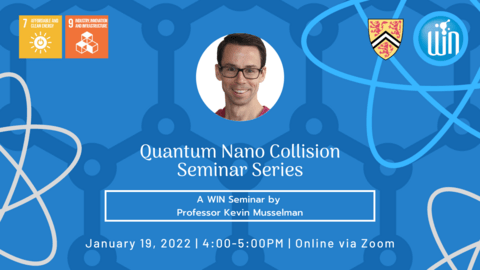
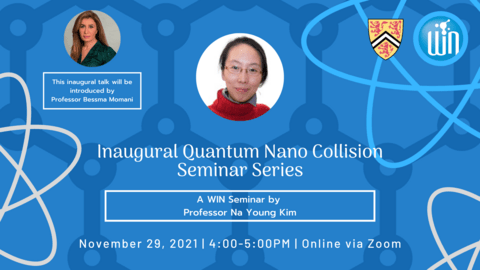
The Waterloo Institute for Nanotechnology (WIN) has launched a new seminar series, Quantum Nano Collision (QNC) Seminar Series, to deepen the engagement of the Waterloo researchers who work at the interface of quantum and nanotechnologies. This seminar series will also provide opportunities for senior graduate students, post-doctoral fellows, and research associates to present their innovative work along with the faculty members to bring together the excitement around these cutting-edge technologies that would shape our future.
The next talk for the QNC Seminar Series will be delivered by Professor Kevin Musselman.
Candidate: Zack Strike
Title: Preliminary Development of a Microfluidic Tool for the Characterization of Molecular Machines
Date: December 14, 2021
Time: 13:00
Place: online
Supervisor(s): Backhouse, Chris (Adjunct) - Wright, Derek
Abstract:
Droplet interface bilayers (DIBs) have been proposed as a key tool to better study transmembrane proteins and their quantum
biology. This work focused on developing a microfluidic device for the formation of DIBs.
Candidate: Sun Sheng Gu
Title: XC: Exploring Quantitative Use Cases for Explanations in 3D Object Detection
Date: December 22, 2021
Time: 13:00
Place: online
Supervisor(s): Czarnecki, Krzysztof
Abstract:
Explainable AI (XAI) methods are frequently applied to obtain qualitative insights
about deep models’ predictions. However, such insights need to be interpreted by a human
observer to be useful. In this thesis, we aim to use explanations directly to make decisions
Candidate: Bianca Esanu
Title: An Assessment of, and Improvements to, the Digital Forensics Acquisition Process of a Law Enforcement Agency
Date: December 10, 2021
Time: 13:00
Place: MS Teams
Supervisor(s): Tripunitara, Mahesh
Abstract:
Forensics addresses the collection and analysis of evidence. Digital forensics is forensics in the context of digital devices. It
is a rapidly evolving field employed in various organizations such as law enforcement, government, and the private sector. The
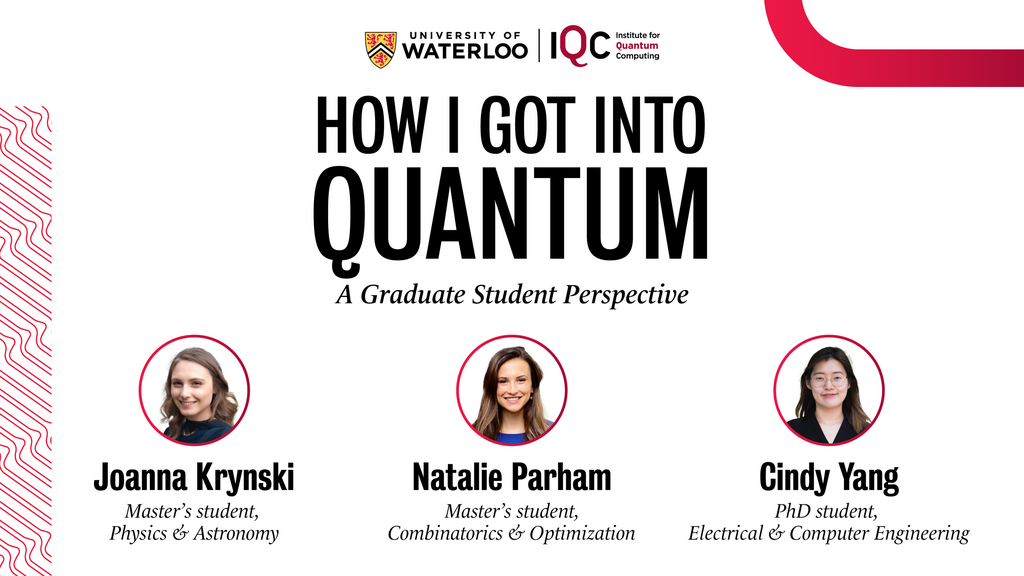
Meet graduate student researchers from science,
engineering, and mathematics and hear how they discovered quantum information
science found their way into research, and how the skills they gained in
their undergraduate studies are helping them develop the next generation of
quantum technology.

As part of the Water Institute's WaterTalks lecture series, Erin Mahoney,
Commissioner of Environmental Services for York Region and Douglas Wright
Engineer-in-Residence will present: York Region’s One Water Story…
recognizing the value of water in all its forms.

Join Research Talks, a panel discussion and Q&A examining the future of
employment featuring: