Electrical and computer engineering PhD student Yu Cao, post-doctoral fellow Omid Bagheri, and MASc student Veronica Leong — all supervised by Dr. George Shaker, Adjunct Professor in the Department of Electrical and Computer Engineering at the University of Waterloo — are advancing the future of wireless sensing technology with a breakthrough approach that allows millimeter-wave radar to detect changes in soft, hydrated materials without direct electrical contact.
For their innovative work, the team has been named finalists in the inaugural IEEE AP-S Industry Application Pitch Competition. Their paper, Near-Field Millimeter-Wave Radar Sensing of a Slot-Loaded Dielectric Resonator, was selected among the top 10 submissions from 106 entries worldwide following an exceptionally rigorous review process. The researchers will now present their work live at the 2026 IEEE APS/URSI Symposium, where final winners will be chosen by an expert judging panel.
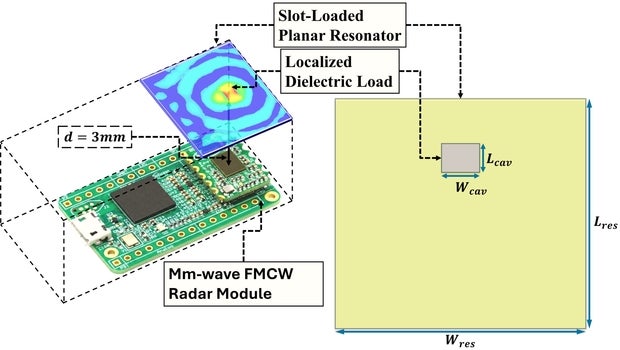
The team’s research focuses on hydrogels, water-absorbing materials commonly used in biomedical technologies, wearable sensors, and smart materials. These materials naturally swell or shrink as they absorb or release water in response to changes in their surrounding environment. The Waterloo researchers developed a way to wirelessly detect these subtle material changes using compact 60-GHz radar technology.
Their sensing platform combines a millimeter-wave radar with a specially designed passive resonator containing a small hydrogel sample. As the hydrogel changes its water content, its dielectric permittivity — a property that describes how the material stores electric energy — also changes. The resonator concentrates the electric field directly around the hydrogel, making it highly sensitive to these variations. The radar can then wirelessly detect shifts in the resonant response caused by the swelling or deswelling of the material.
In simple terms, the researchers are developing a way for radar to “read” material changes by observing how water-driven changes inside a hydrogel disturb the electric field of a tiny resonant structure.
Many existing chemical and biological sensing methods rely on direct electrical contact, wires, bulky laboratory equipment, or repeated manual sampling. These limitations can make it difficult to monitor soft materials, sealed systems, or miniature sensing platforms remotely. The Waterloo team’s approach aims to overcome these challenges by combining compact radar hardware with passive resonant structures capable of operating without physical contact.
The researchers also demonstrated that the radar measurements closely matched full-wave HFSS electromagnetic simulations, validating the physical relationship between hydrogel permittivity changes and the radar-observed resonance shifts.
The work lays the foundation for future wireless sensing systems that could be smaller, simpler, and easier to integrate into real-world applications. Potential uses include hydrogel-based biosensors, pH monitoring, hydration sensing, smart wound dressings, wearable or implant-adjacent sensing systems, and compact lab-on-chip technologies. Because the sensing element itself is passive and the radar operates wirelessly at short range, the platform could also be adapted for monitoring materials inside sealed environments, small fixtures, or controlled systems where conventional probes are difficult to use.
While the current work establishes the electromagnetic foundation for this sensing method, future research could further adapt the technology for biomedical, environmental, and industrial monitoring applications.