A team of researchers from the Wireless Sensors and Devices Lab (WSDL) in the Department of Electrical and Computer Engineering at the University of Waterloo has been named a Top 10 Finalist in the 2026 IEEE Antennas and Propagation Society Industry Paper Competition for their paper, “A Digital Twin Baseline for Hybrid Quantum Machine Learning (QML) in WiFi Sensing.”
Led by Dr. George Shaker, adjunct professor in ECE, and Director of the Wireless Sensors and Devices Lab (WSDL), the research team includes lead author and PhD student Sebastian Ratto Valderrama, postdoctoral researcher Ahmed Sayed, and ECE alum Abdelrahman Elbadrawy, working in collaboration with industry partners Synopsys and EigenQ. Sebastian is co-supervised by ECE professor, Dr. Omar Ramahi, who is also a co-author on the paper.
Selected from 135 submissions worldwide, the paper advanced through a rigorous peer-review process recognizing research with strong technical merit and meaningful potential for real-world impact. The final award will be announced at the 2026 IEEE International Symposium on Antennas and Propagation and USNC-URSI Radio Science Meeting in July in Detroit.
Together, this team is being recognized for helping advance research on how wireless technologies can be used not only to communicate information, but also to better understand the environments around us.
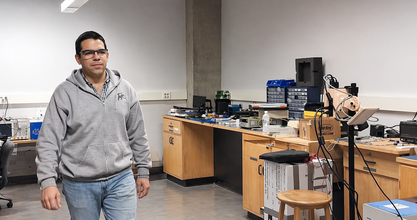
ECE PhD student Sebastian Ratto Valderrama in the Wireless Sensors and Devices Lab
Teaching Wi-Fi to understand the spaces we live in
Wi-Fi is best known for connecting devices, but wireless signals are constantly interacting with the physical world. As signals move through a room, they reflect off walls, furniture, and people, creating subtle variations that contain information about movement and activity.
This team is working to interpret these patterns in reliable and meaningful ways. If successful, this approach could allow existing wireless infrastructure to support sensing technologies that operate quietly in the background — without relying on cameras.
A key challenge in this field is that wireless signals are highly sensitive to environmental conditions, making real-world data difficult to reproduce and compare consistently.
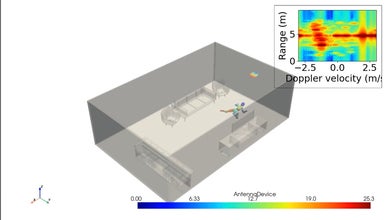
To address this challenge, the research team developed a digital twin — a physics-based simulation environment that models how WiFi behaves in controlled indoor settings. This allows researchers to test novel approaches under controlled conditions and better understand how different learning methods perform.
Within this framework, the team explored hybrid quantum machine learning — an emerging approach that combines artificial intelligence with concepts from quantum computing — to help test whether compact hybrid models can interpret complex wireless data using far fewer trainable parameters.
The longer-term potential is wireless-sensing technologies that could support applications related to safety, wellbeing, and energy efficiency, while also preserving privacy.
Potential future impacts include:
- fall detection systems that could support independent living,
- smart buildings that adapt lighting, heating, and cooling based on occupancy,
- passive health monitoring technologies that do not rely on cameras, and
- more responsive indoor environments that better understand human activity.
Because these approaches build on wireless infrastructure that already exists in many homes, hospitals, and workplaces, they offer a possible path toward solutions that are practical and scalable.
Being named a Top 10 finalist highlights growing interest in privacy-conscious sensing technologies that combine AI, wireless systems, and quantum methods.
It also reflects continued interest in technologies that not only connect people and devices, but can also help researchers better understand indoor environments.