


Electrical and computer engineers shape the future through innovation. They develop and improve systems that serve everyday needs of society spanning from high-voltage engineering and sustainable energy, to breakthroughs in wireless technology. Our faculty and students do everything from creating low-cost digital x-ray imagers to combat tuberculosis in developing countries, to building real-time embedded systems to advance the design and reliability of commercial products. ECE - the future is what we do.







Research
The Department of Electrical and Computer Engineering is a dynamic and innovative hub of cutting-edge advancements in technology and engineering. Faculty members lead pioneering research in areas such as robotics, artificial intelligence, communications, embedded systems, and renewable energy, addressing real-world challenges and driving technological breakthroughs.
Resources
Events
PhD Seminar: Topology-Constrained Generative Modeling and Detectability Analysis for Window-Aggregated Performance Monitoring in Optical Transport Networks
Candidate: Matthew (Zening) Li
Date: October 19, 2026
Time: 11:00 AM
Location: Online
Supervisor: Pin-Han Ho
All are welcome!
PhD Seminar: From Metabolite Sensing to Mechanistic Inference: Experimental and Computational Approaches to Cancer Metabolism
Candidate: Shadi Vandvajdi
Date: November 13, 2026
Time: 10:00 AM
Location: Online
Supervisors: Prof. Mahla Poudineh and Prof. Mohammad Kohandel
All are welcome!
News
Students go weightless to test in-space electronics repair
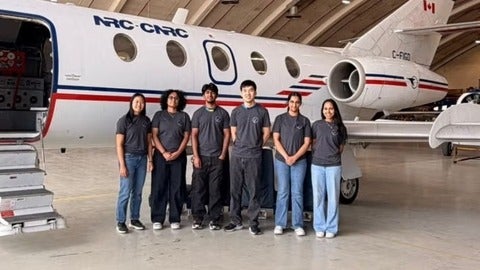
A Waterloo Engineering student design team has taken another step toward repairing electronics in space by designing, building and testing an automated soldering device aboard a microgravity flight. As missions travel farther from Earth, the ability to fix equipment in-space is becoming increasingly important.
The Waterloo Space Soldering Team, made up of 17 students and recent alumni, was one of four teams across Canada selected by Students for the Exploration and Development of Space Canada for this year's Canadian Reduced Gravity Experiment Design Challenge, held August 31 to September 4. Over two flights aboard a reduced-gravity research aircraft in Ottawa, the team operated its experiment through 16 parabolas — steep climbs and dives that each create about 20 seconds of weightlessness — and collected 35 solder samples for analysis.
Electrical engineering student Jordan Leis named 2026 Cansbridge Fellow
Electrical engineering student Jordan Leis has been named a 2026 Cansbridge Fellow, joining a group of just 15 students selected from across Canada this year. The fellowship supports students developing their leadership and entrepreneurial skills through international experience.
Leis is scheduled to complete a self-organized internship in Asia in winter 2027. As a fellow, he will receive a $10,000 scholarship to support the placement, attend a bootcamp and conference in San Francisco, and join a lifelong network of mentors and alumni.
Now in its fourteenth year, the Cansbridge Fellowship is run by alumni and funded by sponsors. For Leis, the community is a meaningful part of the opportunity.

Performance-testing research earns ACM Distinguished Paper Award
A paper co-authored by electrical and computer engineering professor Weiyi (Ian) Shang has received an ACM Distinguished Paper Award at the 2026 IEEE/ACM International Conference on Automated Software Engineering (ASE), a flagship conference in software engineering.
Titled “Stop When It Matters: Detectability-Guided Microbenchmarking for Performance Regression Testing,” the paper resulted from a collaboration among institutions in Canada, Europe and China.
The research tackles a practical challenge in performance testing. Developers run microbenchmarks to catch software slowdowns, but they often do not know how long those benchmarks need to run. Existing approaches usually stop when results appear stable or after reaching a fixed time limit. The paper demonstrates that stability alone is not enough: a benchmark can appear stable while still being unable to reliably detect a real performance regression.
Electrical and computer engineering research team receives Best Paper Award at FPL 2026
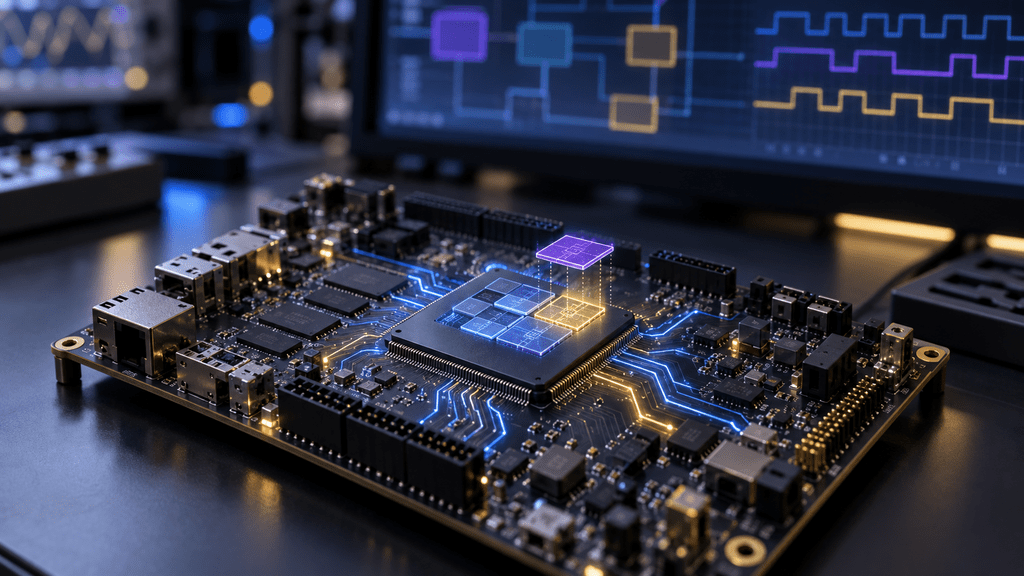
A University of Waterloo Electrical and Computer Engineering (ECE) research team has received the Stamatis Vassiliadis Award for Best Paper at the 36th International Conference on Field-Programmable Logic and Applications (FPL 2026), held in Ghent, Belgium.
The team includes Emir Guevara, an Electrical Engineering alumnus and current ECE PhD student; Gavin Lusby, a current Computer Engineering undergraduate student; Chaitanya Sharma, who graduated from Computer Engineering in 2026; and ECE professor, Dr. Nachiket Kapre.
Their award-winning paper, “Cocotb-PYNQ-PR: From Co-Simulation to Deployment: A Unified DFX Framework for PYNQ,” presents an open-source framework that allows FPGA partial-reconfiguration designs to be tested in simulation and then deployed on PYNQ hardware through a unified workflow.