About the CMHRT
Why seek services at the CMHRT?
The CMHRT:
- Provides psychological services at a reduced fee for the Waterloo community
- Trains clinical psychology graduate students to deliver evidence-based services
- Supports research to improve our understanding of mental health
We are dedicated to providing evidence-based services. This means that the care we provide is based on the latest knowledge and guidelines about best practices.
Is the CMHRT the same as Counselling Services (Campus Wellness)?
No. Counselling Services is a branch of University of Waterloo’s Campus Wellness office, and offers counselling services to University of Waterloo students only, at no charge. The CMHRT is part of the clinical psychology doctoral program at UW and offers psychology services to members of the Waterloo community, which includes UW students. See Counselling Services for more information about them.
CMHRT Services
What services are offered at the CMHRT?
- Individual therapy: one-on-one therapy at the CMHRT begins with a diagnostic assessment to better understand your concerns and to develop a treatment plan. The type of therapy that is suggested may be based on the results of this assessment. Therapy typically involves weekly, in-person sessions.
- Group therapy: clients who share a similar struggle learn new skills in a group setting over a set number of sessions. Please see the group therapy section of our website for the types of groups we offer.
- Parenting and Family therapy: therapy focused on providing parents with strategies to support children using behavioral parenting theory (Positive Parenting Program); emotion-focused family therapy; or other family interventions to improve communication and well-being. Please see the parenting and family therapy section of our website for more information.
- Psychoeducational assessments: see “What is involved in a comprehensive/psychoeducational assessment?” (below).
Feel free to take a closer look at our clinical services page for more information.
What is involved in a psychoeducational assessment?
These assessments are designed to better understand one’s style of learning or to determine the presence or absence of a neurodevelopmental disorder, such as ADHD or a Specific Learning Disability.
We answer your assessment question(s) through collecting information to explore different hypotheses about what could be going on. We collect information about your concerns through interviews, questionnaires, and in-person activities that assess different cognitive domains. The assessment typically takes place over a number of sessions and includes standardized measures of intelligence, academic achievement, memory, executive functioning, and other areas as appropriate. Then, we meet with you to communicate what we have learned. We will also provide you with a written assessment report and recommendations.
Do you assess for Autism?
No. We do not assess for autism at the CMHRT as these assessments require additional training and expertise that are not typically available within our training clinic.
Are CMHRT services in-person or virtual?
Due to being a training clinic, we primarily provide in-person services. We occasionally offer accommodation for virtual sessions as needed, but we are not a good fit for those seeking exclusively virtual care.
How will my privacy be protected at the CMHRT?
Your personal health information is protected by law, and we take the privacy and security of your information very seriously. We collect and use your personal health information only for the purpose of providing services or following the law, unless you give us explicit permission to use it for other purposes (e.g., research). We store heath information using secure methods (e.g., paper files in a locked cabinet in a locked room, virtual files in encrypted form and accessed only by those authorized to do so). See the personal health information and privacy section of our website for more information.
CMHRT Providers
Who provides clinical services at the CMHRT?
CMHRT clinicians are enrolled in the clinical psychology doctoral program at the University of Waterloo. All student clinicians are closely supervised by a registered clinical psychologist. Sessions are video recorded and reviewed by the assigned supervisor to facilitate high-quality supervision.
Students who provide therapy have completed a minimum of two years of intensive graduate training and coursework prior to seeing therapy clients in the CMHRT.
What is the difference between a psychologist, a psychiatrist, and a psychotherapist?
Psychologists complete graduate training that integrates science and applied practice. Through coursework, supervised clinical practice, and completion of a research thesis (and typically a doctoral dissertation as well), psychologists learn to evaluate, interpret, and communicate complex information to diagnose and treat mental health conditions and to provide psychotherapy. They are typically required to complete competency examinations prior to becoming registered with the College of Psychologists and Behaviour Analysts of Ontario.
Psychiatrists are medical doctors (MDs) who can diagnose and treat mental health conditions. Psychiatrists’ educational training typically includes coursework and clinical rotations and may include a research component. Psychiatrists also complete a medical residency (typically five years) and a series of exams to become registered with the College of Physicians and Surgeons of Canada. Because of their medical training, psychiatrists can prescribe medication for mental health concerns. Some psychiatrists also deliver therapy.
Psychotherapists can provide therapy for mental health conditions. They are registered with the College of Registered Psychotherapists of Ontario. Registered psychotherapists have completed graduate-level training in psychotherapy, gained clinical experience, and passed a qualifying examination. In Ontario, psychotherapists are not permitted to communicate a diagnosis.
Access to Services
Who can access CMHRT services? Do I need a referral?
You do not need an external referral. Anyone may be eligible for our services; for information about services we do and do not provide, see our eligibility criteria. To get started, complete our intake form or email us at cmhrtintake@uwaterloo.ca.
How long is the waitlist for services at the CMHRT?
Our waitlist varies depending on the services you are looking for and the resources available at the time of your query. We take great care to match clients and their presenting concerns with therapist training needs and supervisor availability. For up-to-date information about our wait times, contact us directly by phone (519-888-4567 ext. 33842) or email us at cmhrtintake@uwaterloo.ca.
Do I have to participate in research to access CMHRT services?
No. When you begin receiving services at the CMHRT, your clinician will speak to you about your choices regarding research participation. Your research choices do not impact the type, quality, or speed of services that you receive. See the clinical psychology research section for more information.
Is the CMHRT accessible?
We invite you to contact us about your specific accessibility needs, and we will work with you to determine how best to minimize barriers to receiving services at the CMHRT.
Logistics
Do I have to pay for parking on campus?
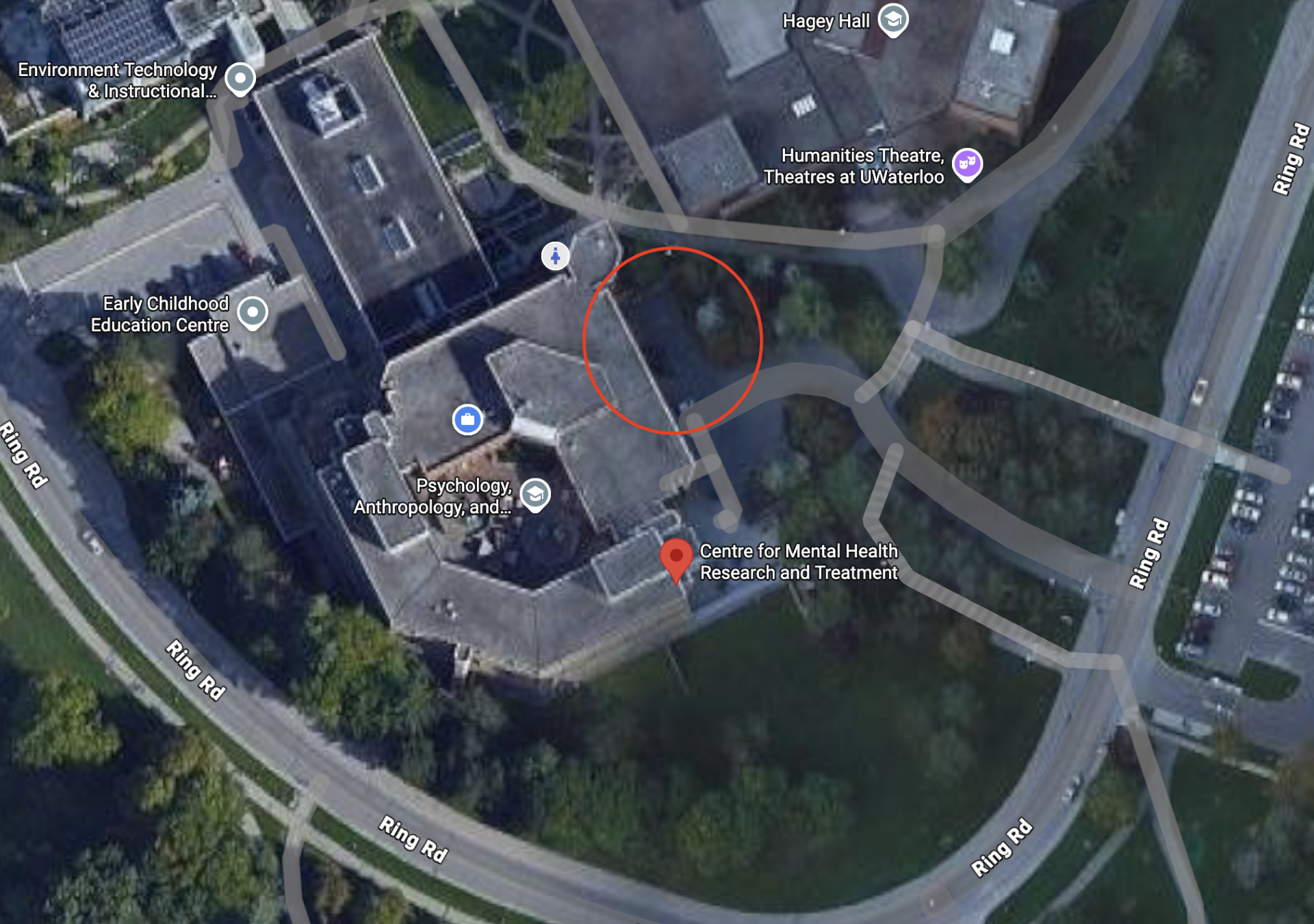
There is free parking for CMHRT clients just outside of the clinic entrance or in the nearby H lot. You will need a parking pass, which can be obtained by your CMHRT clinician. This pass should be placed on your dashboard.
How does payment work at the CMHRT?
Because we are a training clinic, we provide services at a lower cost. Services are offered on a sliding scale. During your first session, you and your clinician will collaboratively determine the fee that fits for you. We accept credit or debit payments. See the arranging fees section of our website for more details.
Are CMHRT fees covered by the Canadian health care system?
Unfortunately, psychological services accessed in a private setting such as the CMHRT are not covered by government funding.
Are CMHRT fees covered by my insurance?
You may be able to get reimbursed by your insurance for our psychological services if you have a student or workplace health plan. Coverage varies depending on the plan, so we encourage you to check with your insurance provider directly. After you pay for your CMHRT service, you will receive a receipt, which includes the information of the supervising psychologist. This can be submitted to insurance for reimbursement. Please note that we do not invoice insurance companies directly.
How can I get more information about CMHRT services?
We would love to hear from you. You can contact us by phone (519-888-4567 ext. 33842) or email at cmhrtintake@uwaterloo.ca.