


Why Nanotechnology Engineering?
Nanotechnology Engineering is a multidisciplinary engineering field which combines concepts from chemical engineering, electrical engineering and chemistry. It also draws from and benefits areas such as materials science, physics, biology, quantum physics and medicine.
In Canada’s leading and first accredited Nanotechnology Engineering program, you will have a broad area of study that covers many subjects, from biology to coding. You will work with materials far too small to see with the naked eye. You will build both theoretical understanding and hands‑on experience through coursework, laboratory work, and co‑op placements. Students will work in a dedicated clean room with multimillion-dollar cutting-edge equipment for hands-on experiential learning.
Nanotechnology engineers are at the forefront of research and development related to a cluster of technologies that harnesses the unique properties and functions of nanoscale systems. Nanotechnology impacts many industries, ranging from medical to pharmaceuticals, electronics to automotive, and communications.
Check out our state-of-the-art labs! Our nanotechnology engineering undergraduate students have exclusive access to our multi-million-dollar clean room!
Where do our graduates work?

A specialization is available to interested students but not required. There are four specializations in the Nanotechnology Engineering program.
They are: Nanobiosystems, Nanoelectronics, Nanofabrication, and Nanomaterials.

Sample first-year courses
This is a sample schedule. Courses are subject to change.
| 1A Term | 1B Term |
|---|---|
|
MATH117 - Calculus 1 for Engineering NE100 - Introduction to Nanotechnology Engineering NE109 - Societal and Environmental Impacts of Nanotechnology NE111 - Introduction to Programming for Engineers NE112 - Linear Algebra for Nanotechnology Engineers NE121 - Chemical Principles |
MATH119 - Calculus 2 for Engineering NE110 - Introduction to Nanomaterials Health Risks NE113 - Introduction to Computational Methods NE125 - Introduction to Materials Science and Engineering NE131 - Physics for Nanotechnology Engineering NE140 - Linear Circuits |
Co-op for Nanotechnology Engineering students
Through the University of Waterloo's world-renowned co-op program, you will gain paid work experience relevant to your field of study during your degree. We'll guide you through every step of the employment process—from crafting résumés to preparing for interviews—while giving you the freedom to explore different roles and industries. It’s a practical way to discover what suits you best, strengthen your professional skills, and connect your coursework to real-world practice. Altogether, it sets you up with a meaningful edge when you graduate.
From your very first year, you’ll typically rotate between academic terms and four‑month work placements, blending classroom learning with on‑the‑job experience. You can choose to return to the same employer for multiple terms to deepen your expertise and take on more responsibility, or you can branch out and work with different organizations to broaden your perspective.
| Year | September to December (Fall) | January to April (Winter) | May to August (Spring) |
|---|---|---|---|
| First | Study | Study | Co-op |
| Second | Study | Co-op | Study |
| Third | Co-op | Co-op | Study |
| Fourth | Study | Co-op | Co-op |
| Fifth | Study | Study | - |
Your first work term will be at the end of first year. Learn more about co-op.
News
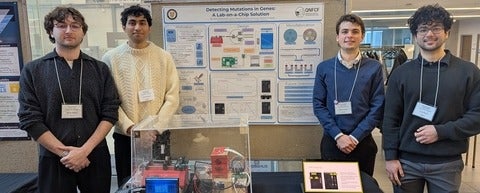
Engineering a faster future for genetic testing
Nanotechnology Engineering (NE) Group 22 placed second for their Capstone Design Project titled Detecting Mutations in Genes: A Microfluidic Lab-on-a-Chip Solution.
The group designed a benchtop microfluidic device which detects DNA mutations. DNA mutation detection can be used to tailor cancer treatments, identify genetic disorders like cystic fibrosis, prenatal testing and more.
DNA mutation detection is a time-consuming process. It takes between four to six hours to get the results from the current process of testing. The device designed by group members Gabriel Ghrayeb, Declan Gunning, Cyrus Hatami, and Alek Kechichian takes a small DNA sample and can process and produce results quickly and with minimal manual intervention.
“Our device works with and can be tuned for any DNA segment of interest, whether you're working in genetic engineering and you want to check if you have successfully caused or edited a gene mutation, or in genetic screening where we want to check if a person's genetic code has a mutation that might make them at higher risk for breast cancer or some other condition down the line,” says Kechichian.

Reimagining ER triage: NE group wins top Capstone Award for VitEx
Nanotechnology Engineering (NE) Group 7 took first place for their Capstone Design Project VitEx, that reimagines hospital emergency room triage through a new approach in wearable nanotechnology.
The group created a wristband for use in hospital emergency rooms embedded with sensors to enable continuous monitoring of the patients’ vitals.
The wrist band uses a sweat-based enzymatic sensor to continuously measure patients’ glucose levels and heart rate. When a voltage is applied to the glucose sensor, glucose is oxidized and then that produces a measurable current that can be measured using an electrode.
The heart rate sensor is a pressure-based sensor that uses piezoelectric PVDF as the sensing layer with the addition of zinc oxide nanorods underneath to increase the overall sensitivity.

Nano Engineering student turns a passion for helping others into a startup transforming animal shelter software
Fourth-year nanotechnology engineering (NE) student Alexei Abiiaka is an entrepreneur with his own software start-up called iNano IoT Corp.
Abiiaka was attracted to the NE program in high school because of the diverse opportunities that the NE Program offers from working with circuits and electronics, to lab work and device fabrication in the cleanroom.
“I’m having a great time in Nano! I love the variety of labs we take part in, and we work with equipment that undergraduate students in other departments never get access to,” says Abiiaka. “Our labs get better every year. For example, working in the cleanroom was interesting—it's a rare opportunity.”
Concurrent to his studies, Abiiaka built a start-up called iNano IoT Corp, inspired by software he began developing in high school. The company offers a highly flexible platform that works like a modular system, allowing users to build customized software solutions, without coding.


