TQT supported startup High Q Technologies develops the world's first quantum-enabled EPR spectrometer.
University of Waterloo spin-off, High Q Technologies, was recently featured by CFI for the development of the world's first quantum-enabled electron paramagnetic resonance (EPR) spectrometer. EPR spectroscopy has been widely used for drug development and investigations into diseases such as Alzheimer's. However, the new EPR spectrometer developed by High Q, utilizes superconducting quantum sensors, and is faster, more stable, and easier to use.
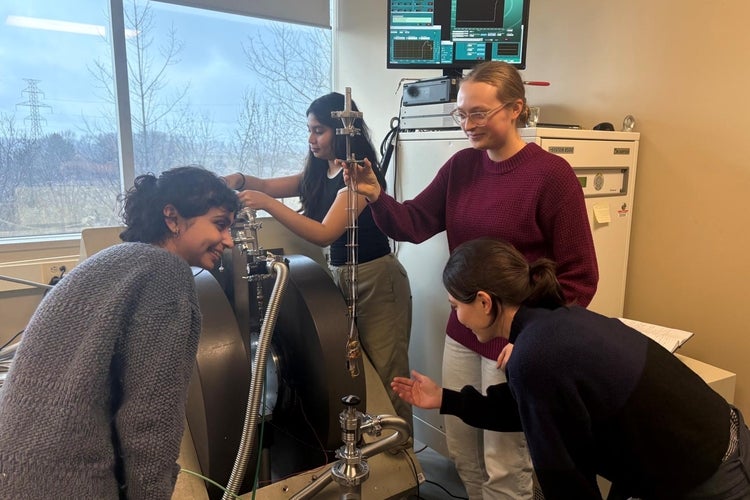
Grad students (left to right) Ruhi Shah, Ayesha Iqbal and Angeline LaFleur and (bottom right) Quantum Valley Ideas Lab Senior Scientist Carola Purser prepare to measure current and voltage characteristics of a quantum device. Image: Erfan Hosseini
Troy Borneman (High Q’s principal scientist) helped develop the superconducting quantum sensor, and credits Transformative Quantum Technologies (TQT) and the Quantum-Nano Fabrication and Characterization Facility (QNFCF) for High Q’s ability to fabricate quantum devices in-house, thereby accelerating the lengthy commercialization process.
To me, that’s the most exciting thing. Getting this technology accessible and in the hands of people who can make a difference with it.