
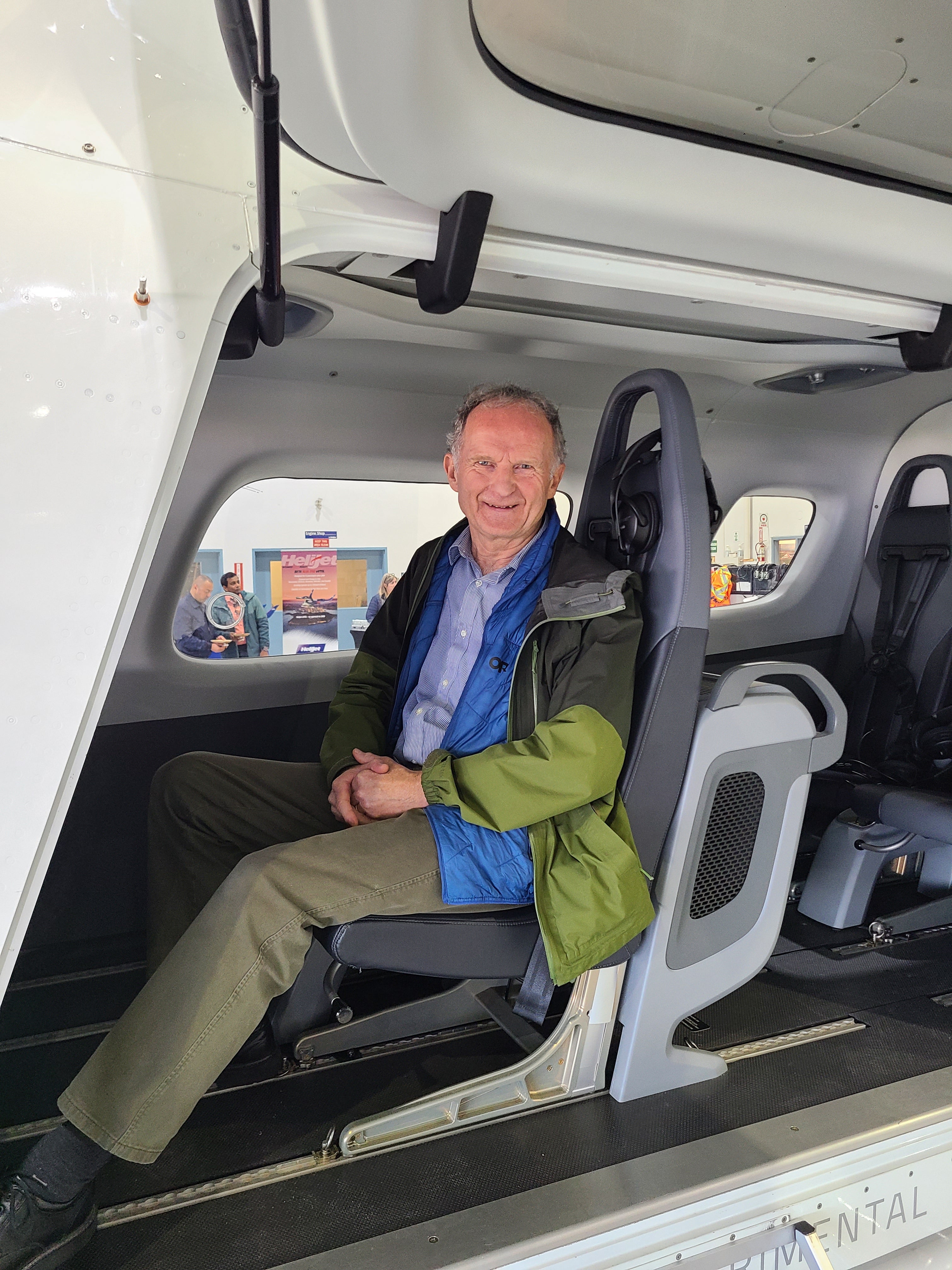
Dr. Paul Parker in ALIA CX300 e-plane
When three different e-planes flew together over Vancouver’s Fraser River in August, the question was how long before more types joined them in the air? Helijet provided the answer on November 5-6th when Beta Technologies flew their 6-seat ALIA CX300 e-plane to visit the Helijet head office at Vancouver’s YVR airport. Its distinctive design was inspired by the sleek Arctic Tern and features a 50 foot wingspan, arched wings and tapered wingtips. The attractive ALIA made a demonstration flight for local electric aviation supporters and regulators and then migrated south, back across the border to Washington state enroute to California.
The Vancouver visit was important because in 2023, Helijet signed on as Beta’s first Canadian customer. The Vermont based e-plane manufacturer is growing its international presence rapidly in 2025, flying e-planes in Norway and New Zealand with early adoption customers. The rugged coasts of British Columbia, Norway and New Zealand all have communities where boat or road trips between communities are demanding and a plane can cover the short distances more easily. This creates an ideal setting to find early adopters of e-plane technology despite the limited range.
WISA researchers (Mehrdad Pirnia and team) are developing models to examine route networks and to optimize choices for e-plane operations. As Beta finalizes aircraft capability based on component choices for the model(s) to be approved by the Federal Aviation Administration (FAA) and Transport Canada (TC), the WISA model can help airline operators like Helijet optimize the integration of e-planes into their fleet with appropriate route selection. The model is easily adjusted to the capabilities of other e-planes, like the Heart Aerospace ES-30 that Air Canada has ordered. Canadian skies are about to see more electric planes and WISA researchers are there to help operators make the best decisions.
Helijet is North America’s largest helicopter airline with scheduled flights among several BC cities and charter services to remote communities, energy projects and fishing camps. Helijet ordered the ALIA A250 eVTOL, electric vertical take-off and landing model, with a design range of 250 nautical miles, to provide a lower cost and more sustainable option in its helicopter services.
In addition to the A250 eVTOL model, Beta has developed ALIA CX300 eCTOL, an all electric conventional take-off and landing model that uses conventional runways. The ALIA CX300 is powered by one H500A (max 572 hp or 426 kw) electric motor, has a maximum speed of 153 nautical miles per hour (283 kph) and a design range of 300 nautical miles (560 km). The maximum demonstrated range is 386 miles (620 km) flown during a leg with no payload. (Beta.team/aircraft) The ALIA has a Hartwell five-blade propellor that recently received FAA Part 35 type certification. It is designed for electric and hybrid aircraft with high power, low noise operations. Since both models (eVTOL and eCTOL) have approximately 80% of the components in common, certification of the eCTOL model, which is expected sooner, will also be a major step toward certification of the eVTOL version.
Early e-plane adoption also requires a support network of high voltage chargers. The ALIA uses larger chargers than those installed for the smaller Pipistrel Velis Electros in Waterloo and Campbell River. Beta has developed a network of chargers at over 50 airports across the United States. A charger was added at Toronto’s Billy Bishop airport where the ALIA CX300 visited in August. In the spring, Montreal became the first Canadian destination for the Vermont based e-plane. Beta has flown its demonstration planes across the United States and now added Vancouver as its third Canadian destination.
The Beta route to Vancouver requires a long diversion to demonstrate the possibility of electric flight between eastern and western Canadian cities. Many other airports need to be added to the electric charger network before we have a truly trans-Canadian electric flyway. Dreams have to start somewhere and the first electrified points on the Canadian aviation map have been created. More will follow!
