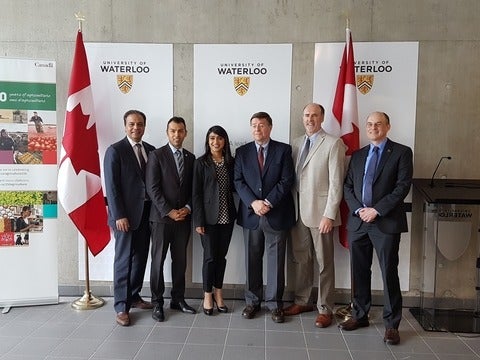
Accelerating water innovation through industry-led collaborative projects


Dangerous Ideas is hosting a panel discussion on May 31, 2017, featuring Vandana Shiva, Shiv Chopra, Maude Barlow and Chief Leslee White-Eye. This event will take place at St. Paul’s University College in room 105.
11:30 a.m. - 12:15 p.m. | Beehive Collective Workshop
12:30 p.m. - 2:00 p.m. | Water is Life Panel
A team of researchers has discovered that many Canadian lakes can provide new insights into ancient oceans, and their findings could advance research about greenhouse gas emissions, harmful algal blooms, and early life forms.
In this talk Ni-Bin Chang, director at the Stormwater Management Academy and professor in Environmental Systems Engineering at the University of Central Florida, focuses on the challenges and forefronts in optical remote sensing for earth observations using case studies of Lake Erie and Lake Nicaragua.
The Cold Regions Research Centre at Wilfrid Laurier University will host Kevin Turner, from Brock University, as he gives a lecture on, "Evaluating Landscape Changes and Associated Influences on Lakes and Rivers in Old Crow Flats, Yukon."
Hosted by the Department of Earth and Environmental Sciences, the 2017 Adrian Smith Lecture will feature professor Alfonso Mucci from the Department of Earth and Planetary Sciences at McGill University. He will be presenting, "Development of hypoxic and acidified bottom waters in the Lower St. Lawrence Estuary and its impact on sediment biogeochemistry."
Date: April 20, 2:00 p.m.
Location: EIT 1015
The 12th Hydrocarbon Summit: Transport, Fate and Remediation of Hydrocarbons in the Subsurface, will take place Wednesday, April 19 and Thursday, April 20, 2017, at the University of Waterloo.
Session topics include:
Carbon based injectates for the remediation of petroleum hydrocarbons in groundwater
The GWF program is a collaborative initiative between multiple Canadian universities and partner organizations funded through the Canada First Research Excellence Fund. GWF aims to deliver risk management solutions for water resources and services – informed by leading edge water science and supported by innovative decision-making tools – in Canada and throughout the cold regions of the world.
Interdisciplinary approaches are key when investigating potential impacts from climate change on human, economic and environmental systems. Unexpected changes to the quantity and quality of water available to local communities and environments can have wide-ranging effects, including impacting public health, environmental resilience, and agricultural and food security. Four Water Institute researchers were recently awarded funding from the Canadian Queen Elizabeth II Diamond Jubilee Advanced Scholars Program to build institutional capacity in select Commonwealth countries to address linkage
During World Water Day celebrations on March 22, the Water Institute and the de Gaspé Beaubien Foundation announced an exciting three-year partnership that will combine water expertise and technology to help mitigate the threats facing our Great Lakes.

Roy Brouwer, Executive Director, Water Institute; Claude Perras, Executive Director, de Gaspé Beaubien Foundation