Please join us for the 9th annual Grad Forum where our Public Issues Anthropology MA students will present their research. Meet and greet our graduate students and professors and enjoy some lunch and refreshments! The event is free to attend and all are welcome. Please register below to join us and learn more about our students' new research topics. Parking is available in Lot C for $5.00.

Carita Tham
Examining Potential Fish Consumption at the Monastery of Ghazali, Sudan through Sulphur Isotope Analysis
This study uses stable isotope analysis of sulphur (δ 34S) on human bone collagen to determine the presence or absence of fish in the diet of the monastic inhabitants at the medieval Makurian site of Ghazali (ca. 680-1275 CE), Nubia. Previous research using stable isotope analyses of carbon (δ 13C) and nitrogen (δ 15N) on bone collagen suggested a varied diet of both terrestrial plants and animals. It also revealed that 5 individuals may have eaten aquatic species, such as fish. Using stable isotope analysis of sulphur, carbon, and nitrogen together can help us see if fish was a part of the diet because of naturally occurring differences in these elements in different food sources and environments. By drawing upon both textual and archaeological evidence, this study thus explores the possible dietary role and status of fish at Ghazali and within the broader region of Makurian monasteries.

Rosie Schwarz
Using Spatial Analysis to Investigate Burial Complexities and Variation at Wadi Faynan 100, Jordan
This paper investigates the spatial and stylistic relationships between burials that were excavated during the 2019 and 2023 field seasons at Wadi Faynan 100, an early Bronze Age site near the western border of Jordan. I conducted near analysis, hot spot analysis, and inverse weight distributed analysis using a Geographic Information System called ArcPro. Using grave photos, grave outlines, and maps, I determined potential and likely burial pairings within the landscape and examined how the landscape influenced the people who buried their dead there.
Jessica Mah
Mobility and the Landscape: Investigating Locality and Movement Patterns of Individuals at Wadi Faynan 100 Using Minimally Invasive Strontium Isotope Analysis
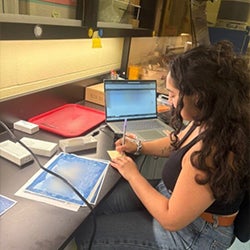
In comparison to other archaeological sites in Jordan, life at the Early Bronze Age site of Wadi Faynan 100 (WF100) is still largely a mystery. The region has been polluted with heavy metals as a result of copper mining over the past 7,000 years. Previous studies demonstrated variable periods of childhood exposure to these heavy metals, which would indicate that individuals were moving in and out of the area. At the same time, there were also signs that people lived there in permanent settlements. To better understand patterns of movement at this site, Laser Ablation-Multi Collector-Inductively Coupled Plasma-Mass Spectrometry (LA-MC-ICP-MS) was used to observe changes in strontium (Sr) isotope ratios in the tooth enamel of 31 individuals. They displayed unpredictable patterns of mobility, with examples of local, non-local, and semi-local individuals. This points to more diverse forms of social organization than originally expected and highlights how LA-MC-ICP-MS analysis of teeth can help us better understand mobility, health and social organization during the Early Bronze Age.

Cassie Sellers
A Proteomic Analysis of Biological Sex and Health in Gurat, France
Teeth can preserve molecular information for centuries, holding traces of who we were and how we lived. This project explores how paleoproteomics—the study of ancient proteins—can help us better understand biological sex and health in past populations. Focusing on six individuals excavated from a rock-cut cave church in Gurat, France, small samples of tooth enamel were analyzed using liquid chromatography– tandem mass spectrometry (LC-MS/MS). The goal of this project was to test a refined method for detecting two kinds of proteins: amelogenins, which indicate biological sex, and immune-related proteins, which may reflect aspects of health. Amelogenin peptides were successfully identified in all six individuals, allowing confident sex estimations in most cases. However, immune proteins such as C-reactive protein (CRP) and immunoglobulin-gamma (IgG) were inconsistently detected, suggesting that these proteins may not survive well in enamel or that current methods require further optimization. These results demonstrate both the promise and the current limitations of proteomic analysis in tooth enamel. Overall, the study shows that minimally destructive approaches can yield meaningful biological information and complement traditional osteological analyses—helping us reconstruct the identities of ancient populations.

Hannah Clark
Death, Care, and Labour: Bereavement Work in Southern Ontario
Death care industry workers perform essential services in the preparation, disposition, and memorialization of our dead. Their work often occurs at the nexus of government policy, cultural tradition, feeling and emotion, biomedical care, and commercial enterprise. Despite the inevitable nature of death, both academic interest and public awareness of the death care industry has been limited. Drawing on interviews with industry professionals, this research explores the experiences of funeral directors, cemetery groundskeepers, crematorium operators, and sales representatives in Ontario.

Aicha Lariani
Duped by Dream Sellers: A Case Study of Student Immobility, Precarity, and Profit in Northern Cyprus
Young migrants arrive in Northern Cyprus seeking opportunity and safety through higher education. Instead, they find themselves in a state of continuous uncertainty, without stable rights or status, in a politically unrecognized territory. What happens when marketing of “affordable” and “internationally recognized” educational opportunities targets vulnerable students from countries affected by war, extreme poverty, and political unrest? Facing safety concerns in their home countries and limited international options, international students continue to arrive in Northern Cyprus despite difficult living conditions. Drawing on 29 ethnographic interviews, this thesis examines how international student migration both responds to and sustains the political and economic structures of Northern Cyprus. It shows how education, labour, and legality produce a system that restricts students’ movement while depending on their presence.