Waterloo Architecture Students Present Research at International Conference in Antwerp
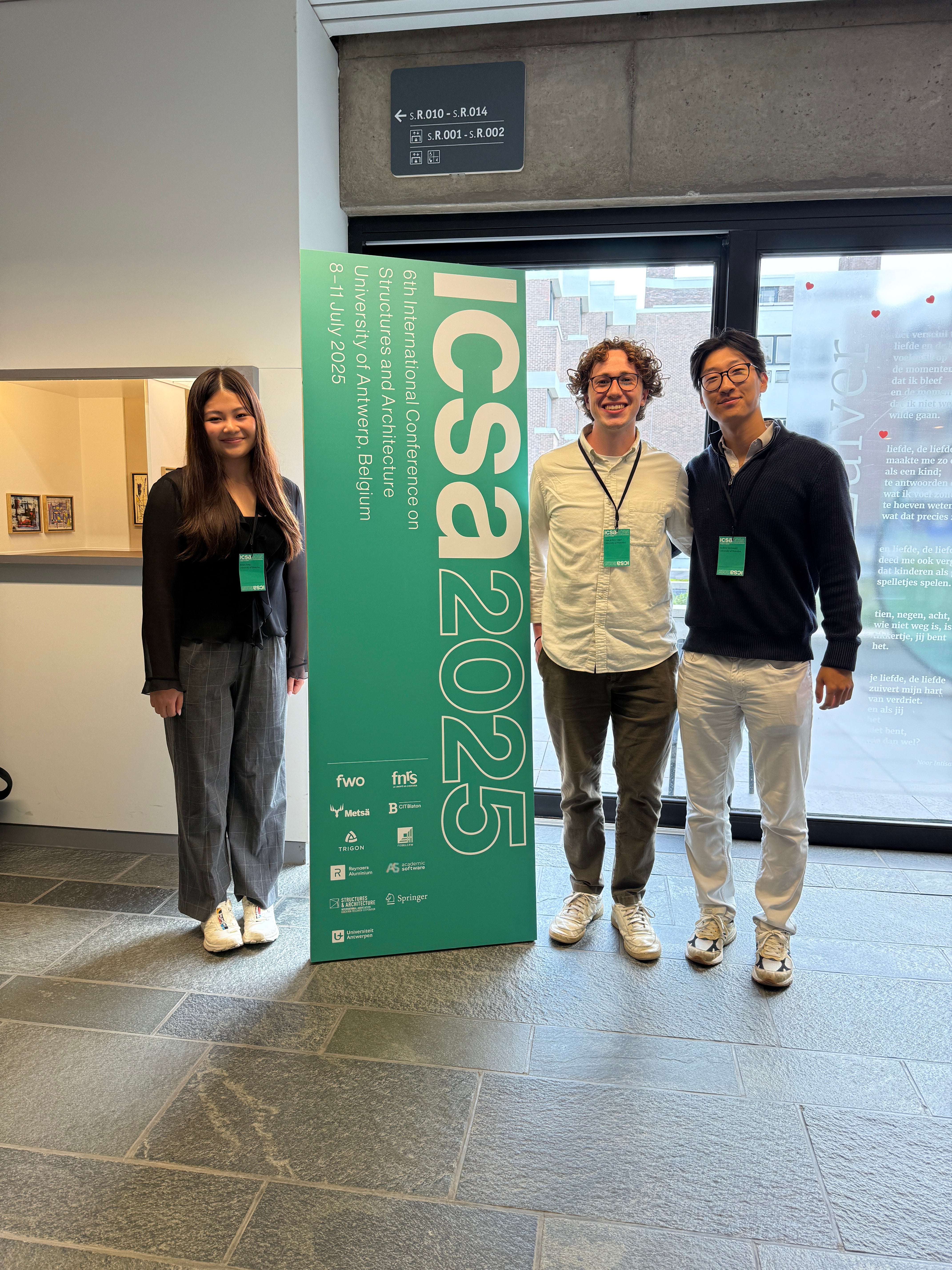
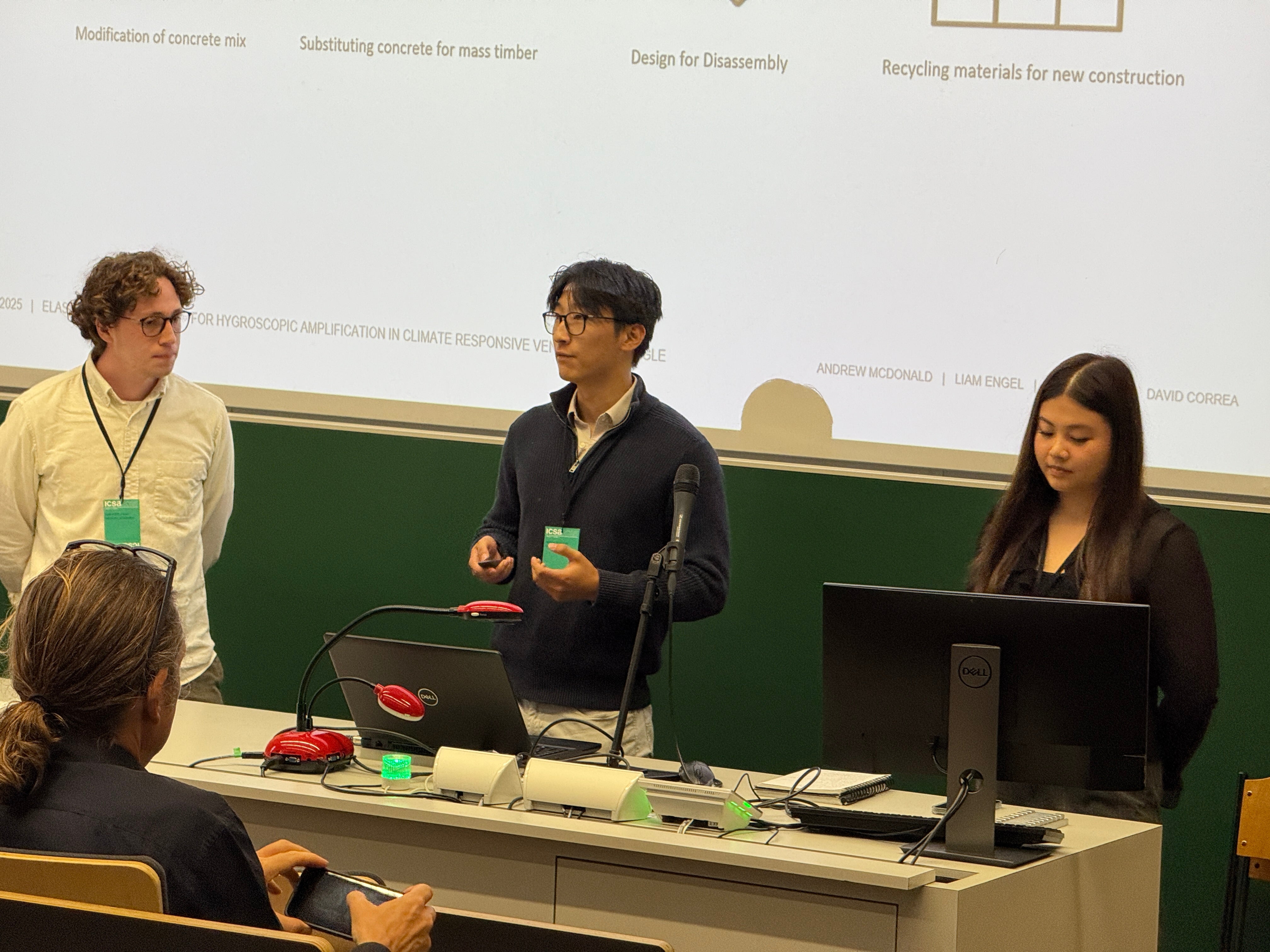
Renee Fang, Liam Engel and Andrew McDonald were one of two student-led research teams from the University of Waterloo School of Architecture presented their work at the 6th International Conference on Structures and Architecture (ICSA2025), held from July 8 -11 in Antwerp, Belgium.
The conference theme, REstructure, REmaterialize, REthink, REuse, invited participants to reimagine architectural practices in response to the global climate and energy crisis.
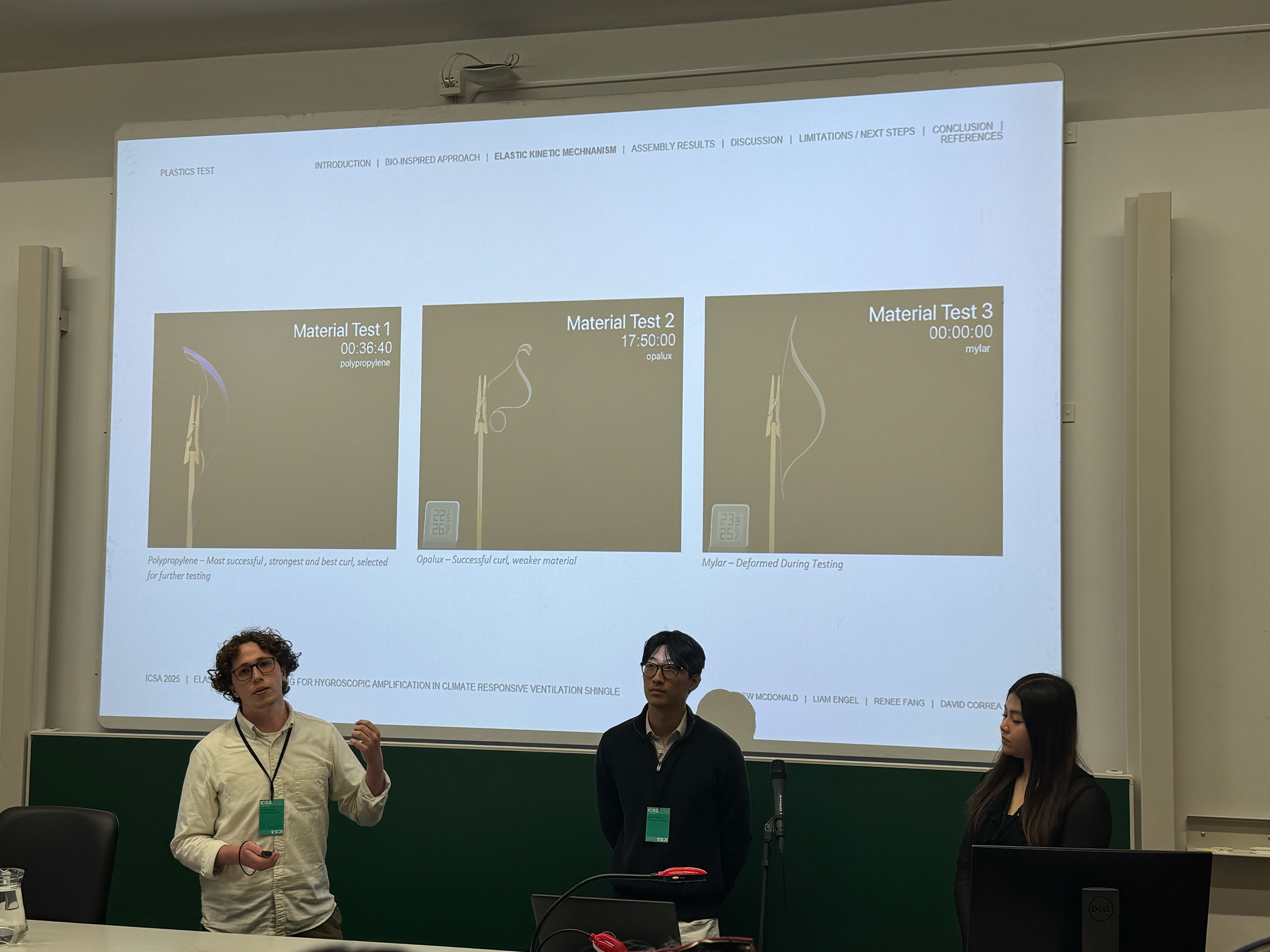
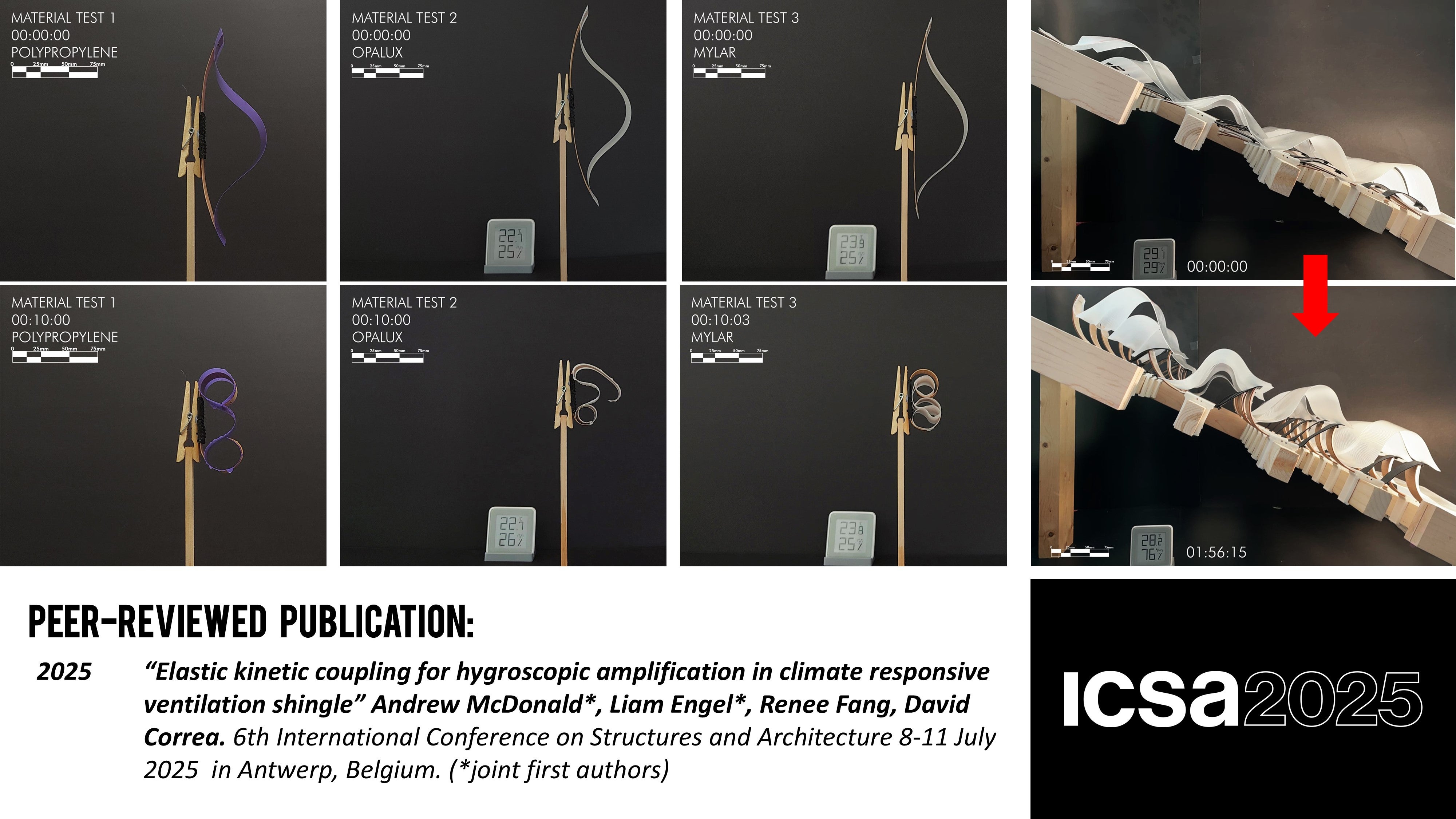
Their project Elastic kinetic coupling for hygroscopic amplification in climate responsive ventilation shingle, developed in the ARCH 393 Biomimetic Design Lab, supervised by David Correa, explores bio-inspired strategies for passive ventilation in roof structures, focusing on innovative shingle designs.
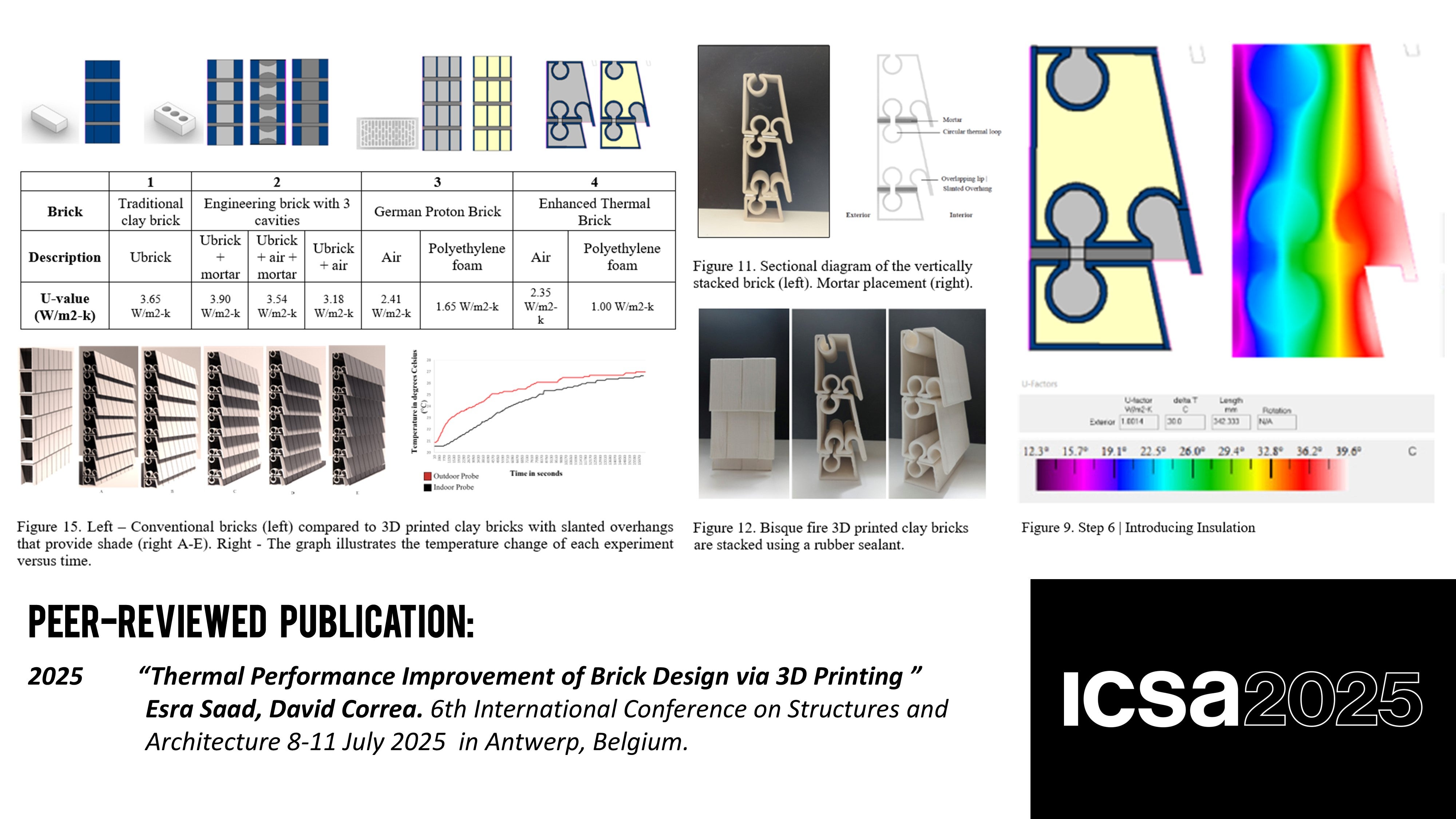
Esra Saad also presented the thesis research project Thermal Performance Improvement of Brick Design via 3D Printing.


Envelope systems that can passively and autonomously respond to climate con-ditions are a valuable, sustainable strategy to improve building performance and reduce ener-gy consumption. Wood bilayer shape-change actuators are cost-effective to produce and can be precisely programmed to respond to target environmental conditions, but their response speed is limited by the speed of moisture diffusion. The thicker and mechanically stronger the sample, the longer it takes to respond. Previous research has shown that some improvement in response time can be achieved through the coupling of bilayers and by integrating moisture diffusion channels within the bilayer architecture, but the response speed remains below the level that most occupants desire. In this paper we present an elastic kinetic strategy that can improve the response time of a hygroscopic wood actuator by augmenting the amplitude of the resulting shape-change deformation. The first section examines local biological role models that use elastic systems to achieve kinematic amplification. The second section presents the de-velopment of a wood bilayer and its integration into an elastic kinetic mechanism. The third section tests the integration of the elastic amplification mechanism into a proof-of-concept cli-mate responsive shingle system for building ventilation purposes. The presented coupling of elastic components with passive hygroscopic actuators demonstrates faster response times through the increased range of motion of the hygroscopic actuator. The shingle application of-fers a valuable perspective for system integration within adaptive architectural building com-ponents, which can greatly contribute to improved building performance in climate adaptive applications.

Additive manufacturing via 3D printing enables precise control over the mechan-ical properties of a component through the geometric definition of its layered composition. In relation to the construction field, traditional solid clay bricks have been developed for mass manufacturing and therefore have lacked thermal efficiency in their design. This research lever-ages 3D printing technology to test the potential to improve and optimize the thermal properties of construction bricks. This is achieved by precisely manipulating the brick’s geometry to en-hance its thermal conductivity, without changing the material itself. This work utilizes digital simulation in combination with 3D printing to create full-scale material models to evaluate the thermal efficiency of the proposed geometry. The key impact of this research is to advance the development of brick geometry while also assessing the potential for 3D-printed designs for construction. The findings from this paper can contribute towards the reduction of material waste and labor-intensive processes in traditional methods.