Submit content for the Daily Bulletin through the Daily Bulletin article or When and Where intake forms.
For all other requests, please contact communications@uwaterloo.ca.
The people who make Waterloo convocation possible
This article was originally published in Waterloo News.
Each graduand who crosses the stage at convocation carries a strong network of support. In the audience and on livestream, proud families, friends and mentors cheer as each name is called. But behind the scenes, another essential team made up of staff, alumni, and student ambassadors work tirelessly to make those moments possible.
The University of Waterloo hosts 19 convocation ceremonies each year: five in the fall and 14 in the spring, conferring more than 10,000 degrees annually.
Long before the ceremonies begin, staff from Community Relations and Events, the Registrar’s Office, Alumni Relations and others across campus spend months preparing to ensure the experience reflects the immense effort Waterloo students have invested in their studies.
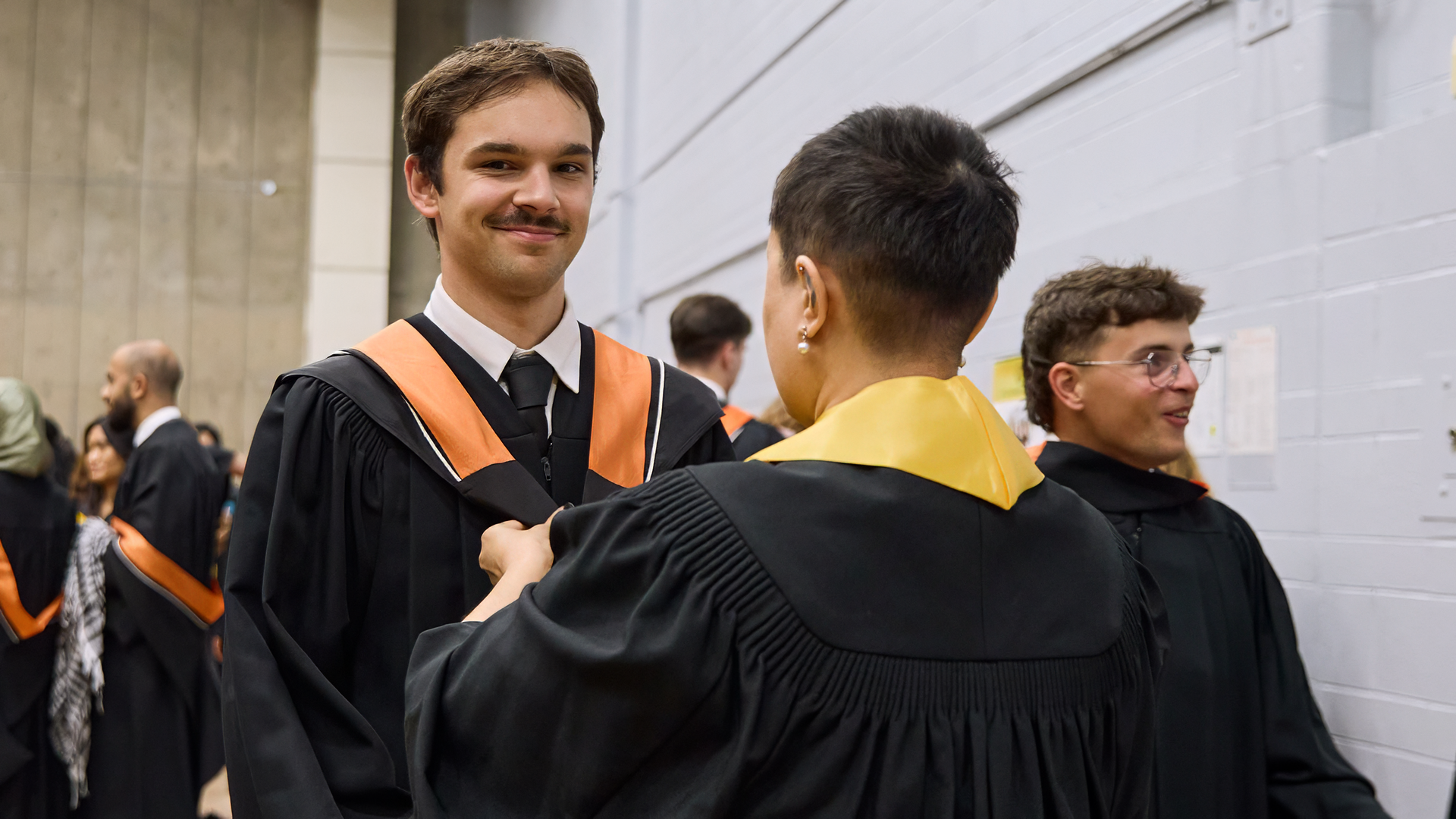
Ambassadors handle important roles before, during and after the ceremonies. These volunteer roles include accessibility support, robing, hooding, check-in, stage management and marshalling.
“Convocation is one of the most meaningful traditions at the University, and it takes an incredible community effort to bring each ceremony to life. Our ambassadors include staff, students, retirees and alumni, all coming together to support graduands and their guests. Their dedication helps create a welcoming and memorable experience that reflects the spirit of Waterloo,” says Kelly McManus, Associate Vice-President, Community Relations and Events.
On ceremony days, a team of convocation marshals is among the most visible supporters inside the Physical Activities Complex (PAC). Drawn from across the University and the broader Waterloo community, marshals guide graduands through every stage of the day, from answering questions to managing lineups and calming pre-ceremony jitters. For many, it’s a meaningful way to contribute to a long-standing campus tradition.
“Convocation is a chance to celebrate our students and provide them with one last lasting memory of a big milestone,” says Sam Charles, who works in University Relations and serves as a convocation marshal. “Whether it’s easing their nerves with a joke or just making sure they’re in the right order to cross the stage, we get to play a small but important role in their big day.”
The collective effort spans well beyond the ceremony. Facilities staff transform the large, varsity gym into an auditorium and prepare campus spaces like the BMH Green, while Special Constable Services ensures safety. Athletics event staff scan tickets and welcome more than one thousand friends and family at each ceremony and the Information Technology team power digital systems so supporters around the globe can watch the livestream.
While every convocation ceremony is unique, each one shares a common purpose: recognizing the accomplishments of Waterloo graduates and the communities that helped them get there.
Crossing the stage often marks the culmination of years of study, growth and discovery. For the staff, alumni and ambassadors working behind the scenes, their efforts often go unnoticed, they are done with a focus on ensuring that graduands and their support networks have a memorable and lasting experience.
As another convocation season gets underway, the University community will come together once again to celebrate achievement, perseverance and the people who make those celebrations possible.
Dr. Nigel Hitchin returns to Waterloo to explore the connection between geometry and physics
A message from the Faculty of Math.
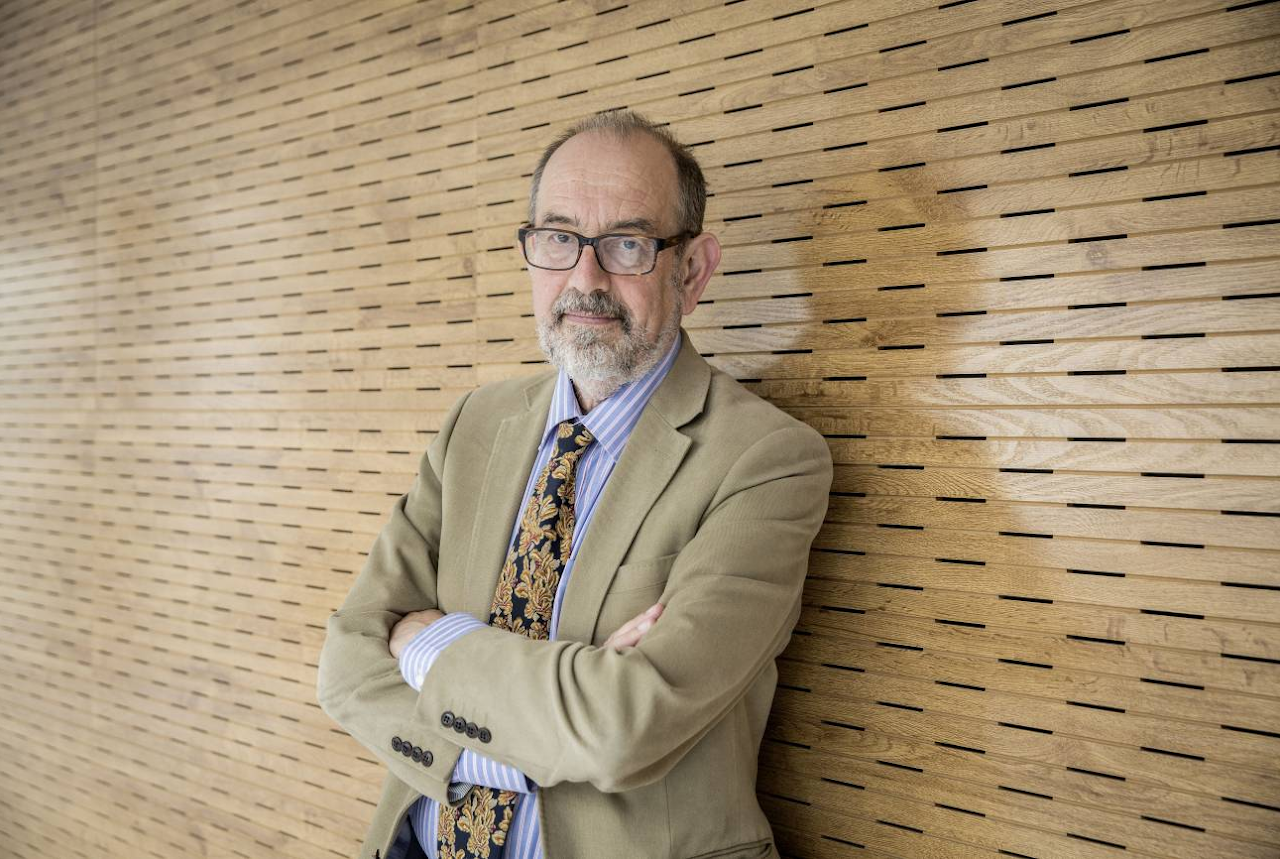
On Thursday, October 22, the Department of Pure Mathematics welcomes Professor Nigel Hitchin of the University of Oxford, an honorary doctorate recipient and distinguished speaker, to deliver a colloquium on the dialogue between geometry and physics. Fifty years ago, gauge theory in four dimensions brought new techniques into geometry and opened a conversation between physicists and mathematicians that continues today. Hitchin will discuss how these ideas have been applied to concrete two-dimensional problems of interest to both communities, revealing the benefits and limitations of having alternative viewpoints.
Hitchin is one of the most influential geometers of the past century, and numerous mathematical objects and techniques carry his name. His research crosses the boundaries of differential geometry, algebraic geometry, gauge theory and mathematical physics. He has held positions at Princeton, NYU, Warwick, Cambridge and Oxford, where he was the Savilian Chair of Geometry, and his honours include the Sylvester Medal of the Royal Society, the De Morgan Medal of the London Mathematical Society and the Shaw Prize in Mathematical Sciences.
Register to attend the free colloquium "Geometry and Physics in two dimensions,” in DC 1302 followed by a reception will follow in DC 1301. All our welcome.
Waterloo co-op students deliver results to local businesses
This article was originally published in Waterloo News.
When Bilal Alberzreh started his studies in Systems Design Engineering, he didn’t expect to work for a construction company like Musselman Excavating — but that’s where he spent his latest co-op term.
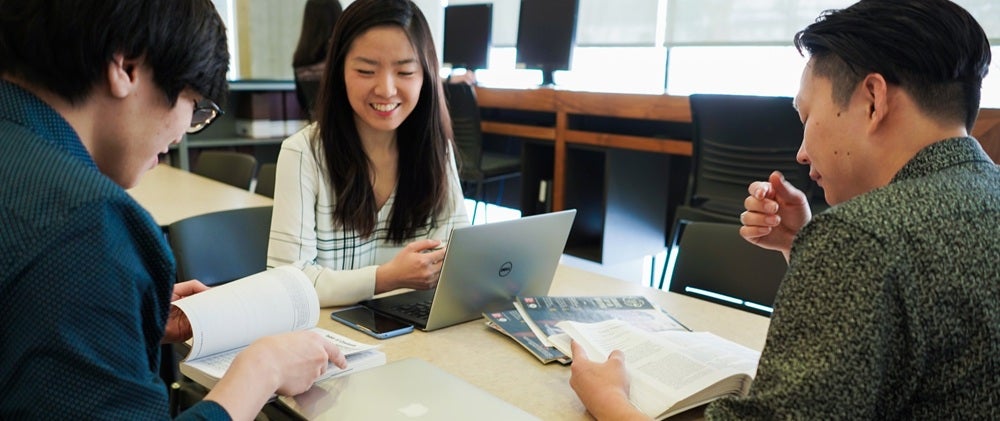
In May, he joined students in the AI@Work program, an initiative led by Communitech that pairs student teams with local small- and medium-sized businesses (SMBs) to create practical, high-value artificial intelligence (AI) solutions.
As part of this unique work term, Alberzreh says he gained significant experience and skills he wouldn’t have found with other employers.
“I came in expecting the interesting part to be AI,” says Alberzreh, who worked as a Product Manager on the Musselman team. “It turned out to be sitting close to a business and working out what’s actually worth building.”
AI tackles excavation paperwork
Musselman Excavating files utility locates for three operating companies. Before excavation can begin in Ontario, companies must request locate approvals from up to 10 utility providers to identify underground infrastructure. Coordinating and replying to these requests was a manual process that had to be completed before a locate expired.
Over the course of a work term, Alberzreh’s team created a custom AI solution that saved time for the coordinator handling requests and generated responses before a locate expires, preventing construction jobs from stalling.
Dishita Chawla, a fourth-year Computational Mathematics student, worked as a Software Developer on the Musselman team. She describes their final product as a “human-in-the-loop AI platform.” The platform monitors the email inbox and extracts project information from various documents. Then, it organizes and calculates information in a dashboard for the coordinator to review.
“Active processing time went from 15 to 25 minutes per ticket down to roughly one minute,” Chawla says. “Package assembly went from 15 to 20 minutes to about two.”
It’s a great example of the value students can bring to co-op employers and showcases the results that Communitech hoped to achieve through the AI@Work initiative. After just one term, students like Alberzreh and Chawla have created AI solutions that local SMBs wouldn’t otherwise have access to.
Faster quotes for custom-made furniture
Kanika Prajapati, a third-year Management Engineering student, took the role of Product Manager for Hauser Industries, a furniture manufacturer that often creates custom products for clients.
Hauser has operated in Waterloo Region for more than 75 years. Thanks to its extensive business knowledge and experience, the company has intricate formulas to help create pricing estimates. Prajapati’s team created an AI quoting engine that reduces manual work with these formulas and generates estimates more quickly and consistently.
“The quoting team can now input product specifications, and the engine uses previous products to output an approximate quote,” Prajapati explains.
Prajapati says the AI engine cut Hauser’s quoting times in half. Since its implementation, Hauser employees have found additional uses in their daily work. The company has already decided to hire another AI@Work team next term with a new challenge to solve.
More than a typical co-op term
Prajapati, Alberzreh and Chawla all agree that the AI@Work experience provided a level of ownership that’s rare in many co-op terms.
“You get the opportunity to own an entire tool end-to-end and see its impact on the day-to-day workings of a business,” Prajapati says.
“Experiences like AI@Work are exactly what we want co-op to make possible," says Shabnam Ivkovic, Director of Industry Relations, Co-operative and Experiential Education.
"Students are given real problems, real responsibility and the opportunity to create something that makes a difference for a real business. At the same time, they’re discovering that AI isn’t limited to traditional technology roles — it can be applied in almost any industry. That combination of meaningful work and career exploration is incredibly powerful for students.”
“If you had asked me in April where AI was going to matter, I’d have said software, finance, health care,” Chawla says. “I would not have mentioned construction, manufacturing or any of the other industries I encountered through AI@Work. This term opened my eyes to the number of opportunities there are for AI in these industries. I would love to continue exploring them and finding new problems to solve.”
Students also benefited from their exposure to smaller businesses.
“I saw how mid-market companies have the same problems as large enterprises, and none of the internal software teams,” Alberzreh says. “That’s not a technology gap, it’s an access gap, and it’s much bigger than I understood before this term.”
The AI@Work program continues this fall, expanding opportunities for students and businesses to collaborate on the next generation of AI-driven innovation.
Building closure
The Douglas Wright Engineering (DWE) building will reopen for regular operations on Monday, October 19. Until then, please continue to avoid the building unless you have been authorized access for select activities.
For the past several weeks following the sewage backup, crews have worked to clean, repair and restore the building and systems. As of October 19, regularly scheduled activity will resume. If you have classes, labs, research activities or other scheduled activity in DWE, you may receive any additional instructions from your instructor, supervisor or organizer as needed.
The DWE service tunnels will remain restricted to authorized Plant Operations staff and contractors.
President's installation
On Thursday, October 22, from 3 to 4 p.m., the University will officially welcome President Rosehart as its eighth president at his Presidential Installation. Register to watch the event. More details are available on the Presidential Installation webpage.
When and Where
The Campus Wellness Student Medical Clinic offers healthcare visits with Physicians and Nurse Practitioners to current undergraduate and graduate students. Services include: vaccinations, immunity testing, naturopathic services and more.Counselling Services offers appointments with counsellors in person as well as via phone and video. Students can book appointments for these services by calling Campus Wellness at 519-888-4096.
The privately-run Student Health Pharmacy(located in the lower level of the Student Life Centre) is now offering new COVID booster shots and flu shots. Covid booster shots are available by appointment only – please call ext. 33784 or 519-746-4500. The Student Health Pharmacy’s summer hours are Monday to Friday, 9:30 a.m. to 4:30 p.m. Naloxone kits are still available – pick them up in the pharmacy at no charge.
The Waterloo Eye Institute optometry clinics in Waterloo and downtown Kitchener offer comprehensive eye exams and eyewear, including glasses and contact lenses, with the Waterloo location offering various specialized services including urgent eye care. Discounts apply for University of Waterloo students and employees. The Waterloo Clinic is at a nearby interim location, 419C Phillip St, during construction at the School of Optometry and Vision Science. The Kitchener Clinic remains at the Health Sciences Campus, 10B Victoria St. S. Book online or by phone at 519-888-4062.
Instructional Innovations Week, Tuesday, October 13 to Friday, October 16. Featuring a range of sessions exploring innovative approaches to teaching and learning, with a particular focus on generative AI and emerging technologies.
Don McCrae Naismith Classic Basketball Tournament, Thursday, October 15 to Saturday, October 17, PAC
Identity offboarding, Friday, October 16, 9 to 10 a.m., virtual
Augmented Reality Video for Online / Hybrid Teaching and Tutoring (CTE7566), Friday, October 16, 1:30 to 3 p.m., Tech Sandbox (LIB 329)
Warriors Football vs McMaster (Senior Game), Saturday, October 17, 1 p.m.., Warrior Field
AI Before the Ruins: Industry and Inquiry Before and After the Bubble, keynote lecture by Dr. Anne Pasek, Environmental Humanities Symposium, October 17, 9 to 10 p.m. EV3 1408
Bodies, Bones, and Burials: What Human Remains Reveal About the 1845 Franklin Northwest Passage Expedition, Wednesday, October 21, 7 to 8:30 p.m., Humanities Theatre, Hagey Hall
ABC (African, Black, Caribbean) Chill, Sunday, October 18, 8 p.m. to 9 p.m., REN 1401 (Link Inclusion Lounge)
Ancient Greece and Rome in German Scholarship and Culture, 18th to 20th Centuries, Monday, Oct. 19, 2 p.m. to Tuesday, October 20, 4:30 p.m., DRAGEN Lab, St. Jerome's University College
Introduction to Crochet, Wednesday, October 21, noon to 1:00 p.m. (class is held over two weeks). It will also be held on Monday, November 2, 5 to 7 p.m. Location will be sent at registration. Note: This workshop costs $25.
Queer & Christian, Wednesday, October 21, 6:00 p.m. to 7:00 p.m. Renison's Chapel of St. Bede (REN 2400)
Safeguarding Science Webinar: Module 7 - Conducting Open-Source Due-Diligence (English), Thursday, October 22, 1 to 2:30 p.m.
Mature Student Coffee Chat, Thursday, October 22, 12:30 to 1:30 p.m., REN 1401 (Link Inclusion Lounge)
SCSRU Workshop - Conducting Surveys with Qualtrics, Thursday, October 22, 9:30 a.m. to 4 p.m., M3 3127
Home Routes folk concert: Brian Conway and Cate Sandstrom, Friday, October 23, 7 p.m. to 9 p.m., Brubacher House - North Campus UW.
Warriors Women's Hockey, Friday, October 23rd, 7 p.m., CIF Arena
Kids’ Science Open House, Saturday, October 24, 10:30 a.m. to 4:30 p.m., Science Teaching Complex. Family event - an extravaganza of science discovery for school-aged kids!
Pumpkin Patch Bus Trip, Saturday, October 24, 11:15 a.m. to 3:15 p.m., $40 to attend
Honk! Spot the scam: Cyber Awareness Month information booth, Tuesday, Oct 27, 9 a.m. to 4 p.m., Student Life Centre (SLC)
Queer & Cozy, Tuesday, October 27, 7. to 8 p.m., REN 1401 (Link Inclusion Lounge)
AI: Opportunity, Risk and Choices Ahead, Thursday, October 29 from 7 to 9 p.m., Centre for International Governance Innovation
Halloween Haunt: The Canvas breach (Shadow IT), Friday, Oct 30, 9 to 10 a.m., virtual
Warriors Volleyball vs. Nipissing (Home Opener), Friday, October 30, 6 p.m.., Carl Totzke Court PAC
Risk, Resilience, and Climate Change - from Power Systems to Communities: Seminar with Seth Guikema, Friday, October 30, 12:00 p.m. to 1:30 p.m., PSE Faculty Hall
Chinese Student Hangout, Friday, October 30, 5 p.m. to 6 p.m., REN 1400 (Dunker Family Lounge)
SCA 50th Anniversary Celebration, Tuesday, November 3, 3 to 5 p.m., Dana Porter Library, First Floor.
Safeguarding Science Webinar: Module 6 - Travelling Safely: Protecting Your Research While Travelling Abroad (English) - Thursday, November 5, 1 to 2:30 p.m
Upcoming service interruptions
Stay up to date on service interruptions, campus construction, and other operational changes on the Plant Operations website.