Submit content for the Daily Bulletin through the Daily Bulletin intake form.
For all other requests, please contact communications@uwaterloo.ca.
United Way spotlight: When food is out of reach
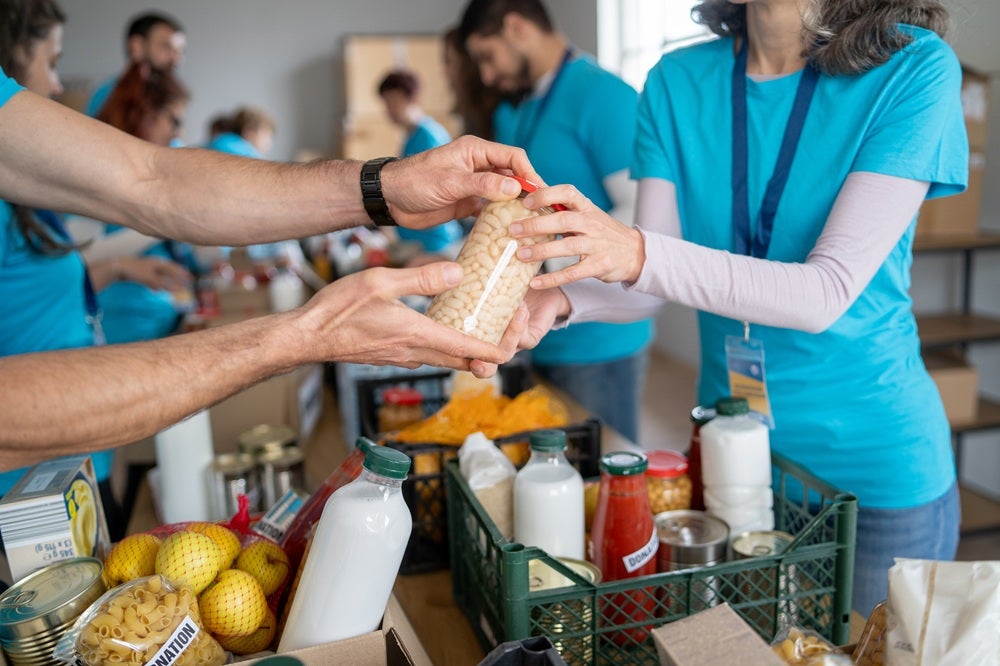
Contributed by United Way Waterloo Region Communities
Access to nutritious food is a fundamental building block for health, learning, dignity, and community well-being. But rising costs are making it harder for individuals and families across Waterloo Region to afford the food they need.
Today, 23% of households in the region experience food insecurity, and 78% of food-insecure households are above the poverty line. Food insecurity increasingly affects working people. In 2025, more than 37K requests for food supports were identified through the 211 service, with more people unable to get their food needs met than in 2024.
Local partners are responding. Between January and February 2026, the Cambridge Food Bank supported 6,203 unique individuals and distributed 3,902 emergency food hampers across Cambridge and North Dumfries. For one client, that support means the family avoids "having to decide who eats less" when rent leaves nothing behind.
Community Support Connections delivered more than 100,000 meals in 2025–2026, helping older adults and people with disabilities stay healthy and independent at home. In schools, Nutrition for Learning reported that as of January 2026, 11% of participating schools offered social food stations or hot food options, while 28% hosted hot breakfast programs.
United Way supports food hampers, hot meals, fresh and culturally appropriate food, and cooking skills programs, helping neighbours meet a basic need with dignity.
Contribute to the University of Waterloo’s 2026 campaign today! Learn more: uwaterloo.ca/united-way
Waterloo researchers advancing cybersecurity in the age of AI

This article was originally featured on Waterloo News.
As Cybersecurity Awareness Month highlights online safety, University of Waterloo researchers are tackling emerging AI security risks
Every day, Canadians trust technology with more of their lives, from banking and health information to workplace communications and smart home devices. Increasingly, artificial intelligence (AI) sits behind those interactions.
As AI systems become more capable, there is concern that new security and privacy risks are emerging just as quickly. At the University of Waterloo, researchers are exploring how to protect the next generation of AI-powered technologies from misuse, manipulation and cyberattacks before they reach millions of users.
"We might not be fully aware that it's everywhere," says Dr. Meng Xu, professor in the Cheriton School of Computer Science in the Faculty of Mathematics and member of the Cybersecurity and Privacy Institute (CPI). "Cybersecurity is basically everywhere that's connected to our lives."
As Canada marks Cybersecurity Awareness Month, Waterloo researchers are investigating some of the newest challenges emerging alongside artificial intelligence. Among them are Xu and fellow professor Dr. Sihang Liu, whose work focuses on identifying vulnerabilities in AI systems before they become widespread problems.
One area of growing concern is AI agents, systems capable of independently completing tasks by combining large language models with external tools and software. While these systems can boost productivity, they also introduce new security risks.
Unlike traditional AI systems, AI agents can take actions on a user's behalf, such as accessing information or interacting with software. That autonomy creates new opportunities for attackers to manipulate their behaviour.
"It really becomes an arms race on how well the defender can use this tool to build secure, more reliable software versus how the attacker can use this tool to find holes and penetrate the system," Xu says.
"How can we make sure this is safe?" Liu says, noting that AI systems can generate outputs at a scale that is difficult for people to review manually.
To help address these challenges, Xu and Liu received support from the National Cybersecurity Consortium (NCC) for research exploring how AI agents can be protected from malicious or compromised tools. The research reflects the broader mission of CPI, where researchers from all six faculties, from computer science and engineering to sociology, law, health and economics collaborate on increasingly complex cybersecurity challenges. Both researchers say CPI’s interdisciplinary approach is one of Waterloo's greatest strengths.
Waterloo is one of Canada's leading cybersecurity hubs because it brings together a unique combination of research excellence, interdisciplinary collaboration, industry partnerships and talent development.
According to Xu, Waterloo students demonstrate an unusually strong cybersecurity mindset, reinforced through specialized courses, competitions and co-op experiences.
The University's extensive co-op network also helps students apply security knowledge directly in workplaces and bring real-world challenges back into the classroom. Together with a growing community of faculty and graduate researchers, that creates an ecosystem capable of addressing both today's threats and the ones that will continue to emerge in the future.
Despite the rapid pace of technological change, both researchers remain optimistic. While AI adoption will continue to introduce new security challenges, they believe research, education and better system design will help build safer and more resilient technologies.
"There will definitely be more solutions than problems as the tech continues to change,” Liu says. “These challenges will eventually be solved as we develop more reliable, trustworthy AI systems and build security into their design from the start.”
As that work continues at Waterloo, Xu and Liu are focusing on anticipating tomorrow's risks, training the next generation of cybersecurity leaders and helping ensure that the technologies shaping Canada's future remain secure and trustworthy.
Janani Sundaresan awarded 2026 Alumni Gold Medal
This is an excerpt from an article that was originally featured on the Cheriton School of Computer Science News.
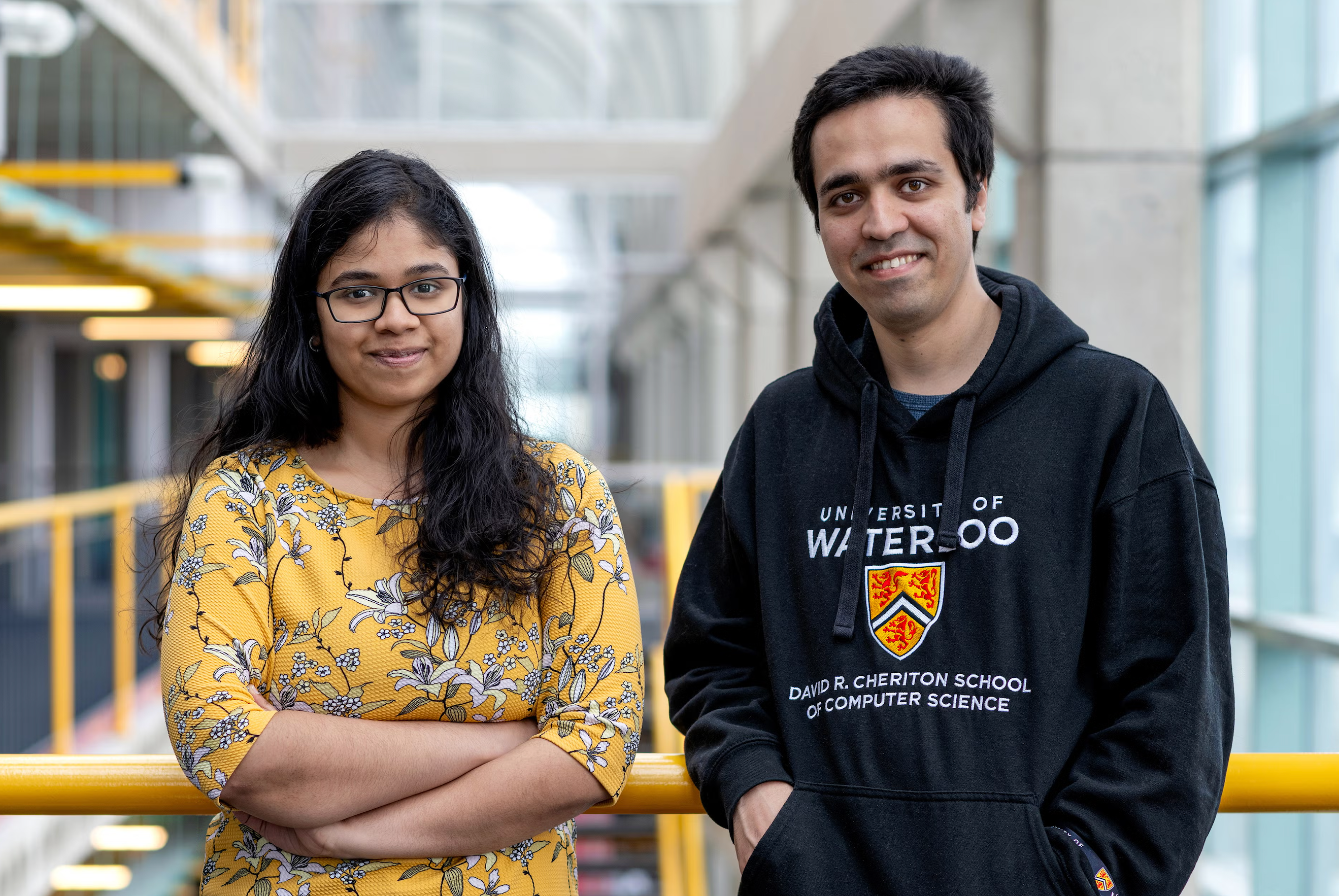
Left to right: Dr. Janani Sundaresan and Professor Sepehr Assadi
Recent PhD graduate Dr. Janani Sundaresan has been awarded Waterloo’s 2026 Alumni Gold Medal in recognition of exceptional academic achievements during her doctoral studies. Conferred by Alumni Relations, the award consists of a 24-karat gold-plated medal embossed with the University of Waterloo’s seal. Since 1970, the Alumni Gold Medal has recognized outstanding graduating students at convocation.
“Janani’s dissertation exemplifies exactly what an excellent thesis in our field should look like,” said Professor Sepehr Assadi, Janani’s PhD supervisor. “It makes foundational advances on longstanding open questions, brings genuine originality in ideas and methods, and demonstrates exceptional technical rigour. Importantly, it also offers a coherent contribution that changes how a research area approaches its central questions, with exposition that makes difficult ideas accessible to others.”
More about Dr. Sundaresan’s PhD dissertation
Dr. Sundaresan’s dissertation confronts a defining question of modern computation: what is fundamentally achievable when data grows so vast that the basic assumptions of classical algorithm design no longer hold? She studied this question through a theoretical lens in two central models for processing massive graphs — graph streaming, where the constraint is the memory of the algorithm, and the CONGEST model of distributed computing, where the constraint is the communication bandwidth. Her work established the minimum resources algorithms require to solve fundamental problems, including the number of passes over the data, computational rounds, memory space and communication costs.
In an era of ever-larger data and ever-faster algorithms, lower bounds identify the barriers that no amount of engineering can overcome. Her results do more than close gaps. They define the true frontier of computation on massive data. Thus, the central contribution of Dr. Sundaresan’s dissertation is a general framework for establishing impossibility results, also known as lower bounds, for several fundamental problems. This framework has led to the resolution of several longstanding open questions in both graph streaming and distributed computing. As an example, her work established the exact number of passes over the input that any small-space algorithm needs for fundamental graph problems such as maximal independent set and maximum matching.
The impact of Dr. Sundaresan’s work is reflected in its publication record. The seven papers forming the foundation of her dissertation have been presented at top theoretical computer science conferences, including the ACM Symposium on Theory of Computing (STOC), the IEEE Symposium on Foundations of Computer Science (FOCS), and ACM-SIAM Symposium on Discrete Algorithms (SODA), as well as in the Journal of the ACM and the SIAM Journal on Computing. Notably, her STOC 2024, SODA 2025, and FOCS 2025 papers each received invitations to special journal issues, an honour typically reserved for the top 5 to 10 percent of accepted papers.
When and Where
The Campus Wellness Student Medical Clinic offers healthcare visits with Physicians and Nurse Practitioners to current undergraduate and graduate students. Services include: vaccinations, immunity testing, naturopathic services and more. Counselling Services offers appointments with counsellors in person as well as via phone and video. Students can book appointments for these services by calling Campus Wellness at 519-888-4096.
The privately-run Student Health Pharmacy (located in the lower level of the Student Life Centre) is now offering new COVID booster shots and flu shots. Covid booster shots are available by appointment only – please call ext. 33784 or 519-746-4500. The Student Health Pharmacy’s summer hours are Monday to Friday, 9:30 a.m. to 4:30 p.m. Naloxone kits are still available – pick them up in the pharmacy at no charge.
The Waterloo Eye Institute optometry clinics in Waterloo and downtown Kitchener offer comprehensive eye exams and eyewear, including glasses and contact lenses, with the Waterloo location offering various specialized services including urgent eye care. Discounts apply for University of Waterloo students and employees. The Waterloo Clinic is at a nearby interim location, 419C Phillip St, during construction at the School of Optometry and Vision Science. The Kitchener Clinic remains at the Health Sciences Campus, 10B Victoria St. S. Book online or by phone at 519-888-4062.
The Fall 2026 Student Experience Survey (SES) is now open. Please check your @uwaterloo email or visit LEARN to see if you have been invited. Those that submit their responses will receive $5 on their WatCard. The survey is open until Nov. 6.
Introduction to Crochet, Wednesday, October 21, noon to 1:00 p.m. (class is held over two weeks). It will also be held on Monday, November 2, 5 to 7 p.m. Location will be sent at registration. Note: This workshop costs $25.
Generative AI for Research: Responsible Use, Wednesday, October 28, 10 to 11:30 a.m., LIB 329
Data Journeys: Tears, Tabs, and Terrible File Names, a survivor's guide to organizing your data, Wednesday, October 28, 11 a.m. to noon., Online
Community Well-being Fruits and Veg Market, Wednesday, October 28, 11 a.m. to 3 p.m., SLC Marketplace, PSE 1st floor, and EV3
Center for Nanointegration Duisberg-Essen (CENIDE) and Waterloo Institute for Nanotechnology (WIN) Seminar Series on 2D-MATURE: "A Journey from Fundamental Science to Technological Application", featuring Thomas Szkopek, McGill University, Electrical Engineering, Thursday, October 29, 10 a.m. to 11 a.m., QNC 1501
Farvolden Day 2026, Thursday, October 29, 1:30 to 6 p.m., Federation Hall. Register today!
James Vukelich: The Seven Grandfather Teachings and the Seven Generations, Thursday, October 29, 6 to 8 p.m., LHI 1621
AI: Opportunity, Risk and Choices Ahead, Thursday, October 29 from 7 to 9 p.m., Centre for International Governance Innovation
Halloween Haunt: The Canvas breach (Shadow IT), Friday, Oct 30, 9 to 10 a.m., virtual
Warriors Volleyball vs. Nipissing – Friday, October 30, 6 p.m. (Women) / 7:30 p.m. (Men) (Carl Totzke Court, PAC) - Home Opener, Camps and Minor Leagues Day, Employee Night. Email WarriorsTickets@uwaterloo.ca for coupon code. Buy your tickets today!
Risk, Resilience, and Climate Change - from Power Systems to Communities: Seminar with Seth Guikema, Friday, October 30, noon to 1:30 p.m., PSE Faculty Hall
Chinese Student Hangout, Friday, October 30, 5 p.m. to 6 p.m., REN 1400 (Dunker Family Lounge)
Waterloo Institute for Nanotechnology (WIN) Industry Seminar Series: "Positive Electrode Materials and Electrode Architecture for Lithium-Ion Batteries" Featuring Yoshinari Makimura, Monday November 2, 11 a.m. to 12 p.m., QNC 1501
Blockchain Innovation Challenge powered by Stellar, Monday, November 2, 4 to 6 p.m., Black & Gold Room, SLC
Generative AI for Research: Finding Literature, Tuesday, November 3, 10 to 11:30 a.m., LIB 329.
WICI Talk: Terry Stewart, Energy Efficient AI, Tuesday, November 3, 2 to 4 p.m., RCH 209
Systematic and Scoping Reviews: Systematic Search Methods, Tuesday, November 3, 1 to 3 p.m., online.
SCA 50th Anniversary Celebration, Tuesday, November 3, 3 to 5 p.m., Dana Porter Library, First Floor.
Take Our Kids to Work Day 2026, Wednesday, November 4, 10 a.m. to 3 p.m., STC
Warriors Men's Hockey vs. Laurier– Wednesday, November 4, 7 p.m. (CIF Arena). Battle of Waterloo. Buy your tickets today!
Anti-Racism Reads: Alt-Right From 4Chan to the White House, Thursday, November 5, 12 to 1 p.m., LIB 338
Safeguarding Science Webinar: Module 6 - Travelling Safely: Protecting Your Research While Travelling Abroad (English) - Thursday, November 5, 1 to 2:30 p.m.
Fall 2026 EH Slow Reading Group, Thursday, November 5, Thursday, November 19, and Thursday, December 3 from 1:30 to 2:30 p.m. in Hagey Hall 335
Queer Space and Trans Life: A Book Talk with Dr. Eden Kinkaid, Thursday, November 5, 3 to 4:30 p.m.
2026 National Bank Field Hockey Canada U SPORTS Championship, presented by Farm Mutual Re– Thursday, November 5 to Sunday, November 8 (Warrior Field). Buy your tickets today!
Collaborative Water Program Student Information Session, Friday, November 6, 10-11am, STC 2002.
Warriors Basketball vs. Carleton– Friday, November 6, 6 p.m. (Women) / 8 p.m. (Men) (Carl Totzke Court, PAC). Home Opener, Camps and Minor Leagues Day. Buy your tickets today!
Film Screening and Panel Discussion: "A Chip Odyssey", Monday, November 9, 5:30 p.m. to 8:30 p.m., Balsillie School of International Affairs
Virtual Reality in the Classroom: An Introduction for Instructors - In Person (TII5020), Wednesday, November 11, 2:30 to 3:30 p.m., LIB 329 (Tech Sandbox)
Where is the Peace Tech? Enabling Encounters Between Peacebuilders and Technologists, Friday, November 13, 7:30 to 9 p.m., Humanities Theatre
Understanding Policy: Staff Leaves and Vacation, Monday, November 16, 12 p.m. to 1 p.m.
Crochet 2.0: Introduction to Amigurumi, Monday, November 16, 5 to 7 p.m., Location sent at registration. There is a $15 cost for this workshop.
Positions available
View the latest career opportunities on the Careers website or through Workday's new recruitment module. To access Workday Recruiting, login to Workday, and navigate to the Jobs Hub from the left side menu.
Upcoming service interruptions
Stay up to date on service interruptions, campus construction, and other operational changes on the Plant Operations website.