This year, the Canada Research Chairs (CRC) program is investing more than 198 million to support new and renewed Chairholders, with up to 311 million invested annually to attract and retain some of the world’s top research talent. Electrical and computer engineering (ECE) professors Dr. Lan Wei and Dr. Kerstin Dautenhahn have been named new Canada Research Chairs, bringing their cutting-edge work in nanoscale electronics and socially intelligent robotics to the forefront.
The announcement was made by the Honourable Mélanie Joly, Minister of Industry and Minister responsible for Canada Economic Development for Quebec Regions.
ECE’s newest CRCs are among Canada’s leading experts in their fields. They join a network of Chairholders working across the University’s six faculties to advance research that transforms societies, economies, technologies, sustainability and health for humanity to thrive in a complex future.
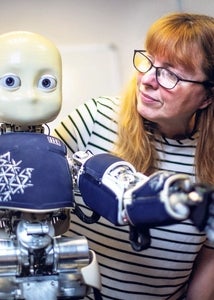
Dr. Kerstin Dautenhahn
Tier level: Tier 1 NSERC CRC in Socially Intelligent Robotics
Funding: 1,400,000
Socially interactive robots have the potential to support people in meaningful ways, but advancing their real-world impact requires a human-centred approach to ensure they function effectively outside the lab.
Dr. Kerstin Dautenhahn’s research aims to develop the next generation of socially intelligent robots that act human-like through voice, gestures and expressions while learning from experience and personalizing their behaviour. Her team focuses on three areas: assisting older adults, supporting therapy for children with disabilities and improving access to mental health services for adolescents and university students through robot coaches.
These robots are designed as tools — not replacements — for therapists or caregivers. By co-designing with users, clinicians and carers, the team ensures inclusion, cultural adaptability and alignment with real-world needs across diverse communities.
Dr. Lan Wei
Tier level: Tier 2 NSERC CRC in Nanoscale Devices and Circuits
Funding: 500,000 (CRC) + 100,000 Federal Research Fund
Wide bandgap (WBG) semiconductors — particularly gallium-nitride (GaN) — are emerging as a leading material for next-generation wireless and power electronics. WBG-based technologies promise faster, more efficient and more compact hardware.
Dr. Lan Wei will push WBG technology to new frontiers by building on her research expertise and experience translating semiconductor devices and integrated circuit innovation to industry.
Leveraging strong collaborations and the University of Waterloo’s state-of-the-art facilities, her research aims to meet the demanding needs of commercial and industrial applications, such as more reliable wireless communication in harsh environments for aerospace, medical imaging, oil drilling, and efficient power management for fast chargers, electric vehicles and data centres.
Beyond WBG, Dr. Wei is also pioneering advancements in cryogenic semiconductor and quantum technology to enable the next generation of large-scale quantum computers.

The Department of Electrical and Computer Engineering at the University of Waterloo continues to build leadership in these critical fields, cultivating researchers who are driving innovation, advancing emerging technologies, and putting Canada on the global map for excellence in both robotics and next-generation electronics.