News

Filter by:

Limit to news where the title matches:
Limit to items where the date of the news item:
Date range
Limit to news items where the audience is one or more of:

What started as an interdisciplinary i-Capstone collaboration has grown into a transformative partnership between the City of Iqaluit and the Future Cities Institute. Faced with complex infrastructure challenges in a harsh Artic environment, the city turned to Waterloo co-op students to bring fresh thinking and technical expertise to the table, and the results have been impactful.  

Engineering student Ahraz Yousuf spent a co-op term in Iqaluit, modernizing the city’s fleet management system. From implementing Fleetio software to building custom tools and leading multi-department training, Yousuf’s work has helped streamline operations and improve service delivery in the North. “I got to build something from the ground up,” he shared. “It allowed me to step outside of the traditional software development and into stakeholder collaboration.” 

This partnership continues to create opportunities for students to apply their skills in meaningful, community-driven projects, advancing real innovation in Canada’s northern cities. 

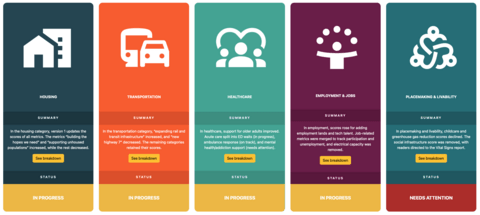
As Waterloo Region prepares to welcome one million residents by 2050, the Future Cities Institute has partnered with the Business and Economic Support Team of Waterloo Region (BestWR) to launch the Vision 1 million Scorecard, a first-of-its-kind academic–business collaboration. 
 
This public, data-driven tool tracks the region’s progress across five key areas: housing, transportation, healthcare, employment, and livability. Updated every six months, the scorecard highlights where the region is succeeding and where more focus is needed, helping guide investments and drive meaningful conversations across the region. 

As the academic partner, FCI is grounding the scorecard in data, equity, and long-term impact. With many regions facing similar growth challenges, this model has real potential to scale nationwide, and FCI is proud to help lead the way.

Sehaj Raj Singh joined the Future City Innovation Challenge, co-hosted by the FCI and Velocity, with a bold idea: make Canada’s permitting process smarter. He walked away with the top prize, new interdisciplinary teammates, and the attention of judge Frank Cairo, founder of the Future Cities Institute and a leader at CAIVAN.  

Now graduating, Sehaj is stepping into a new role as an Analyst in Land Development Engineering at Caivan Communities. Reflecting on the experience, he shared, “The Velocity Future City Innovation Challenge was hands down one of the most fulfilling moments of my undergrad... From being in the crowd to being on stage, I’m just glad I bet on myself.” A powerful example of how ambition, collaboration, and real-world challenges can shape the future.

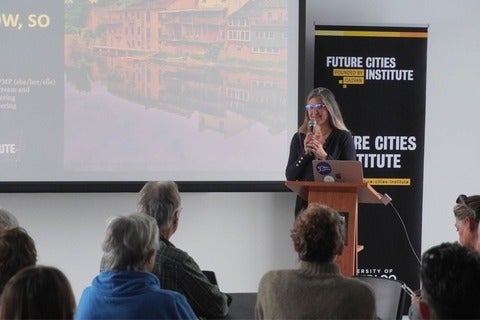
At a recent event co-hosted by the University of Waterloo and TD Wealth, members of the Waterloo community gathered for a powerful conversation on Shaping Cities of the Future: Women, Leadership & Philanthropy.  

Moderated by Leia Minaker, our Director at the Future Cities Institute, the discussion highlighted the vital role women play in financial leadership and philanthropy. Leia guided a rich conversation that emphasized the value of trust-based giving, the power of intentional investment, and the many forms philanthropy can take, whether it be time, ideas, or financial support. 

From affordable housing to AI-driven mobility, University of Waterloo students turned bold ideas into actionable solutions at the inaugural Future Cities Innovation Challenge. 

The inaugural Future Cities Innovation Challenge, co-hosted by Velocity and the Future Cities Institute, brought startup energy to real-world urban issues. 
 
Their solutions addressed real-world problems, from sustainable infrastructure to the ethical use of technology, bringing Waterloo’s Global Futures vision to life. The event showcased the power of student innovation in shaping healthy, prosperous, and sustainable cities. Explore six standout ideas that are helping build the cities of tomorrow. 

Dr. Shams Anwar, a postdoctoral researcher with the Future Cities Institute, recently presented his work on sustainable mobility and resilient infrastructure at two major national conferences: the 247th ECS Meeting and the CSME International Congress–CFDSC–CSR 2025. 

His research explores the role of energy-efficient transport and urban systems in enabling the transition to low-carbon, climate-resilient cities. Emphasizing practical, impact-driven green technologies, Dr. Anwar’s work contributes to a growing body of applied research that informs infrastructure planning for sustainable urban futures. 

From AI-powered civic tools to sustainable housing solutions, University of Waterloo students came together to present interdisciplinary projects tackling real-world issues at this year's i-Capstone symposium. 

Held on March 26, the event showcased student creativity, teamwork and dedication to solving real-world urban challenges. Designed to unite students from every faculty, i-Capstone — the University of Waterloo’s first interdisciplinary undergraduate capstone program — enables students to tackle complex problems facing Canadian communities while working with real world partners, all for academic credit. This includes areas like sustainable housing, infrastructure and integrated urban planning.