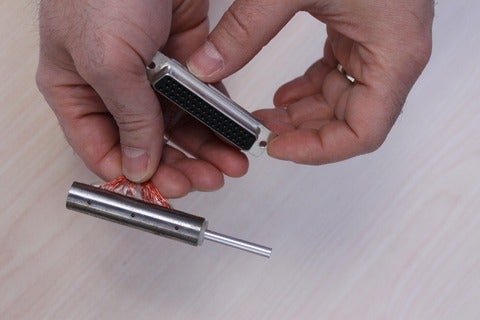
New sensor could help doctors monitor patient progress from a distance
Research results of our PhD candidate, Hassan Askari, is featured in Waterloo news as: “New sensor could help doctors monitor patient progress from a distance”.
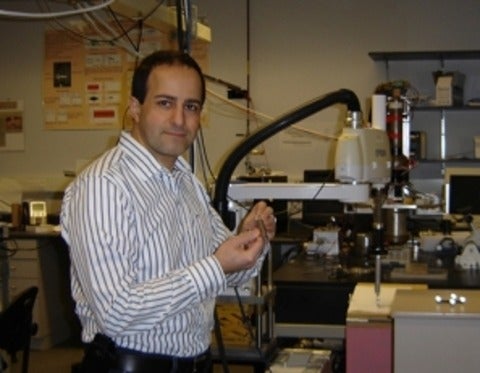
Dr. Khamesee was interviewed for CBC News article and his scientific insight is reflected in the article “Insect-sized robot can go from air to water and back again”.
They consume minimum energy because they're lightweight and they can do many things that a big robot cannot do.
Our novel nano sensor: Research results of PhD candidate, Hassan Askari, is featured in Waterloo news as: "Super-sensitive measurement method could advance medical research, environmental monitoring".
The Waterloo Engineering website has the feature on Behrad Khamesee, PEng, and his new way of charging your cell phone.
Behrad Khamesee's new design converts the energy when shovelling snow, into energy that can charge a cell phone. Full article in Waterloo Stories!
The Waterloo Institute for Sustainable Energy website has all the details on Mir Behrad Khamesee and Pratik Patel's innovate gizmo that can convert vibrational energy into useful electricity!
At the University of Waterloo in Ontario, microroboticist Behrad Khamesee, PEng has developed a flying robot about the size of a pencil eraser.
That is exactly what Behrad Khamesee and his colleagues at the University of Waterloo, in Ontario, have managed. They have built a micro-robot that levitates, rather like a Dalek in “Dr Who”. And instead of having an old sink-plunger doubling as its arm, their robot has a useful set of grippers.
A research team, led by Professor Mir Behrad Khamesee, manipulates magnetic fields to levitate and move around three axes a robot weighing about three-hundredths of an ounce.
- cnet
Dutch pressetext online magazine also had a feature on the tiny robot fliers!