The novel device produces a ‘nanojet’ of light and holds promise to advance scalable quantum technologies.
Researchers at the Institute for Quantum Computing (IQC) at the University of Waterloo have demonstrated a nanoscale optical device that makes it easier to probe quantum systems with light to enable more efficient quantum sensors and solid-state quantum computing systems. The new device was demonstrated in diamond as a proof of principle.
This optical device has the potential to make quantum sensors better at detecting weak magnetic fields, which could enhance technologies in biomedical imaging or navigation in GPS-denied environments. It could also advance solid-state quantum computing architectures by improving control and readout of individual quantum bits (qubits), and the transfer of quantum information between them.
“Our new approach offers a powerful and practical route to enhance light–matter interaction in solid-state platforms."

Semnani spearheaded the research in Dr. Michal Bajcsy’s group, IQC Faculty and Professor, Department of Electrical and Computer Engineering.
Solid-state quantum platforms such as diamond, silicon carbide, and silicon can host atom-like defects, also known as quantum emitters or color centers, that can serve as qubits. These defects can be initialized, controlled, and read out with laser light, and in many cases can also act as solid-state single-photon sources.
In practice, however, aiming a laser at a single defect can be difficult. Additionally, efficiently collecting the optical signal is challenging because these materials have a high refractive index, causing much of the light emitted by the defects to remain trapped inside the material rather than being collected.
That’s the problem Bajcsy’s group aims to solve with a novel device reported in a new paper Probing Individual Quantum Emitters in Bulk Semiconductors via Photonic Nanojets published in Science Advances.
The device was fabricated at the Quantum-Nano Fabrication and Characterization Facility at the University of Waterloo. The group says access to the facility’s advanced tools, technical support and adaptable processes gave them a flexible and robust fabrication ecosystem to develop new ideas and iterate the device concept.

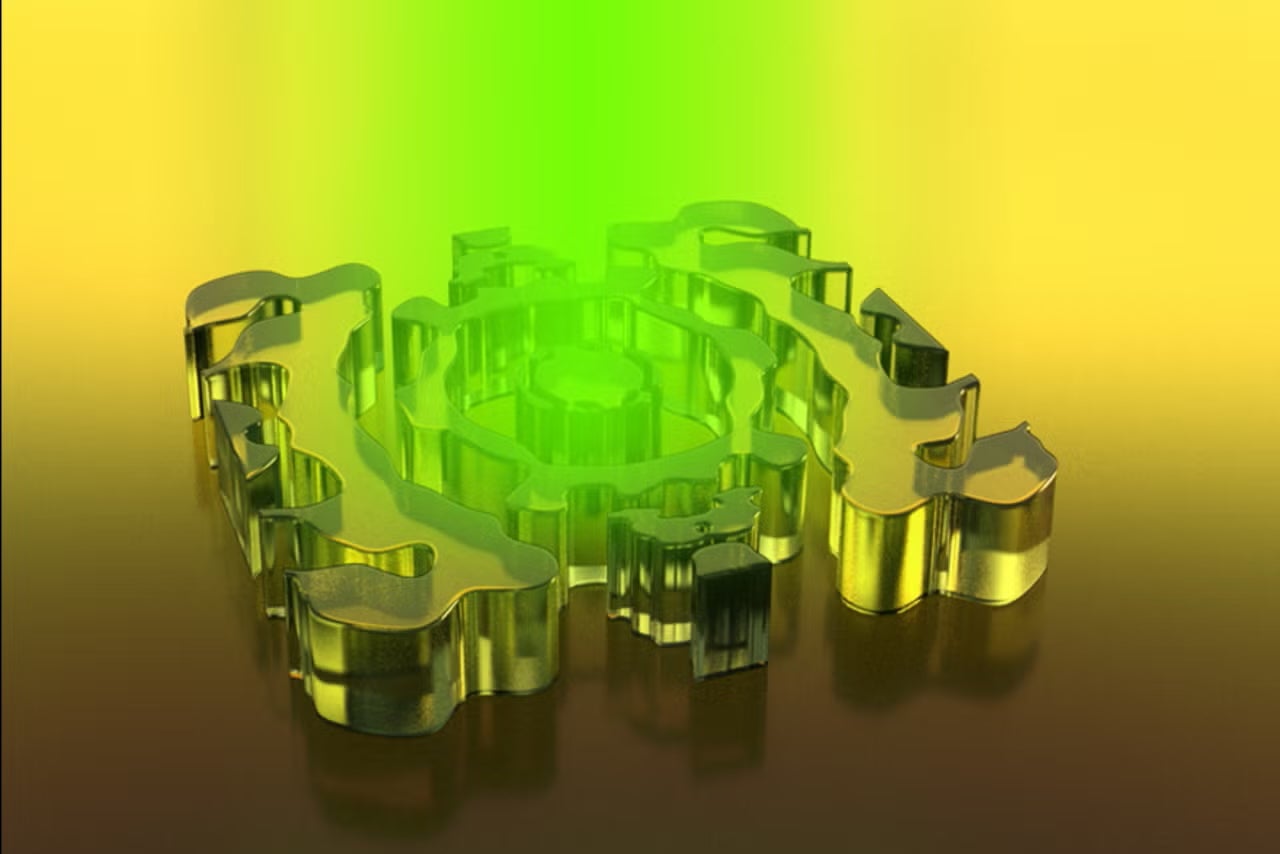
Dr. Michal Bajcsy's group designed a quantum device in diamond that funnels and aims a highly localized beam of photons at single engineered defects in diamond and is optimized to extract photons. Better collecting and controlling light has applications in quantum sensing and solid-state quantum computing architecture.

The group used an automated, inverse design approach to optimize the shape of a two-dimensional structure sculpted into a diamond surface. The device size is about 1 micrometre - 100 times smaller than the width of a human hair.

The research was supported in part by the Canada First Research Excellence Fund through the Transformative Quantum Technologies (TQT) program at IQC.