News

Filter by:

Limit to news where the title matches:
Limit to items where the date of the news item:
Date range
Limit to news items tagged with one or more of:
Limit to news items where the audience is one or more of:

A new University of Waterloo study reveals that shoreline erosion plays a far greater role in the health of our Great Lakes than previously understood. Findings for Lake Erie suggest that coastal erosion and the associated input of the essential nutrient element phosphorus could partially offset the water quality improvements expected from watershed management efforts.

A new chapter in water economics research is beginning with the introduction of the Journal of Water Economics (JWE), the open-access continuation of Water Resources and Economics (WRE), a leading journal in the field since 2013. Originally published by Elsevier, WRE will be discontinued at the end of 2025, after 52 issues and more than 250 articles. Its founding Editors-in-Chief, Roy Brouwer (Department of Economics, University of Waterloo) and Erik Ansink (School of Business & Economics, Vrije Universiteit Amsterdam), built the journal into a respected forum presenting (beyond) state-of-the-art research on the economics of water resources.

From modelling floods and droughts to managing watersheds and tracking climate change, today’s environmental challenges require faster, more powerful computing. Now, researchers at the University of Waterloo and across Canada have a new tool to help solve them: Nibi, Waterloo’s newest high-performance supercomputer.

Water Institute members Dr. Nandita Basu and Dr. Julie Mai recently hosted a webinar showcasing the POSEIDON Water Quality Portal, a collaborative platform that uses AI to transform water quality data into actionable insights for researchers, watershed managers, and communities.

Water Institute delegation visits the University of São Paulo (USP) as part of a long-term research collaboration on water (in)security and welcomes visiting USP students to campus

Between October 15-17, 2025, Water Institute members David Rudolph, Philippe Van Cappellen, Andrea Brookfield and Executive Director Roy Brouwer joined University of São Paulo colleagues for a field visit as part of the project SACRE: Integrated Water Solutions for Resilient Cities.

The Water Institute is pleased to launch its Fall 2025 WaterTalks, a three-part speaker series showcasing fresh perspectives on some of today’s most pressing water challenges. This year’s talks will span topics from groundwater use and the water–energy–food–poverty nexus in South Asia to advancing environmental justice and strengthening resilience to hydroclimate extremes.

Dr. Bryan Grimwood, Professor in the Department of Recreation and Leisure Studies (RLS) in the Faculty of Health, has been awarded approximately $380,000 in funding from the Social Sciences and Humanities Research Council of Canada (SSHRC) to lead a new research initiative entitled Tourism, ruination, and regenerative futures that rethinks tourism’s role in landscapes marked by environmental and cultural ruination.

When devastating floods swept through Pakistan in 2022, millions were displaced, and more than 1400 lives were lost. For Malak Kamal, a graduate architecture student from Quetta, Pakistan, it was a turning point.

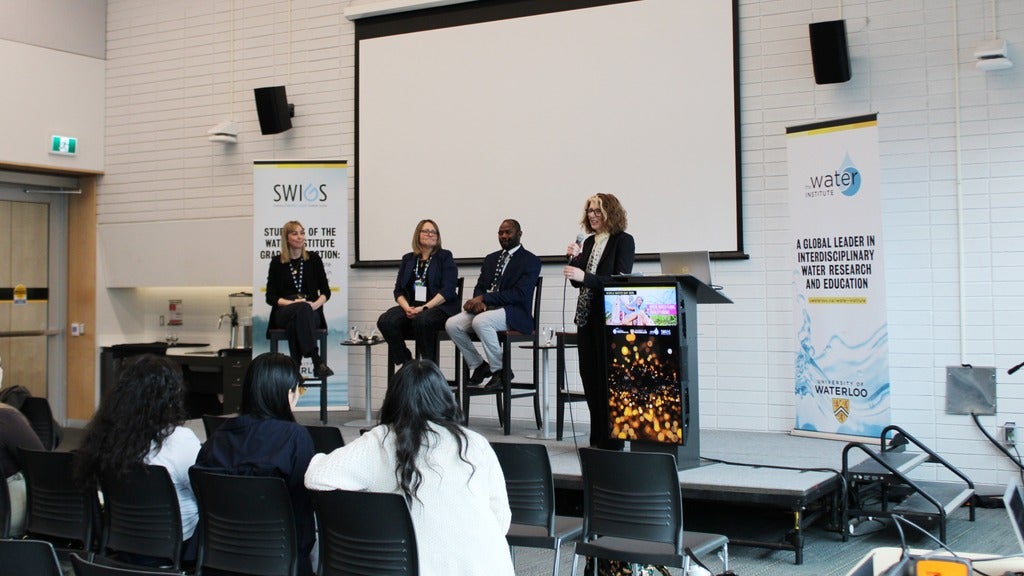
On March 22, the Water Institute marked World Water Day—an annual event bringing together students, researchers, and community members to reflect on our relationship with water. This year’s event aligned with the United Nations’ 2025 theme, Glacier Preservation, and featured insightful talks from distinguished speakers, a showcase of emerging research, and a special recognition of alumni driving change in water management.

The Water Institute is pleased to announce that Rachael Messenger-Lehmann has been awarded the 2025 John Parish Memorial Graduate Scholarship. This prestigious award recognizes outstanding research in fluvial geomorphology—the study of rivers, their processes, and how they influence the landscape.