News

Filter by:

Limit to news where the title matches:
Limit to items where the date of the news item:
Date range
Limit to news items tagged with one or more of:
Limit to news items where the audience is one or more of:

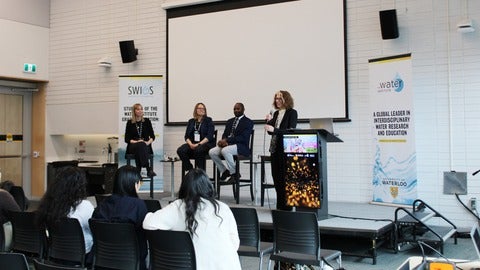
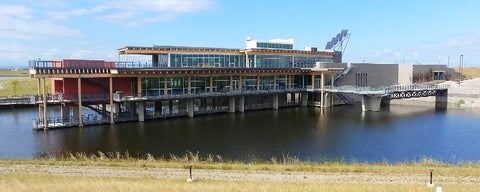
A new scan published in the Journal of Great Lakes Research offers a look into the ingredients for success among academic and non-governmental water research centres focused on the Laurentian Great Lakes. Led by Professor Michael Twiss, Department of Biology at Algoma University, the study analyzed 22 centres across the region, based on interviews with the directors of these centers and institutes, including the University of Waterloo’s Water Institute to uncover patterns in governance, funding, outreach, and long-term sustainability.

Building better flood resilience through science and innovation

As climate change fuels more extreme rainfall and flooding, protecting Canada’s communities, infrastructure, and ecosystems depends on understanding where—and how severely—floods will strike. But in many regions, especially where historical data is limited, predicting the likelihood of rare, high-impact floods remains a major challenge.

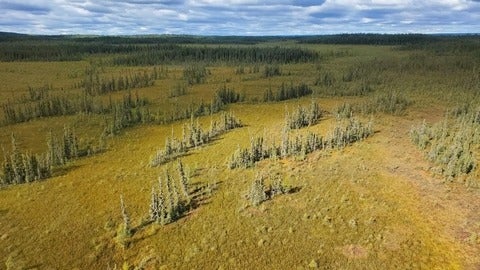
What started as a personal curiosity during a California drought has become a global, interdisciplinary research journey for Isabel Jorgensen, PhD candidate, School of Environment, Resources, and Sustainability - Collaborative Water Program, Water Institute. 

Lake Winnipeg has been experiencing increasingly severe algae blooms since the 1990’s, earning it the title of “Canada’s Sickest Lake”. This “illness” stems from excess nutrients, primarily phosphorus and nitrogen, running off from agricultural lands, urban areas, and wastewater treatment plants. These nutrients result in various water quality problems, including excessive algae growth, which can block light, deplete oxygen levels, and release toxins into the water.

Dr. Neil Thomson, internationally recognized groundwater remediation expert and long-time Water Institute member, was named Distinguished Professor Emeritus by the University of Waterloo in 2024 in recognition of his outstanding scholarly achievements and leadership. Now officially retired after more than 35 years with the Department of Civil and Environmental Engineering, Dr. Thomson continues to lead impactful research and mentor the next generation of environmental engineers.

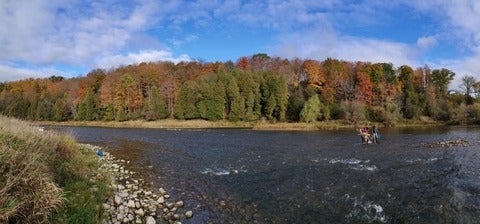
Have you ever been on a “skunked” fishing trip—one where you don’t catch a single fish? Sometimes, it’s the weather. Other times, it’s faulty gear. But if you’ve been fishing in rivers for a while, you may have noticed more and more skunked trips. The problem might not be your technique—it could be the river itself.

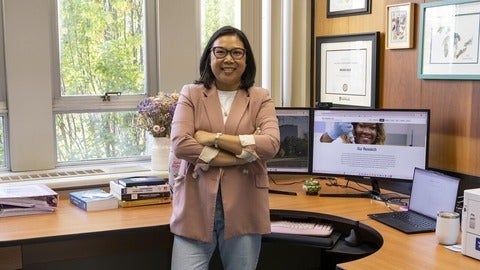
Dr. Michael Tam, a chemical engineering professor and University Research Chair, has been named the 2025 recipient of the R.S. Jane Memorial Award — the highest honour conferred by the Canadian Society for Chemical Engineering (CSChE). He will deliver a plenary lecture at the CSChE Conference on October 8.

This spring, Water Institute member Dr. Leah Jones-Crank, Assistant Professor in the School of Environment, Resources and Sustainability, co-led a new international field course on urban sustainability in Singapore. Open to students in the Faculty of Environment, the course highlighted water management through immersive, real-world learning experiences.