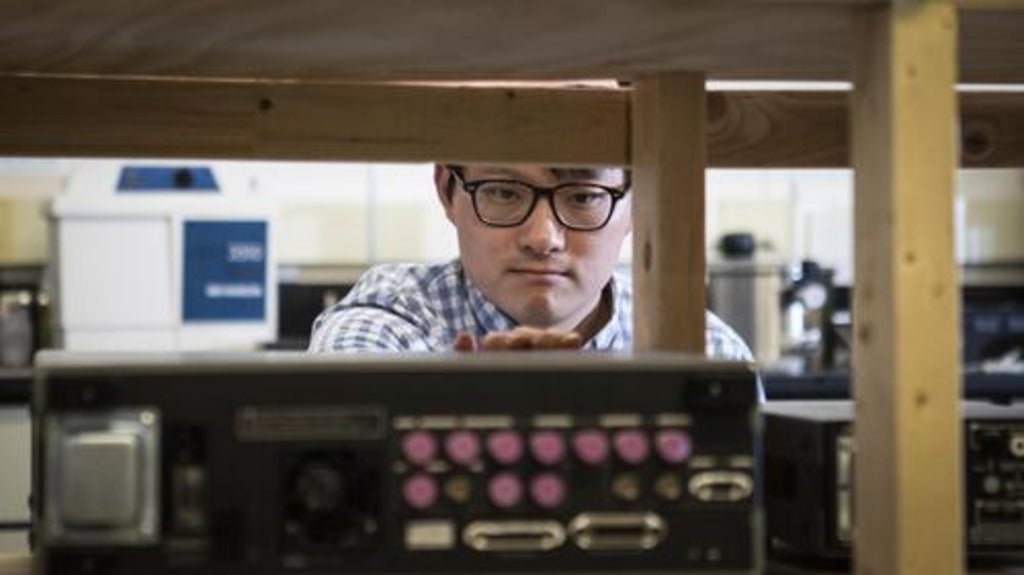
Professor Mario Gauthier retires
This week, we mark the retirement of Professor Mario Gauthier after 30 years of service as an accomplished faculty colleague.

The Canadian Foundation for Innovation’s John R. Evans Leaders Fund has recognized four Faculty of Science researchers to embarking upon research or technology development that is innovative, high quality and meets international standards.
From using microbes to breakdown contaminates in landfills to learning how to conserve our amphibian populations in the face of climate change, the Government of Ontario has awarded three Waterloo Science researchers $140,000 each to advance ‘Ontario made’ research and innovation as part of Ontario's Early Researcher Awards.
New research is showing that some tiny catalysts being considered for industrial-scaled environmental remediation efforts may be unstable during operation.
Congratulations to Victoria Grace Wilkes for being awarded the University of Waterloo President's Award of Excellence.
As we continue to navigate the COVID-19 pandemic, virtual learning has necessarily become an integral part of the day-to-day life of students, faculty, and staff at the University of Waterloo. One of the challenges often associated with online learning is creating active engagements between students and instructors, especially with hands on learning opportunities such as with labs.
Professors Aravindhan Ganesan (Pharmacy) and Subha Kalyaanamoorthy (Chemistry) use drug design methods to target the molecular machinery that supports COVID-19 replication.
An interdisciplinary research team intends to close critical gaps in our understanding of plastic pollution and its impacts, and generate new knowledge to support policy and decision-making.
To a scientist, trial and error is common in laboratories to refine new tests and methods, and look for potential problems on the small scale. But what happens when these techniques are meant for human tissues, such as for surgeries, medical tests, and treatments, where multiple different trials are not possible?
Researchers studying two-dimensional crystalline materials have observed an electromagnetic effect, called the nonlinear anomalous Hall effect, of unprecedented size. Their finding opens the door to exploring other quantum materials using their techniques and hints at promising applications in spintronic devices.