Donors | Friends | Supporters
Waterloo launches the Cybersecurity and Privacy Institute
Bringing together researchers from across Waterloo’s six faculties.
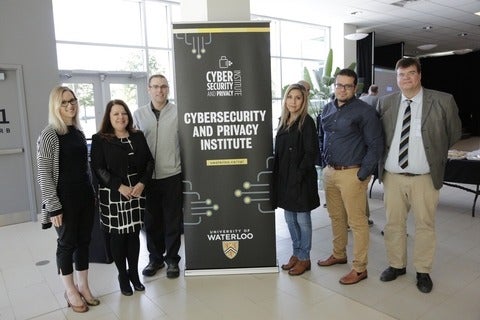
On Friday, September 27, Waterloo celebrated the launch of the Cybersecurity and Privacy Institute (CPI) with 100 attendees including security leaders from the private and public sectors. CPI was formed to uncover new approaches to security and privacy and educating Canada’s future leaders to be able to understand and respond to emerging online threats.
Cybersecurity and Privacy Institute Launch

Join us
On Friday, September 28 we will launch the new Cybersecurity and Privacy Institute.
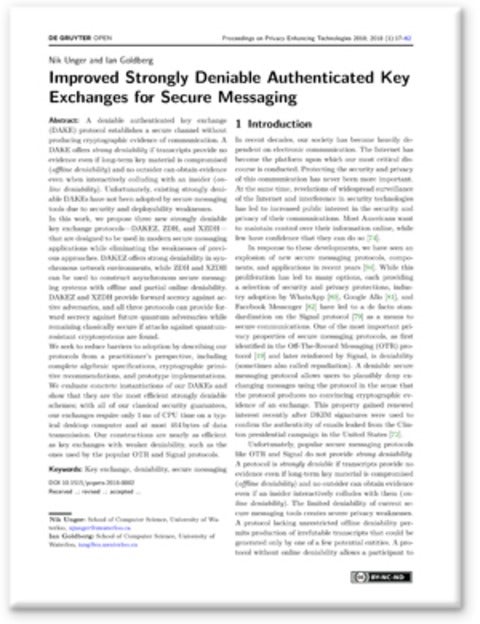
Professor Ian Goldberg, his doctoral student Nik Unger and colleagues win prestigious paper awards at PETS 2018
Cheriton School of Computer Science Professor Ian Goldberg, along with his PhD student Nik Unger and colleagues, have won three prestigious paper awards at the 2018 Privacy Enhancing Technologies Symposium (PETS). Held this year in Barcelona, Spain from July 24–27, 2018, PETS is the top research venue dedicated to the study and advancement of privacy enhancing technologies.
When A Small Leak Sinks A Great Ship: Deanonymizing Tor Hidden Service Users Through Bitcoin Transactions Analysis
Aiman Erbad, Qatar University
With the rapid increase of threats on the Internet, people are continuously seeking privacy and anonymity. Services such as Bitcoin and Tor were introduced to provide anonymity for online transactions and Web browsing. Due to its pseudonymity model, Bitcoin lacks retroactive operational security, which means historical pieces of information could be used to identify a certain user.
National Defence funds University of Waterloo project to connect experts focused on defence and security
An affiliate of the University of Waterloo’s Cybersecurity and Privacy Institute (CPI), Bessma Momani, leads the winning submission for the Defense Engagement Program.
The submission, The Future of Canadian Defence and Security: New Challenges, New Perspectives, provides a network of external experts for the Department of National Defence (DND), connects and educates the next generation of experts, and helps to inform Canadians about the importance of defence and security matters.
Smartphone PIN protection methods have high failure rate
Popular methods of protecting smartphone personal identification number (PINs) may only be successful in safeguarding your personal information 20 per cent of the time, according to a new study out of the University of Waterloo.
How blockchain can democratize green power
Professor Srinivasan Keshav recently wrote an article for The Conversation Canada about how blockchain technologies could help homeowners sell their green electricity to their neighbours.
RBC to open a cybersecurity lab and fund new research at the University of Waterloo
The Royal Bank of Canada (RBC) is opening a cybersecurity lab and investing $1.78 million into research at the University of Waterloo to develop advanced cybersecurity and privacy tools.
Developing protocols for better Off-The-Record encryption
Cryptography done right has become increasingly important as the impacts of poor implementations are being felt by journalists, whistleblowers and political activists around the world.
- Previous page
- Currently on page 4 4