Editor:
Brandon Sweet
University Communications
bulletin@uwaterloo.ca
Coming home - a history of Homecoming at Waterloo
By Sam Charles. This is an excerpt of an article originally published on Waterloo News.
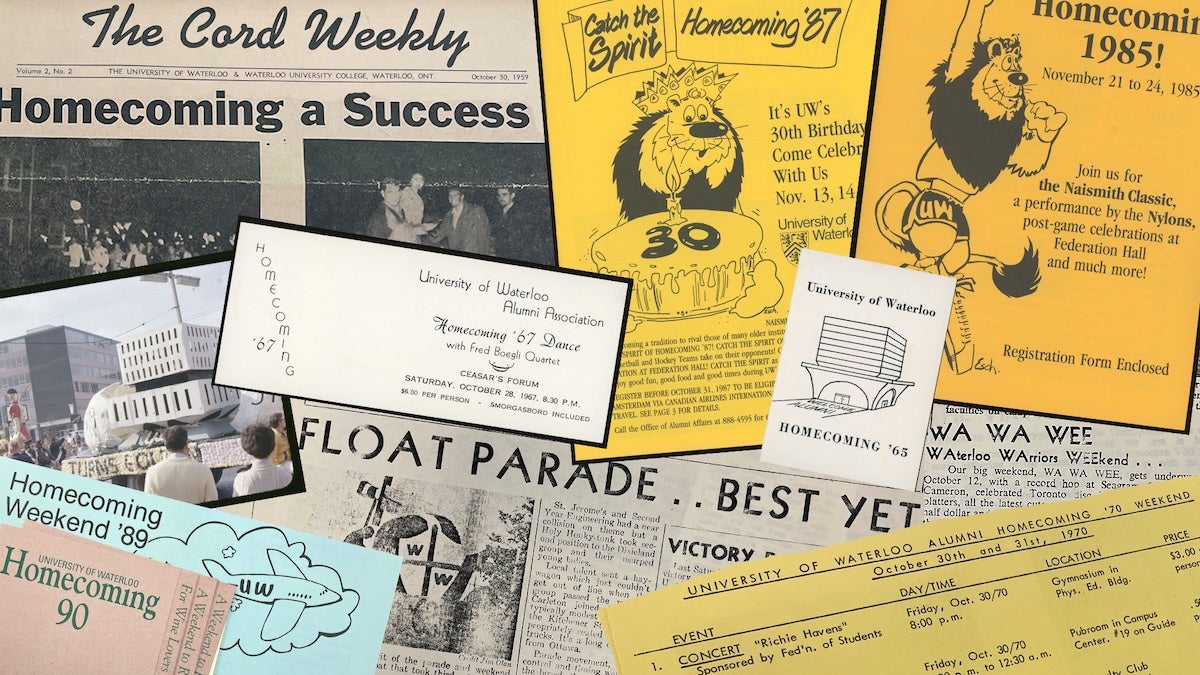
Homecoming has a long and rich history. The annual celebration has gone by several different names over the years including Wa-Wa-Wee (Waterloo Warriors Weekend), Reunion, Alumni Black and Gold Day and Rally Weekend. The festivities have been running since the early 1960s and have always been focused on bringing together the University of Waterloo community and building school spirit.
In the early years, before having any alumni, the event was jointly held by Waterloo and Waterloo University College (a predecessor of Wilfrid Laurier). Waterloo’s contribution to the event included a one-day affair entitled Wa-Wa-Wee. In 1959, a student newspaper columnist wrote “WA WA WEEKEND comes but once a year and it’s your weekend to howl so help build the floats, cheer at the game, have a ball at the dances.”
That same year, the Cord Weekly (a joint student publication from the two institutions), described that year’s homecoming this way: “Although it was raining, the enthusiasm wasn’t dampened in the least. The parade was led by the lovely girls of Conrad Hall, carrying their banner and followed by Bill Powell leading the Waterloo Mule.”
Yes, literally a mule. Waterloo College’s athletics mascot in the late 1950s was a mule.
“It was always such a good time. The parades and the cross-town football rivalry,” says Rick LeRoux (BSc ’72), who has been attending Homecoming since 1967. “It was fun. Everyone was really involved in, not just the football game, but the entire weekend, different activities like concerts and dances.”
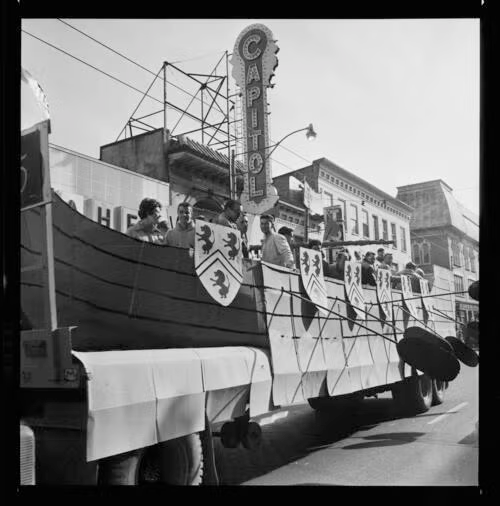
Archival images courtesy of the the University of Waterloo's Special Collections & Archives.
Waterloo’s Homecoming began to include alumni in 1962, expanding to two days that included dances, a parade, concerts and the football game.
The parade was a staple of Homecoming in those early years and helped cement Kitchener-Waterloo as a “college town” as the route extended from Kitchener’s downtown to campus.
Waterloo students quickly established a strong track record of building prize-winning parade floats. It was often Engineering students, but other faculties were also recognized. In 1963, the Engineering class designed a parade float that featured an enormous football and a boot. The float accompanied a caravan of other floats that were driven around the perimeter of the campus.
That parade had 23 floats including 16 built by Waterloo students. The best float winner took home bragging rights, a coveted trophy and the $25 first prize. That prize money went far, since tickets for the ’63 Homecoming semi-formal “Un soir à Paris” held at Bingeman Park Lodge were only $4 and included a “delicious sandwich buffet.”
For LeRoux, two of his biggest memories of the parades at that time were the engineering students Rigid Tool that they’d carry alongside the floats and their marching band. “There would be about five or six of them carrying this ten-foot-long tool, it was classic. And their marching band wasn’t very good, but they had great energy and got everyone involved.”
By 1965, Homecoming expanded to four days, featuring a barbecue and fireworks at Laurel Lake along with a chess tournament on Thursday, a concert on Friday night, the parade and football on Saturday and ended with another concert on Sunday.
From its earliest origins, Homecoming was planned around a football game with an emphasis on celebrating athletics, the university and its community.
Read the full story on Waterloo News.
Waterloo signs MOU with the Chippewas of the Thames First Nation
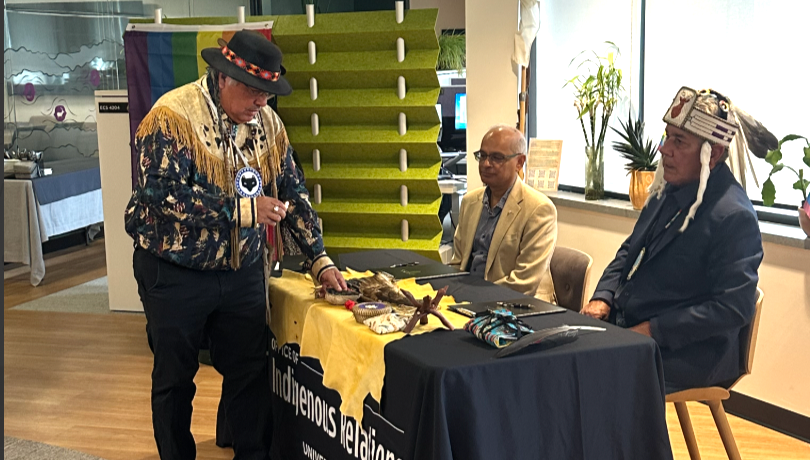
University of Waterloo President Vivek Goel and Chief Joe Miskokomon of Chippewas of the Thames First Nation (COTTFN) came together recently to sign a Memorandum of Understanding (MOU) to advance shared research interests addressing social, environmental and economic challenges faced by COTTFN and other Indigenous communities.
This MOU represents Waterloo’s first formal relationship with a First Nation. The goal is to foster a teaching and research culture in which Indigenous communities can define on their own terms, while collaborating with Waterloo experts to create solutions to local challenges that are shaped both by and for Indigenous Peoples.
“This MOU is not just a document - it is a commitment to collaboration, learning, and action. It recognizes the unique strengths and gifts that both the Chippewas of the Thames and the University of Waterloo bring to this relationship,” said Vivek Goel, President and Vice-Chancellor at Waterloo. “It affirms our shared goals: to advance community wellbeing, economic prosperity, and stewardship of lands and waters, while also deepening understanding and fostering reconciliation.”
Chief Miskokomon emphasized the importance of the agreement for the Nation saying, “this MOU affirms Deshkan Ziibiing’s commitment to lead the work that matters most to our Nation,” adding, “In partnership with the University community, we will ensure joint projects reflect First Nation priorities, are guided by our values, honour our ways of knowing, and strengthen the path of self-determination for future generations.”
A working group will be formed with representation from COTTFN, Waterloo faculty and staff, and guided by the Office of Indigenous Relations. The group will create a space where Indigenous ways of knowing inform discussions about environmental, economic, health and social challenges.
As we approach the anniversary of Waterloo’s commitment to reconciliation, Indigenization, and decolonization at the institution this collaboration centres Indigenous people as partners in knowledge exchange with settler researchers. It recognizes Indigenous people are already envisioning the future, one where cultural knowledge, practices and governance are actively engaged, and at times blended with Western ideas and technologies, to build communities that are resilient and resurgent.
Green labs bring Science into the twenty-first century
By Vanessa Parks. This article was originally published on the Faculty of Science website.
If you’ve passed through the Earth Sciences and Chemistry building (ESC) in the last two years, you may have noticed the work being done on the third-floor labs. What you may not realize is that this renovation is bringing the university a step closer to its net-zero carbon goals while ushering Science at Waterloo into the twenty-first century.
ESC was one of the first half dozen buildings on campus when it opened in 1964. With its isolated workspaces that prioritized focused work, it has served faculty and students well for decades. This renovation aims to meet the evolving needs of science today, both in terms of space and efficiency.
“The original goal was to revitalize the building,” says Mike Ditty, Director of Infrastructure and Technical Resources. “What we’re going to end up with are layouts meant for modern science and systems that are more energy and resource efficient.”
There are now eight modular labs on the third floor of ESC, each providing space for lab work and offices. With glass walls to let in light from windows on both sides, the space now has an open, airy feeling that John Corrigan, Chair of Chemistry, hopes will provide an opportunity for collaboration and informal networking.
“The interface between the lab and the student office space is fantastic for collaboration,” Corrigan says. “Everything used to be separate, and there was very little cross-pollination. Now there is space in and around the labs and also between them, so there’s more opportunity for networking. The common space is fantastic for our undergraduates, too, who don’t currently have this.”
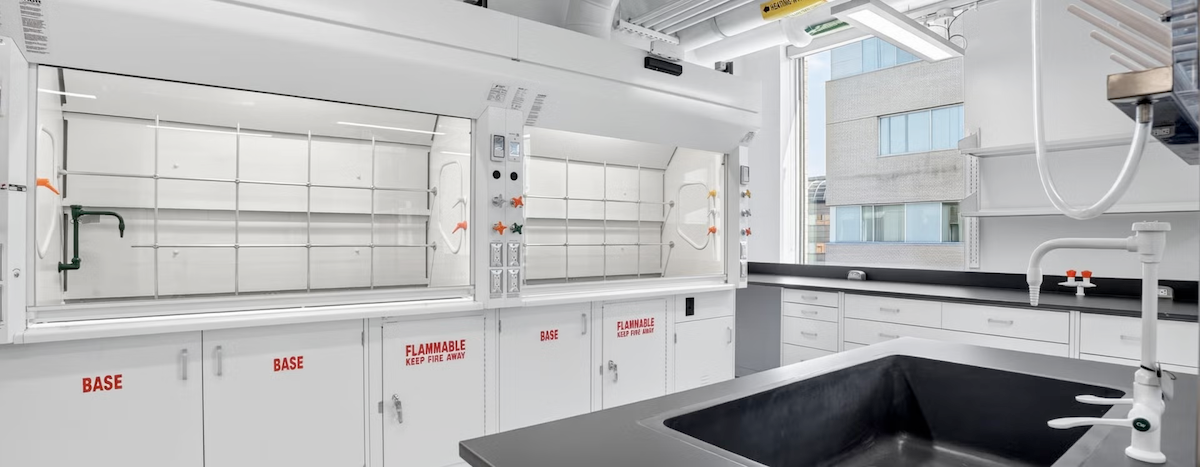
The new labs will house faculty in synthetic chemistry who rely on fume hoods to vent potentially dangerous gases from the chemicals they work with. These fume hoods were a key feature of the renovation.
“Everything we do takes place in a fume hood,” says Derek Schipper, Associate Professor, one of the first occupants. “Ventilation is very important to our work, and moving into this brand-new space means we don’t have to worry about our ventilation requirements.”
But the new fume hoods won’t just be able to handle more capacity. They are also a key component of how the new labs will better meet sustainability goals.
“Fume hoods generally run on what’s called a constant volume, which means they extract as much air as they’re set up to, whether or not you’re using them,” Ditty explains. “These new hoods have variable air volume, meaning they consume a lower amount of air when not in use. It’s just as safe for containment but more energy efficient.”
Mary Georgious is one of the principals at mcCallumSather, the architectural firm engaged to work on the Science Renewal Masterplan, and the mastermind behind these efficiencies. “Minimizing the amount of outdoor air you’re bringing into the space is one way to support energy recovery,” Georgious says. “With low flow hoods, you’re moving a lot less air, which can correlate with at least a 30 percent reduction in energy consumption.”
Georgious also made sure the labs were ready for longer-term sustainability plans by preparing them to connect to a future geothermal system. A geothermal system utilizes the relatively constant underground temperature to regulate a building’s temperature by pumping heat from the ground in cooler weather and to the ground in warmer weather via a system of underground piping. While the university isn’t currently connected to a geothermal system, this renovation will allow it to do so easily if that option becomes available.
Remembering Professor Kostadinka "Dida" Bizheva

A message from the Faculty of Science.
It is with great sadness that we acknowledge the passing of Kostadinka Bizheva, Professor in the Department of Physics and Astronomy, affectionately known as Dida to her colleagues and friends.
Dida was passionate about her research into biomedical optics and designing optical imaging technology. She initiated the field of optoretinography, a non-invasive method of measuring physiological and metabolic changes in the photoreceptors of the retina. She joined the Department of Physics and Astronomy in July 2004 and established her Biomedical Optics Research Group, which is world-renowned for its development of novel imaging technology for use in clinics. Dida was cross-appointed to the School of Optometry and Vision Science and to the Electrical and Computer Engineering Department in the Faculty of Engineering. She was also the Graduate Officer for her home department of Physics and Astronomy.
Recently, Dida was named a 2025 Optica Fellow, acknowledging her lifetime of achievement in optics and imaging. Teaching and mentoring were important to Dida, and she looked forward to how this appointment would help her shape the trajectory of students entering the field of biomedical optics.
Dida is remembered for her passionate approach to her research and her warmth in connecting with collaborators and students alike.
Read tributes from her colleagues and friends on the Faculty of Science website.
Brave Space Conversations and other dots and dashes
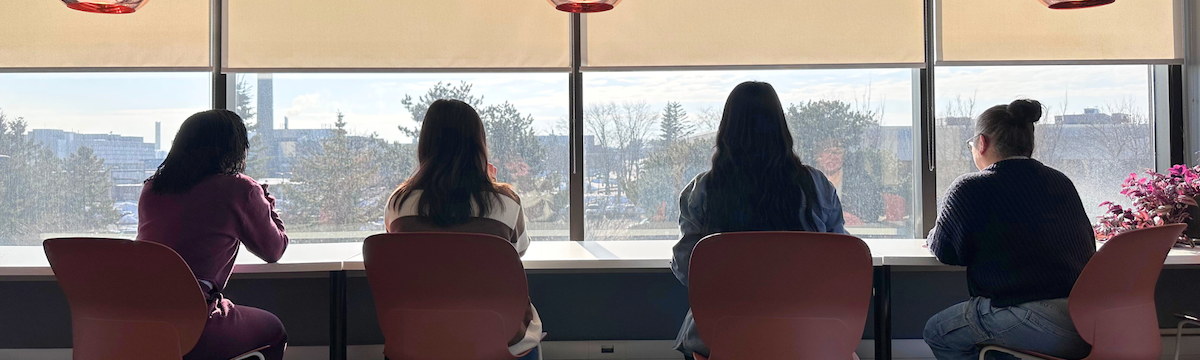
"Why do we avoid difficult conversations—or shy away from uncomfortable questions?" asks the EDI-R Office, probably not rhetorically. "Many people at work avoid conversations about race, identity, harm, and systemic inequity—not because they don’t care, but because they’re afraid of saying the wrong thing, causing discomfort, or facing backlash. Yet real progress can’t happen if we can’t talk honestly. Join the Office of EDI-R for our latest Table Talk Session designed to help individuals and teams move beyond silence and into meaningful dialogue."
The session, "Brave Space Conversations: A Care-Centered Approach to Navigating Difficult Dialogues Through an EDI-R Lens," takes place on October 1 from 12 noon to 1:00 p.m. online and is open to staff and faculty. You can register for the session online.
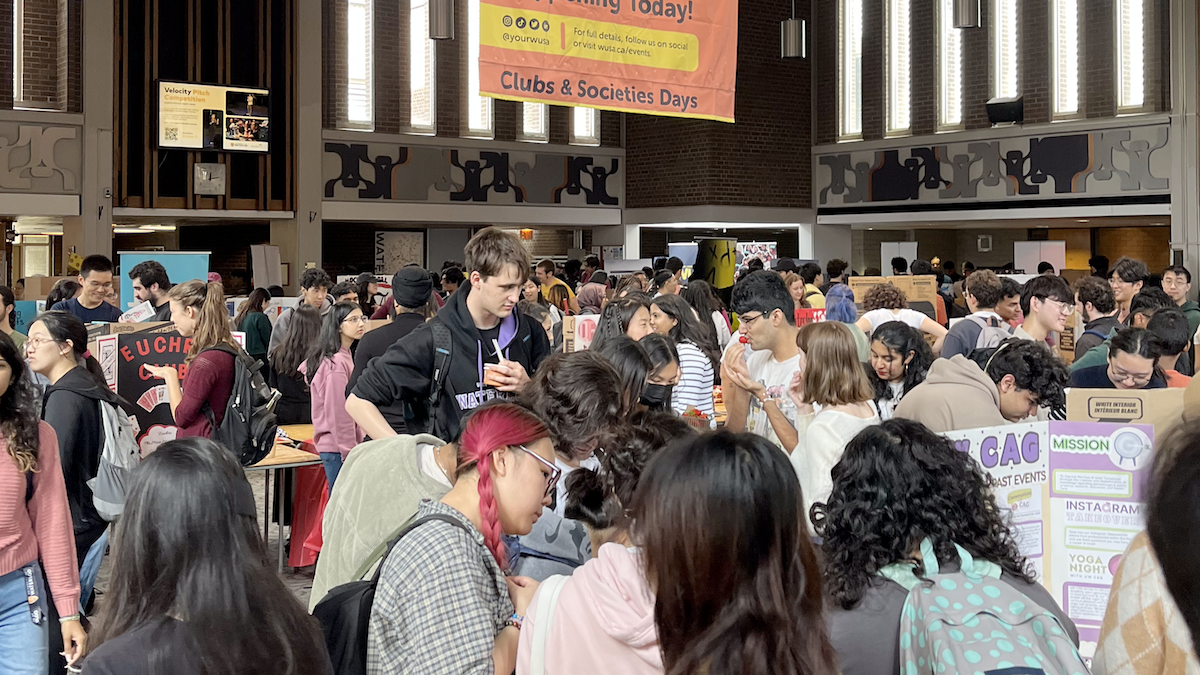
We be clubbin': Student life in all its various facets will be on display in the Student Life Centre today and tomorrow as the Clubs and Societies Fair takes over the Great Hall. More than 200 student clubs and representatives from faculty and department student societies will have information booths for students to peruse. The fair runs from 11:00 a.m. to 3:00 p.m. Thursday, and from 11:00 a.m. to 2:00 p.m. on Friday.
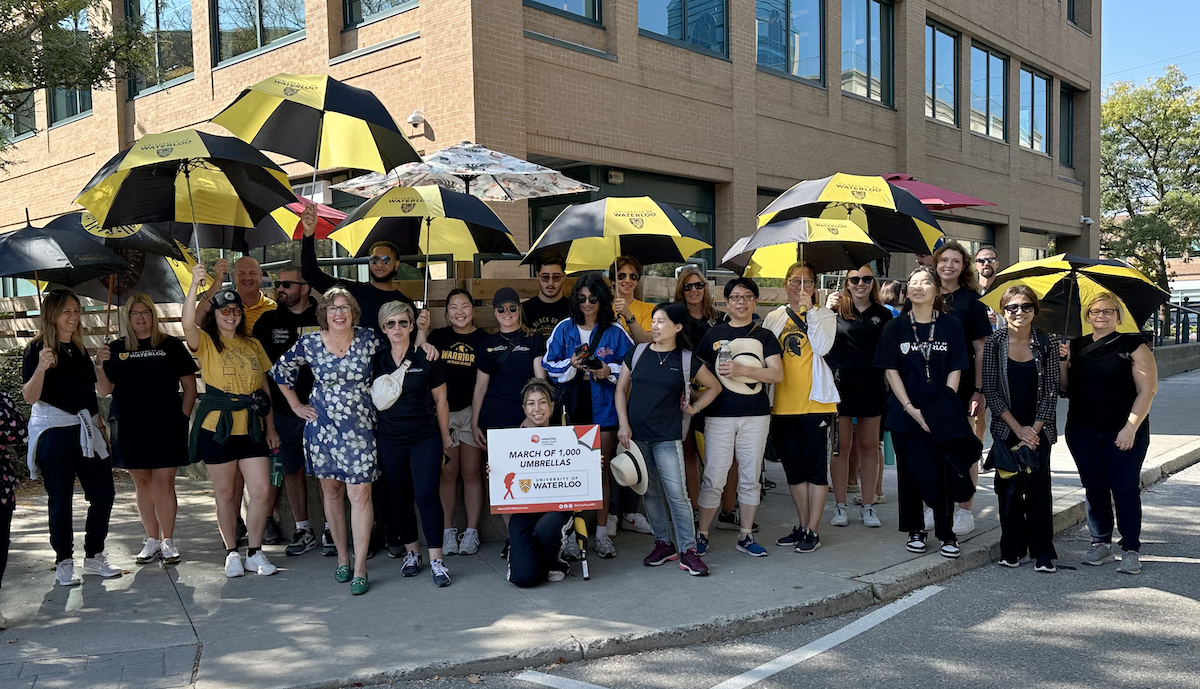
Get ready to open those umbrellas and go on the march: The annual March of 1,000 Umbrellas, which kicks off the local community's United Way fundraising campaign each year, is set to take place today in Uptown Waterloo. The Waterloo contingent will meet at the bottom of the stairs at South Campus Hall (SCH) at 10:30 a.m. for a group photo before beginning their journey at 10:45 a.m. to join the main march at Waterloo City Hall by 11:30 a.m. This 3-km walk runs from Waterloo City Hall to Carl Zehr Square in Kitchener. More information about the University's internal United Way campaign can be found on the United Way website.
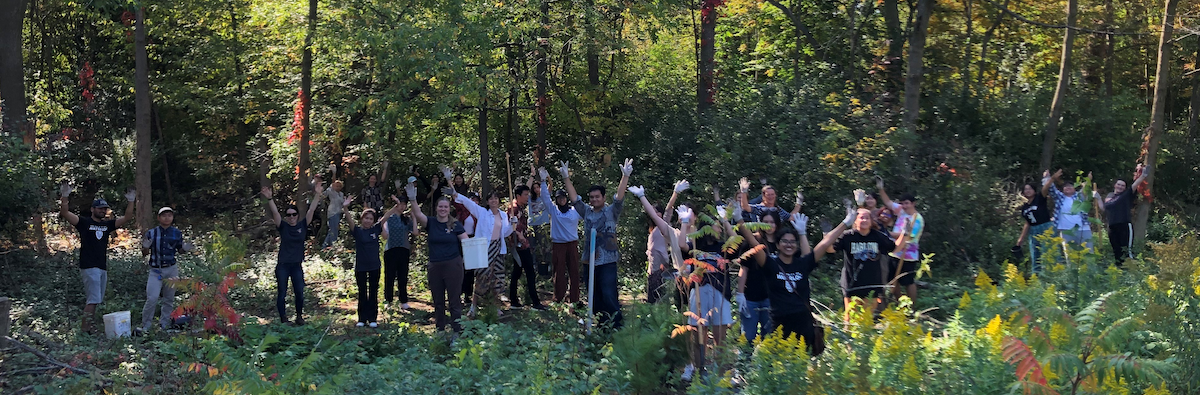
Employees and students are invited to come out and get their hands dirty with the Sustainability Office from 12 noon to 2:00 p.m. for a buckthorn pull. It's the latest in a series of campus naturalization events happening this fall. Gloves, tools and light refreshments will be provided, and no experience is necessary. More details and registration link can be found on the Sustainability Office events website.
Link of the day
When and where
The Campus Wellness Student Medical Clinic offers healthcare visits with Physicians and Nurse Practitioners to current undergraduate and graduate students. Services include: vaccinations, immunity testing, naturopathic services and more. Counselling Services offers appointments with counsellors in person as well as via phone and video. Students can book appointments for these services by calling Campus Wellness at 519-888-4096.
The privately-run Student Health Pharmacy (located in the lower level of the Student Life Centre) is now offering new COVID booster shots and flu shots. Covid booster shots are available by appointment only – please call ext. 33784 or 519-746-4500. The Student Health Pharmacy’s summer hours are Monday to Friday, 9:30 a.m. to 4:30 p.m. Naloxone kits are still available – pick them up in the pharmacy at no charge.
The Waterloo Eye Institute optometry clinics in Waterloo and downtown Kitchener offer comprehensive eye exams and eyewear, including glasses and contact lenses, with the Waterloo location offering various specialized services including urgent eye care. Discounts apply for University of Waterloo students and employees. The Waterloo Clinic is at a nearby interim location, 419C Phillip St, during construction at the School of Optometry and Vision Science. The Kitchener Clinic remains at the Health Sciences Campus, 10B Victoria St. S. Book online or by phone at 519-888-4062.
Clubs and Societies Fair (Day 1), Thursday, September 18, 11:00 a.m. to 3:00 p.m., Student Life Centre Great Hall.
Buckthorn Pull with the Sustainability Office, Thursday, September 18, 12 noon to 2:00 p.m., Healing Forest.
NPAW 2025: Postdoc to Faculty Panel, Thursday, September 18, 12 noon to 1:30 p.m., online.
Language Sessions: Speak and write with confidence!, Thursday, September 18, 3:00 p.m. to 4:15 p.m., NH 1124.
From Idea to Impact: Finding Gaps in Your Problem Space, Thursday, September 18, 4:30 p.m. to 5:30 p.m., online.
Take Back the Night, Thursday, September 18, 5:00 p.m. to 9:00 p.m., Gaukel Block, Kitchener.
Clubs and Societies Fair (Day 2), Friday, September 19, 11:00 a.m. to 2:00 p.m., Student Life Centre Great Hall.
NPAW 2025: Happy Hour, Friday, September 19, 3:00 p.m. to 4:00 p.m., Grad House Purple Room.
Thinking Beyond the Market: A film about genuinely affordable housing screening, Friday, September 19, 3:00 p.m. to 5:00 p.m., EV3 1408.
Remembering Elder Bill Woodworth, Friday, September 19, 2:00 p.m. to 4:00 p.m., School of Architecture.
Homecoming 2025, Saturday, September 20.
2025 Faculty of Health Fun Run, Saturday, September 20, 10:00 a.m., Ring Road outside Burt Matthews Hall.
Warriors Football Homecoming vs. Queen's, Saturday, September 20, 1:00 p.m., Warrior Field. Free yoga session, outdoor spin class, pregame Parking Lot Party for all fans in Lot W, Alumni Day, W Store Pop Up Shop and Pass, Punt, Kick Student Contest for $5,000. Find out more and Purchase tickets.
Waterloo Institute for Complexity & Innovation Open House, Monday, September 22, 12 noon to 1:30 p.m., DC 1302.
Unlock the Poseidon Water Quality Portal: Transforming Water Quality Data into Decisions, Monday, September 22, 1:00 p.m. to 2:30 p.m., online via Zoom. Register now.
Canadian Engineering Graduate Studies Fair, Monday, September 22, 1:00 p.m. to 4:00 p.m., Engineering 7 second floor event space.
University Senate meeting, Monday, September 22, 3:30 p.m. NH 3407 and online.
Chemistry Seminar featuring Boniface Fokwa, Tuesday, September 23, 11:00 a.m. to 12 noon, C2-361.
Buckthorn Pull with the Sustainability Office, Tuesday, September 23, 12 noon to 2:00 p.m., Healing Forest.
Writing Café for Black, Indigenous, and Racialized Students, Tuesday, September 23, 3:00 p.m. to 5:00 p.m., SCH 228F.
NEW - Health & Accessibility Needs Finding Session, Tuesday, September 23, 3:00 to 5:00 p.m., WCRI Fenwick Building.
P4E Job Fair, Wednesday, September 24, 10:00 a.m. to 3:00 p.m., RIM Park.
W3+ Coffee and UW Art Gallery (UWAG) visit, Wednesday, September 24, 12 noon to 1:00 p.m., meet at the Engineering C&D (E7 first floor) before heading to UWAG at 12:15 p.m. No registration is required.
Noon Hour Concert: Exiled, Wednesday, September 24, 12 noon to 1:00 p.m., Conrad Grebel University College Chapel.
WCC Writing Café for graduate students, Wednesday, September 24, 2:00 p.m. to 4:30 p.m., GSA Grad Lounge, SLC 3216.
WaterTalk | Recent trends in groundwater use in South Asia: The role of technology and water-energy-food-poverty nexus tradeoffs, Wednesday, September 24, 2:30 p.m. to 3:30 p.m., DC 1304.
Climate Crossroads: interdisciplinary networking workshop for students, Wednesday, September 24, 4:00 p.m. to 6:00 p.m., SLC Multipurpose Room.
Warriors Women’s Basketball School Day Game vs. Humber, Thursday, September 25, 11:00 a.m., Carl Totzke Court, PAC. Limited spots available for local schools to receive tickets at a discounted rate. Email WarriorsTickets@uwaterloo.ca for more information.
Generative AI and the Literature Review, Thursday, September 25, 11:30 a.m. to 1:30 p.m., online.
NEW - Health & Accessibility Needs Finding Session, Thursday, September 25, 3:00 to 5:00 p.m., E7 Faculty Hall.
Language Sessions: Speak and write with confidence!, Thursday, September 25, 3:00 p.m. to 4:15 p.m., NH 1124.
2025 Cheriton Research Symposium, Friday, September 26, 10:00 a.m. to 4:30 p.m., DC 1302 (presentations), DC Atrium (poster session) and DC 1301 (poster awards ceremony).
NEW - 22nd Annual Pow Wow, Saturday, September 27, 10:00 a.m. to 5:30 p.m., Columbia Icefield (CIF), Outdoor Field 7.
PhD oral defences
Physics and Astronomy. Connor Kapahi, “Structured Wavefunctions for Precision Quantum Metrology.” Supervisors, Dr. David Cory, Dr. Dmitry Pushin. Visit the Faculty of Science Thesis Submission Notices website for details on requesting a copy, Oral Defence Thursday, October 2, 9:30 a.m., PHY 308 and Remote via MS Teams.
School of Environment, Enterprise and Development. Durgham Darwazeh, "Understanding and Advancing Pro-Environmental Behavior in Hospitality: A Systematic Review and Multi-Method Investigation Using the Fogg Behavior Model." Supervisors, Dr. Jeffrey Wilson, Dr. Amelia Clarke. Available upon request from the Faculty of Environment, Administrator, Graduate Studies. Oral defence Thursday, October 2, 12 noon, ENV EV3-4222 and hybrid.
Pure Mathematics. Nicolas Banks, "Classification Results for Intersective Polynomials With No Integral Roots." Supervisor, Dr. David McKinnon. Thesis available from MGO - mgo@uwaterloo.ca. Oral defence Thursday, October 2, 2:00 p.m., MC 5407.
Recreation and Leisure Studies. Haley Baxter, "Organizational support and management of volunteer coaching pathways for girls in community sport.", Supervisor, Dr. Katie Misener. Email Health Graduate Administration for a copy. Oral defence Friday, October 3, 1:00 p.m., hybrid and EXP 1686.
Upcoming service interruptions
Stay up to date on service interruptions, campus construction, and other operational changes on the Plant Operations website. Upcoming service interruptions include:
- Douglas Wright Engineering clock system shutdown, Monday, September 15 to Friday, September 19, clocks will not be showing the correct time or in some cases not operating at all.
-
Engineering 2 and Engineering 3 electrical shutdown, Thursday, September 18, 9:30 p.m. until Friday, September 19 at 5:00 a.m., all power will go down in E3 except for the GAIA Lab, all 600v power in E2 will be down, and AHUs in E2 will also be affected.
-
Tunnel between South Campus Hall and the Tatham Centre closure, Friday, September 19 to November 1, access to the A3 section of the tunnel between SCH and TC will be restricted due to construction work, there will be no entry to the tunnel and pedestrians will need to use alternative routes.
-
South Campus Hall and Graduate House electrical shutdown, Thursday, September 18, 11:00 p.m. to Friday, September 19 at 5:00 a.m., all normal power affected by metering installation, emergency power will not be affected.
-
School of Architecture fire alarm testing, Friday, September 19, 6:30 a.m. to 8:15 a.m.
-
Digital Media Stratford fire alarm testing, Friday, September 19, 12 noon to 3:00 p.m.
-
Engineering 2 electrical shutdown, Saturday, September 20, 7:00 a.m. to 5:00 p.m., all 600V power will go down in E2, AHUs in E2 will also be affected, emergency power will not be affected.
-
Engineering 3 electrical shutdown, Saturday, September 20, 7:00 a.m. to 2:00 p.m., all normal power affected by metering installation, emergency power will not be affected.
-
Earth Science Chemistry electrical shutdown, Sunday, September 21, 7:00 a.m. to 2:00 p.m., all normal power affected by metering installation, emergency power will not be affected.
-
Engineering 5 electrical shutdown, Monday, September 22, 6:00 a.m. to 7:00 a.m., rooms 3001, 3005, 3008, 3012, 3014, 3018, 3039 UPS(x6), 3041, 3044, AV equip 3052, as well as receptacles in 3052 will have interrupted electrical power for one hour.
-
Optometry building air handler shutdown, Tuesday, September 23, 7:00 a.m. to 3:00 p.m., during the shutdown, airflow throughout the older building will be reduced, and the 2009 addition will be operating normally.
-
Burt Matthews Hall original building electrical shutdown, Friday, September 26, 2:00 a.m. to 7:00 a.m., all normal power affected by metering installation, emergency power will not be affected.
-
Biology 1 electrical shutdown, Saturday, September 27, 7:00 a.m. to 4:00 p.m., all normal power to the building will be off to accommodate a meter installation, emergency power will not be affected.
-
Biology 2 electrical shutdown, Sunday, September 28, 7:00 a.m. to 2:00 p.m., all normal power to the building will be off to accommodate a meter installation, emergency power will not be affected.
-
RAC-1 southeast stair closure, Monday, September 29 to October 20, stair "A" will be closed from level 2 to level 3, excessive noise will be expected throughout the closure period.