
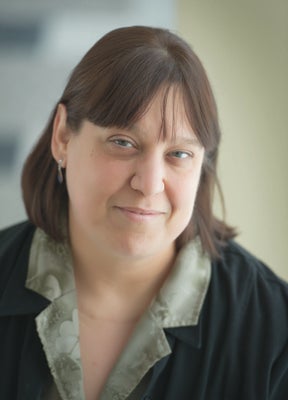
It is with great sadness that we acknowledge the passing of Kostadinka Bizheva, Professor in the Department of Physics and Astronomy, affectionately known as Dida to her colleagues and friends.
Dida was passionate about her research into biomedical optics and designing optical imaging technology. She initiated the field of optoretinography, a non-invasive method of measuring physiological and metabolic changes in the photoreceptors of the retina. She joined the Department of Physics and Astronomy in July 2004 and established her Biomedical Optics Research Group, which is world-renowned for its development of novel imaging technology for use in clinics. Dida was cross-appointed to the School of Optometry and Vision Science and to the Electrical and Computer Engineering Department in the Faculty of Engineering. She was also the Graduate Officer for her home department of Physics and Astronomy.
Recently, Dida was named a 2025 Optica Fellow, acknowledging her lifetime of achievement in optics and imaging. Teaching and mentoring were important to Dida, and she looked forward to how this appointment would help her shape the trajectory of students entering the field of biomedical optics.
Dida is remembered for her passionate approach to her research and her warmth in connecting with collaborators and students alike. Read more from her colleagues and friends.
Please reach out if you’d like to share your memories of Dida on this page.
I always enjoyed discussions of research ideas with Dida, primarily because of her positivity and enthusiasm. She was the chief cheerleader for her graduate students and always wanted to see them succeed.
During COVID, my husband and I often encountered Dida on our walks, and Dida recently mentioned that she missed that. It meant that we got to know her a little better: her volunteer work with Big Sisters, the seriousness with which she approached waste reduction in the fight against climate change, and the enjoyment she got from teaching a large first year class “Physics for Engineers.” I feel both profound shock and loss.
Melanie Campbell, Professor Emeritus, Physics and Astronomy, University of Waterloo
Dida was so full of ideas, optimism and enthusiasm. I am sad that we have lost her. She had so much life in her and so much left to contribute.
Elizabeth Irving, Professor Emeritus, Optometry and Vision Science, University of Waterloo
Dida was a kind-hearted and generous colleague and mentor who always carried a positive outlook on life. She welcomed me with open arms when I first joined the Department, sharing her experience and guidance in teaching. Over the years, we connected through many conversations and meetings, where her warmth and humour always shone through. She loved food, travelling, and gardening – often sharing stories and photos of her adventures. A devoted Star Trek fan, she always found ways to weave sci-fi jokes and references into our conversations, bringing laughter to even the busiest days.
Professionally, Dida was highly respected for her groundbreaking work in optical imaging, but it was her empathy and kindness that left a deep impression on countless students and colleagues. She will be remembered not only for her accomplishments, but for the warmth, generosity, and genuine connections she fostered with those around her.
Brenda Lee, Associate Professor, Physics and Astronomy, University of Waterloo
Dr. Kostadinka (Dida) Bizheva's passing is a tremendous loss to the Canadian and international biophotonics community, to her many friends and colleagues, to her students, and to her family. To mourn her passing, celebrate her life, and cherish her memories, here are some personal recollections of the wonderful individual that Dida was.
In a word, Dida was a delight! It was indeed a pleasure to interact with her as a colleague , fellow researcher, and friend. She was positive and creative, dependable and altruistic, and overall a kind of person you just wanted on your team. She was a responsible (and responsive!) research scientist, always willing to contribute to a joint grant proposal, organize or chair a session at a conference, serve on a research panel, help edit a scientific journal, offer constructive feedback to a colleague, support a new research initiative and so forth. She brought tremendous scientific acumen, positivity and "can do" attitude to these many interactions. She was also devoted to her many students and trainees, mentoring the next generation of scientists by spending countless hours in the lab and in the classroom with enthusiasm, dedication, and good cheer.
So, while we mourn the untimely passing of our valued friend and colleague, let these few selected vignettes serve towards the deserved celebration of her rich life, and also guide each of us in our own personal quests to do better. Life is short and unpredictable and precious, so carpe diem! RIP, dear Dida!
Alex Vitkin, Medical Biophysics and Radiation Oncology, University of Toronto
It is with great sadness that I learned the news of the sudden passing of Prof. Kostadinka “Dida” Bizheva. Dida was a brilliant scientist at the forefront of ophthalmic research, whose work and vision advanced the field of biomedical optics in profound ways. She combined a rigorous, uncompromising approach to science with a warmth and passion for teaching that inspired many students and colleagues.
Beyond her outstanding academic contributions, Dida was a true community-builder. She founded and sustained the not-so-secret “Canadian scientist club,” a cherished tradition that brought us together every year at one of our major conferences. What began as an informal gathering became a space of collegiality, laughter, and support, thanks to her passion and generosity.
For many of us, Dida was not only a respected colleague but also a dear friend. I will miss our conversations tremendously—her sharp insights, her encouragement, and her ability to bring perspective and humour even in the most intense scientific debates.
Caroline Boudoux, Professor, Engineering physics, Polytechnique Montréal
Dida was my PhD advisor. I first met her in 2016, when I had just begun my PhD journey and was starting a new life in a foreign country. From the very beginning, she was so much more than an advisor to me; she was a kind, caring, and welcoming friend. She opened the doors of her lab with warmth, patiently taught me OCT, and introduced me to the field of ophthalmic imaging, laying the foundation for my current career. Beyond science, she was an amazing storyteller, always sharing fun and lively stories that filled the lab with joy. She was a gifted chef, able to create magic from the simplest ingredients. Her Christmas parties were the highlight of the cold winter months, bringing us together as international students and making us feel at home even while far from our families.
One of my most cherished memories is traveling with her to San Francisco for the first time to attend SPIE Photonics West in 2018. She introduced me to leading OCT groups in the field, and through those connections, I eventually met my postdoctoral advisor. That trip not only expanded my horizons but also planted the seed of my dream to move to the Bay Area; a dream Dida played an instrumental role in shaping.
As a mentor, Dida was truly remarkable. She treated her students like family, caring deeply not just about our scientific growth but also our happiness and sense of belonging. Whenever she attended Photonics West or ARVO, she always found a reason to bring her students and lab alumni together for dinner, to celebrate milestones, and to create unforgettable memories. She had a rare gift for turning professional gatherings into moments of warmth, laughter, and connection.
The last time I saw her was at ARVO 2025 in Salt Lake City. We shared dinner, walked around the city, and laughed together. I can still picture her vivid smile, hear her voice, and feel the kindness in her words. It is almost impossible to believe that she will not be at Photonics West this year, chairing the ophthalmic imaging session as she always did. Her absence will leave a profound void in the community and in the hearts of those who knew her.
I will truly miss her. Dida touched my life in ways words cannot fully express. Her impact both personal and professional will remain with me forever. May her beautiful soul rest in peace
Zohreh Hosseinaee, Senior Optical Engineer, Digital Health, Kodiak Sciences Inc., California
I worked closely with Dida with her imagining research. Dida was imaginative and excited to accomplish her goals. Her mind raced from one idea to the next so quickly that it was hard to keep up with her. She will be missed by my husband and myself. Rest peacefully Dida.
Kathy Delaney, Office of Research Ethics, University of Waterloo
I am deeply saddened by the passing of Professor Kostadinka Bizheva from the University of Waterloo. I was so lucky to meet her when she visited the Casey Eye Institute in 2023, and I’ve learned so much from her work on functional imaging through ARVO and Photonics West.
What I’ll always remember most is not just her science, but her kindness to people working in science—making everyone feel supported and valued in every piece of effort.
Naixing Huang, PhD candidate, Oregon Health and Science University
I am an alumnus of the Department of Physics at the University of Waterloo, and I was genuinely delighted when I first heard of Dida's appointment. Her expertise and knowledge were not only a tremendous asset to the department but also a natural and inspiring bridge to the field of optometry due to her technical expertise in Optical Coherence Tomography (OCT).
I had the privilege of exchanging research ideas with Dida, and we even began to shape the foundations of potential collaborative work. We served together on peer-review committees (most recently the CIHR), and, on a lighter note, shared conversations about music and physics. Through it all, I was consistently struck by her in-depth expertise in biomedical optics and biophotonics. Her contributions to OCT were truly world-class.
What stood out even more was her warmth, enthusiasm, and genuine care for her students, colleagues and our community. She elevated not just the field of biomedical optics, but the people around her. Her sudden passing is a profound shock and a loss to the Canadian and International biomedical optics community. She will be deeply missed.
Michael C. Kolios, Professor and Associate Dean, Research, Innovation, and External Partnerships, Faculty of Science, Toronto Metropolitan University
I may have spoke to Prof. Kostadinka Bizheva only twice, but I always looked for her and her teams presentations. Their topics where always interesting and the work was consistently done with rigor.
Dida will be missed. We got used to seeing her annually in Photonics West. The small community will never be the same without her.
Muhammad Al-Qaisi, CEO, Aliph Medical
I write this with a heavy heart. My desk is strewn with notes about ideas and questions to discuss with Dida. She was generous in sharing her knowledge and experience in optical engineering, vision science, and life. In a single conversation, Dida could connect you with a fantastic supplier for optical equipment and invite you to join her for a trip to her favourite quiet swimming hole on Lake Huron. Dida’s contagious enthusiasm was inspiring and brought joy to her friends and colleagues.
Dida loved conferences and was passionate about sharing that joy with others. I first got to know Dida in 2005 when we travelled together for a photonics meeting in Munich. Dida was a champion to other researchers by encouraging participation and leadership in a host of international meetings. Sadly, she never had the opportunity to present her invited talk at the conference in Romania.
Already, I greatly miss Dida’s energetic personality and drive to pursue new avenues in ocular imaging. Dida was highly respected in the greater OCT community. She was relentless in the pursuit of new imaging advancements paired with clear goals for their clinical application. The substantial number of collaborators across a vast range of disciplines speaks to the broad vision that Dida had for her science. I am disappointed not to see where her latest ideas would have led.
Jennifer Hunter, Associate Professor, Optometry and Vision Science, University of Waterloo
I have had the tremendous pleasure of being a close collaborator and friend of Dida's for more than 15 years. One thing that I remember is the sheer joy and passion Dida exudes every time we are talking about research. There is always a smile on her face and seeing it always brings me a sense of happiness and calm, regardless of the challenges we face when pushing advances in science in the area of optics and imaging. Dida loves her research and her students dearly, and she is loved by her colleagues and students for the focus, dedication, and tremendous contributions to science through her life's work. She is deeply missed by all of those whose lives she has touched, especially myself.
Alexander Wong, Professor, Systems Design Engineering, University of Waterloo
I have known Kostadinka for more than 20 years and followed her publications and conference participations with interest. She was rigorous and meticulous and always friendly and willing to establish bridges of understanding. She was a fervent supporter of our field, biophotonics. We lost a valuable friend and dedicated colleague while the profession lost a passionate contributor. She will be sorely missed.
Adrian Podoleanu, University of Kent, Canterbury UK
I was the chair of the hiring committee that chose to offer Dida a position in our department. It was the absolute joy Dida exuded when discussing her research that convinced the committee that our department would benefit greatly from Dida’s presence. She maintained this level of excitement about her research and was always ready to have a discussion about her latest results. I enjoyed our many discussions over the years both about optics and her travels, including her wonderful trips home to Bulgaria.
Donna Strickland, Nobel Laureate, Professor, Physics and Astronomy, University of Waterloo
Dida always met me with a deep smile, asked after my family, and we enjoyed many meals together. She cared deeply about developing health diagnostics, particularly for vision. She gladly worked with optics and instrumentation vendors, challenging them to improve their performance, thus improving their usefulness in her development projects.
Photonics West/BIOS was one of her favorite conferences and she was very happy to enable her students to present their work to the biomedical community. She will be sorely missed!
Douglas Malchow, retired from Sensors Unlimited
I met Dida in her first month of joining the Physics Department at UW. We were both bright-eyed, bushy-tailed researchers: she in an academic setting, me in a startup, and we became fast friends and collaborators. Her passion for science, STEM education, especially of women, and medical imaging was infectious. The photonics community of Canada has lost a wonderful champion, while UW has lost a great educator. Many of us lost a brilliant and supportive friend.
I will miss her enthusiastic scientific discourses over sushi.
Olga Pawluczyk, CEO, P&P Optica
It is with gratitude and appreciation of friendship that I comment on the wonderful woman Dida was both in her professional and personal life. Over the years, we have celebrated milestones and successes together, mourned the loss of friends and family, and empowered each other through our walks, talks and accomplishments. How one passionate lady made time for so many while making huge strides in science and research is truly unfathomable; so, you can imagine how honoured I was to be asked if I would support her choice to join the Big Sister Program years ago. She was an inspiration in this busy world, and she saw no limits to what she could contribute to it. I'll miss you Dida.
Ann Girling, MOAD, Clinic Operations Manager, Waterloo Eye Institute, University of Waterloo
I have been familiar with Dida’s work for many years as a member of the university’s Clinical Research Ethics Board. Last year, I saw Dida at a research event hosted by the Centre for Bioengineering and Biotechnology. My teenage daughter was tagging along and had started learning about the physics of eyes in school. She noticed Dida’s poster, so I introduced them. Dida immediately lit up, pulled up a chair and the two of them spent the next 20 minutes talking about the different ways we use physics to understand vision. Before that day, I was quite familiar with Dida’s research and was impressed with her intelligence, commitment and work ethic. That day, though, I really understood Dida's enthusiasm and love of physics. She was a true force, and I have no doubt she inspired many young people to be passionate about physics too. Her passing is a great loss to our community.
Kelly Grindrod, Associate Professor, Associate Director, Clinical Education, School of Pharmacy and Vision Science, University of Waterloo
Dida’s passing is a great loss to the OCT community. She made important contributions to ultrahigh-resolution OCT, OCT microscopy, and optoretinography. She was always generous in sharing her knowledge at conferences. I will miss her.
David Huang, Professor and Director of Research, Casey Eye Institute, Oregon Health and Science University
I am deeply saddened by the sudden passing of my PhD supervisor, Dida. She was my mentor in biomedical optical imaging and the one who first guided me into this field. When I joined her group in 2017, she gave me patient and detailed guidance, teaching me how to design and build bio-optical imaging systems from the ground up. Dida was a genuine and simple person, whose life revolved around research, teaching, community, and music. Her passion for biomedical imaging was boundless and truly inspiring.
I will always remember her happiness and pride the first time we imaged a motion-free cornea and limbus in vivo with our line-scan OCT prototype. Even during COVID, when we had to shift from clinical applications to system optimization, she never lost her drive and continued pushing the limits of LSOCT.
In 2019, at SPIE and ARVO, she warmly introduced me to her collaborators and even acted as a tour guide, filling the trip with joy. Dida rarely took photos, but I will forever treasure our only picture together at Vancouver’s Capilano Suspension Bridge.
Her vision, kindness, and enthusiasm will remain with me always.
Le Han, Research Fellow, Singapore eye research institute, Singapore
Dida was a wonderful colleague. I was Chair when she was hired, delighted with how her career developed, and so saddened by her sudden departure.
I knew her best from working with her on teaching first year physics. We never taught a course together, but we often discussed best practices, teaching ideas, policy, etc. She hosted me, my wife Nancy, and several other colleagues from our department at a number of dinners that were always a delight to go to. Discussions lasted until late in the evening and were enjoyed by all.
Dida had a way of expressing opinion without alienating people, of being forthright in her ideas whilst being able to listen to others. She has been taken much too soon from us all. We miss her so much.
Robert Mann, University Professor Emeritus, Physics and Astronomy, University of Waterloo
I am deeply saddened to learn of Dida’s passing. We have lost another good one.
I first met and worked with Dida when I was the CTE Liaison for Science many years ago. Her passion for her discipline and teaching and care for her students was boundless. It was always a great joy to drop by her office and chat. Even after I moved to another position and no longer worked directly with Science, Dida continued to connect and always welcomed me with a big hug when I ran into her.
I was lucky to be included in some of her dinners with Physics colleagues. These were always wonderful evenings with great food and conversation. During the pandemic she even hosted a couple of these dinner parties online and while not quite the same brought people together for conversation and laughter in a challenging and isolating time.
Dida’s kindness and love of people and life will be greatly missed.
Mary Power, Senior Educational Developer, Faculty Programs and Blended Learning, Centre for Teaching Excellence, University of Waterloo
One of Dida’s gifts, apart from her prolific research, was empathy. Dida served as Graduate Officer while I served as Chair. Every term, a student or two would have an emotional crisis of one sort or another. As faculty, we aren’t trained to deal with such things. But Dida had the empathy and patience to help students sort through their issues and land them safely and productively back into the program. Dida loved chamber music and kept me abreast of concerts and events. She was perennially upbeat and eager to share the excitement of the grant she was writing at the time. She had so much in front of her. I’m at a loss.
Brian McNamara, Professor and former Chair, Physics and Astronomy, University of Waterloo
When I started at Waterloo, the very first colleague I reached out to was Dida. She welcomed me with such warmth and generosity, and from the very beginning she was incredibly helpful. Over the years, we had the chance to work together on different occasions and events, and I was always struck by how wonderful she was to collaborate with. Losing her is not only a personal loss for me but also a great loss for our entire Waterloo community. Rest in peace, Dida.
Parsin Haji Reza, Associate Professor, Systems Design Engineering, University of Waterloo
Dida had a brilliant mind and was a trailblazer in biomedical optics. She was highly respected and known for her collaborative work ethic. Waterloo Science and the scientific community as a whole has lost a brilliant mind.
Chris Houser, Dean, Faculty of Science, University of Waterloo
Dida was the very first Postdoc in my lab (2001 to 2005), joining us after her time in Professor Boas’ lab in Boston and before moving on to Waterloo. Hearing of her passing was truly devastating for me – I was still in email contact with her as recently as August 28.
She was deeply passionate about her work and her students, an excellent teacher who genuinely cared about their growth and progress. As a scientist, she was meticulous and dedicated, always preparing her conference presentations and publications with the utmost care. She often confided that she wished she could spend more time with her parents and sister and live closer to her home country, though at that time (more than 20 years ago) pursuing a comparable academic career there was not possible.
Beyond her professional qualities, Dida was exceptionally kind and warm-hearted. She enjoyed spending time with my wife and my three children back then and radiated positivity in all her interactions. She will be profoundly missed – not only within the scientific community but also in my professional and personal life.
Wolfgang Drexler, Professor, Medical University of Vienna, Austria
Dida was an outstanding scientist and an inspiring collaborator. She played an important role in the recent renewal of funding for the Centre for Eye and Vision Research in Hong Kong and will be deeply missed by our research team.
Ben Thompson, Professor, School of Optometry and Vision Science, University of Waterloo
Dida was in the group of my first three students the first year I started as a Research Assistant Professor at Tufts University in 1996, along with Xuefeng Cheng and Andy Siegel. She led the work for my first independent projects from my own PhD advisor and brought us into the world of optical coherence tomography (OCT).
I recall she refused to be the first author on her first paper, saying that I had led the project, wrote the paper, and she just collected data that I told her to collect. But in fact, she did more than enough to be the lead author. She quickly followed that up with her second paper. She made many of her own intellectual contributions to this work and I fondly recall our many, many discussions of how to interpret all the data she was collecting and then organizing into this paper. This was a really fun project because we exploited the highly sensitive pathlength resolution of low-coherence interferometry (the backbone of optical coherence tomography) to characterize the transition from single scattering to diffusive scattering within highly scattering tissue, and then apply that to better understand the limits of depth penetration in optical microscopy methods like confocal, two photon microscopy and optical coherence microscopy.
Following her PhD defense in 2001, she took a post-doc with Wolfgang Drexler in Vienna. I still remember long conversations with her as she advanced functional imaging with OCT with Wolfgang, which led to their exciting PNAS paper in 2006 “Optophysiology: Depth-resolve probing of retinal physiology with functional ultrahigh-resolution OCT.”
Our paths only crossed a few times after that as the biomedical optics field became much larger and we were going to different conferences. But it was always a pleasure when we did see each other at a conference and we would catch up. She was taken too soon.
David Boas, Professor, College of Engineering, Boston University
It is with great sadness that I learned of the passing of Professor Bizheva (Dida). During my five years at the University of Waterloo, I had the privilege of spending twelve months in her laboratory as part of my co-op terms. Those experiences became some of the most formative chapters in my biomedical career.
Dida first introduced me to the field of Optical Coherence Tomography (OCT), and through her guidance, I was able to attend Photonics West in San Jose in 2009—an extraordinary opportunity that opened my eyes to the scale and energy of the international scientific community. In my fourth year, under her supervision, I undertook a research project on Corneal OCT Imaging at 800nm. That project earned the highest grade of my undergraduate studies, a reflection not only of my own efforts but of her constant encouragement and mentorship. She even urged me to pursue graduate studies with her, a path I ultimately did not take as I began my career at the BC Cancer Research Center in Vancouver. Yet, the skills and confidence I built in her lab shaped my trajectory in ways I could not have imagined—leading me from Vancouver to the Wellman Center at MGH in Boston, and ultimately to my current work in the healthcare data field in Korea. Without Dida, I simply would not be where I am today.
My fondest memories of her go beyond science. I often brought her lunch from the campus cafeteria—her favorite was a simple eggplant dish from the Chinese counter. Her enthusiasm for science was infectious, and I sometimes wonder if my own enthusiastic nature traces back to her influence. She brought me along to dinners with industry sales engineers and collaborators, where I witnessed how science and business intersect. One Christmas, she even welcomed me into her home to share dinner with her family from Bulgaria. These moments revealed not only the brilliance of a scientist, but also the generosity and warmth of a teacher.
Dida gave me countless opportunities but never burdened me with undue pressure. She opened doors, trusted me to step through them, and let me grow at my own pace. For this, I will remain deeply grateful.
I mourn her loss, but I also celebrate her legacy. She was a true mentor, a kind guide, and an inspiring scientist. I will carry forward her enthusiasm, generosity, and dedication as part of what she instilled in me. May she rest in peace.
Daryl Chulho Hyun, University of Waterloo alumnus
I was always impressed by Dida’s engaging discussions at SPIE BIOS, and over the past few years, we became good friends through our shared interests in blood flow measurements. She was always generous in sharing her recent work and progress, often joking about how fresh the results were in her presentations. When my student reached out to her directly for advice on the same interferometer model, she shared her experience openly and without reservation. She will be deeply missed by me and my team.
Yali Jia, PhD, Jennie P. Weeks Professor of Ophthalmology, Professor of Biomedical Engineering, Casey Eye Institute, Oregon Health and Science University
I first met Dida in 2009 when she was a collaborator of my PhD supervisor, Dr. Vitkin. I visited her lab at Waterloo in 2009 where she mentored me for a week and taught me how to build an OCT system. During that week, Dida and I would start early every morning and work throughout the day to build part of the system that I ended up using for clinical imaging during my PhD. Dida shared her knowledge generously and answered my questions patiently. She continued to be a strong collaborator and scientific resource throughout my PhD and a co-author on all my publications.
I was always amazed by Dida's genuine enthusiasm for research, and her collaborative spirit. Her excitement for scientific discoveries was contagious. I will always remember her as a great scientist and teacher, and know that she will continue to have a strong presence in the Biophotonics community through her published scientific contributions and the scientists/engineers she has mentored.
Bahar Davoudi, Senior Clinical Scientist, Kelly Sciences/ Johnson & Johnson Vision
Dida wasn’t just a mentor or my supervisor — she was our research mom. I’d been working with her for over five years, and there’s so much I want to say, so many stories to share, but not enough words or strength to do so.
Her generosity didn’t need an introduction — we all felt it every single day. I can’t remember a single time I mentioned that I wasn’t feeling well and she didn’t offer to help in some way. She’d happily drive to my place to drop off herbal tea, offer rides to the clinic, or find any little way she could to make things easier. She was always ready to help.
I saw her just the day before — cheerful as always — dropping off extra produce so it wouldn’t go to waste, making plans for future work and group dinners. One of our papers had just come out that morning, and she promised we’d celebrate it in the coming weeks. Alas, we never got that chance.
She was notorious for never taking pictures, but at ARVO this year, I finally convinced her to take a group photo at our next dinner. I wish we’d had the chance to do that — and so much more.
I still can’t believe she’ll never walk into the lab again and fill it with her laughter and positive energy.
We’ll carry her with us wherever we go. I just hope we make her proud.
Khushmeet Dhaliwal, Postdoctoral researcher, Department of Physics and Astronomy, University of Waterloo