News

Filter by:

Limit to news where the title matches:
Limit to items where the date of the news item:
Date range
Limit to news items where the audience is one or more of:

FCI member and public health scientist Dr. Plinio Morita was featured in a CTV News story highlighting how climate risks are increasingly showing up inside our homes, and what researchers are doing about it.

Alongside PhD student Irfhana Z and the Ubiquitous Health Technology Lab at the University of Waterloo, Dr. Morita is developing a indoor heat warning system. Using smart thermostats and machine learning, the team is mapping regions most at risk across North America and creating dashboards to alert people before residents face life-threatening temperatures.

Their findings? When homes exceed 26°C for prolonged periods, especially without cooling infrastructure, the health effects can be severe, especially for older adults. Many public health systems still rely on outdoor temperature thresholds, missing the critical indoor picture.

By bringing together smart technology, public health insight and data-driven design, this project is helping communities stay safe as extreme heat events become more common. It also calls attention to urgent policy gaps, and opportunities for smarter resilience planning.

Read and watch the full story in CTV News: https://lnkd.in/gZeQWH_h

FCI member and transportation expert Dr. Jeff Casello joined CBC’s Cross Country Checkup with Ian Hanomansing to weigh in on one of Canada’s most spirited civic debates: the future of bike infrastructure.  
 
With decades of expertise in urban mobility and transportation planning, Jeff offered clarity, data, and thoughtful perspective to the national conversation, highlighting how the way we design our streets shapes who has access to safety, opportunity, and connection in our cities. 

Link to the full segment on CBC Listen: https://www.cbc.ca/listen/live-radio/1-13-cross-country-checkup/clip/16160356-when-comes-bike-lanes-streets-many-few  

In a recent Globe and Mail opinion piece, FCI member Dr. Jeff Casello, professor of planning and engineering at the University of Waterloo, offers a clear-eyed assessment of the growing fiscal crisis facing Ontario’s postsecondary institutions. With deficits running between 10–20% and core revenues falling 25% over the last decade, Casello warns: “There is a real chance of a university, or universities, in the province failing.”  

This isn’t just a budget issue, it’s a challenge to the very foundation of public education and innovation in Ontario. Universities are key to building the housing, infrastructure, and data systems our future depends on. At FCI, we support Jeff’s call for bold, system-wide reforms that safeguard both access to education and the province’s long-term prosperity. 

Read more: https://www.theglobeandmail.com/opinion/article-fiscal-crisis-university-education-ontario/ 

Four Future Cities Institute members have received national research funding through the Natural Sciences and Engineering Research Council of Canada (NSERC), SSHRC-CRSH, and the New Frontiers in Research Fund. These grants are part of the Government of Canada’s $1.3B investment in advancing research across the country.  

Congratulations to Rodrigo Costa, Warren Dodd, Jennifer Dean, and Fatma Gzara. Their funded projects explore critical urban challenges, including disaster recovery, heat resilience, regional immigration, and operational logistics, through interdisciplinary collaboration and community-engaged design.  

From Ideas to Impact: Students Help Build the Future of Housing  

Students from the Pearl Sullivan Engineering IDEAs Clinic and the Sustainability and Social Entrepreneurship Fellowship recently stepped out of the classroom and into action at the Habitat for Humanity Waterloo Region ReStore. Together, they assembled cabinets destined for future homes and mapped out full-scale floor plans for upcoming BUILD NOW: Waterloo Region housing units, gaining tangible insight into the complexities of designing affordable, livable spaces. 

The Future Cities Institute has joined forces with BUILD NOW, a $500-million initiative led by Habitat for Humanity Waterloo Region, to help deliver 10,000 new “missing middle” homes by 2030 across the Region of Waterloo. With 70% of these homes set aside for ownership and protected by a legal model that ensures lasting affordability, this is one of Canada’s most ambitious attainable housing efforts to date. 

At the heart of the project is a 25-acre living lab near RIM Park, where FCI researchers will examine how housing design and neighbourhood planning shape lives. Over 40 researchers from all 6 faculties at the University of Waterloo are already involved, bringing expertise in housing futures, urban health, and community resilience. 
 
With home prices in Canada up 77% over the past decade, and most solutions focused on rentals, homeownership is slipping out of reach, especially for younger generations. FCI is working to track what works, share evidence, and help co-create a scalable model for communities nationwide.

What started as an interdisciplinary i-Capstone collaboration has grown into a transformative partnership between the City of Iqaluit and the Future Cities Institute. Faced with complex infrastructure challenges in a harsh Artic environment, the city turned to Waterloo co-op students to bring fresh thinking and technical expertise to the table, and the results have been impactful.  

Engineering student Ahraz Yousuf spent a co-op term in Iqaluit, modernizing the city’s fleet management system. From implementing Fleetio software to building custom tools and leading multi-department training, Yousuf’s work has helped streamline operations and improve service delivery in the North. “I got to build something from the ground up,” he shared. “It allowed me to step outside of the traditional software development and into stakeholder collaboration.” 

This partnership continues to create opportunities for students to apply their skills in meaningful, community-driven projects, advancing real innovation in Canada’s northern cities. 

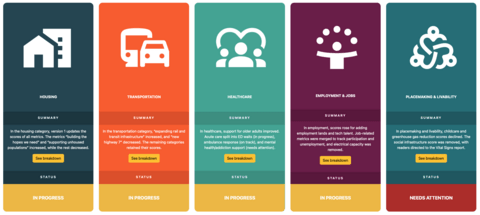
As Waterloo Region prepares to welcome one million residents by 2050, the Future Cities Institute has partnered with the Business and Economic Support Team of Waterloo Region (BestWR) to launch the Vision 1 million Scorecard, a first-of-its-kind academic–business collaboration. 
 
This public, data-driven tool tracks the region’s progress across five key areas: housing, transportation, healthcare, employment, and livability. Updated every six months, the scorecard highlights where the region is succeeding and where more focus is needed, helping guide investments and drive meaningful conversations across the region. 

As the academic partner, FCI is grounding the scorecard in data, equity, and long-term impact. With many regions facing similar growth challenges, this model has real potential to scale nationwide, and FCI is proud to help lead the way.

Sehaj Raj Singh joined the Future City Innovation Challenge, co-hosted by the FCI and Velocity, with a bold idea: make Canada’s permitting process smarter. He walked away with the top prize, new interdisciplinary teammates, and the attention of judge Frank Cairo, founder of the Future Cities Institute and a leader at CAIVAN.  

Now graduating, Sehaj is stepping into a new role as an Analyst in Land Development Engineering at Caivan Communities. Reflecting on the experience, he shared, “The Velocity Future City Innovation Challenge was hands down one of the most fulfilling moments of my undergrad... From being in the crowd to being on stage, I’m just glad I bet on myself.” A powerful example of how ambition, collaboration, and real-world challenges can shape the future.

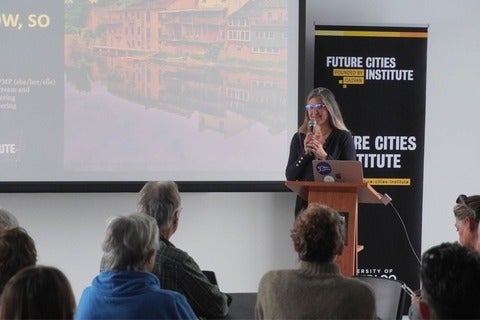
At a recent event co-hosted by the University of Waterloo and TD Wealth, members of the Waterloo community gathered for a powerful conversation on Shaping Cities of the Future: Women, Leadership & Philanthropy.  

Moderated by Leia Minaker, our Director at the Future Cities Institute, the discussion highlighted the vital role women play in financial leadership and philanthropy. Leia guided a rich conversation that emphasized the value of trust-based giving, the power of intentional investment, and the many forms philanthropy can take, whether it be time, ideas, or financial support.