News

Filter by:

Limit to news where the title matches:
Limit to items where the date of the news item:
Date range
Limit to news items where the audience is one or more of:

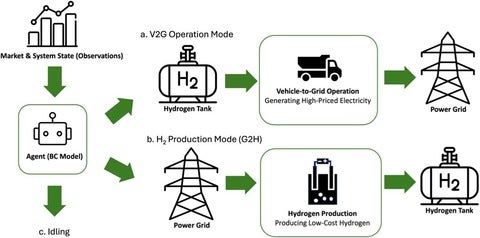
In a recent paper, we developed a supervised learning AI agent to support real-time decision-making for a fuel cell electric vehicle-to-grid (FCEV2G) station, specifically, whether to connect to the grid, produce hydrogen, or remain idle. The agent enabled the station to operate more effectively and capture most profit-making opportunities. While there is still significant room for improvement, this project is an interesting and promising first step for my group.

Congratulations to Arda Mert Çetin!

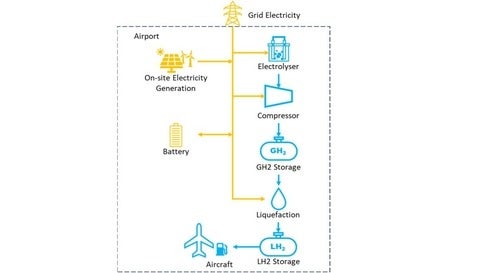
In our recent paper, we built a model to study renewable hydrogen infrastructure at airports, and analyzed how the infrastructure planning and its costs will depend on various options (e.g., grid connectivity, renewable energy sources, sub-system costs and efficiency). This helps us to identify scenarios where renewable hydrogen can be economically competitive with jet fuels. 

Congratulations to Zhen!

A recent work from our group studies rapid heating strategies for the cold-start of Li-ion batteries under subzero temperatures. The paper is titled "Thermal System Simulation of Heating Strategies for 21700 Lithium-Ion Battery Modules Under Cold-Start Conditions" and is available in Batteries with open-access. 

Congratulations, Grace and Hanieh!

Friday, June 13, 2025

Spring convocation

Greener production group celebrates our graduates, family, and friends in the Spring convocation.

Fuel cell electric vehicles can work as distributed generators to produce electricity during peak demand hours, a.k.a. fuel cell electric vehicle to grid (FCEV2G). In our recent paper, we found that FCEV2G is currently suitable in a volatile and carbon-intense electrical grid, as it can generate profits while reducing carbon emissions. But in a stable and clean grid, technical improvements, e.g., higher fuel cell efficiency and lower clean hydrogen costs, are needed to make FCEV2G economic viable. You can read the paper for more information.

We are happy to share Carlo's new paper "Cost benefit analysis of grid-based electrolytic ammonia production across Canadian provinces," which is published in the International Journal of Hydrogen Energy. In this paper, we compare the costs and benefits of three ammonia production pathways: electrolytic ammonia production, and methane-based ammonia production with and without carbon capture. Social costs of carbon were considered in our analyses, and we concluded that blue ammonia is very cost-effective in reducing carbon emissions, while electrolytic ammonia production is competitive only when low-cost and low-carbon electricity is readily available.