Abstract
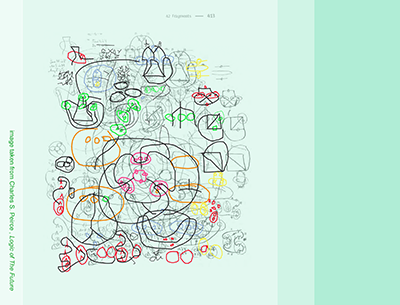
Charles Peirce developed the Existential Graphs in the 1890s as a graphical calculus for the logic of relations. Though it offered a number of advantages over algebraic syntax, the graphical calculus failed to attract many adherents and has since remained largely outside contemporary logic. My recent work has provided a new categorical foundation for Peirce’s graphical syntax and inference rules, and has inspired the Neo-Peircean Calculus of Relations as a compositional presentation of first-order logic. The Existential Graphs are now recognized as a precursor to the string diagrams used in category theory. Just as significant, Peirce is now also recognized for his early contributions to linear logic. In this talk I will discuss this recent work and the dramatic new perspective it suggests for Peirce’s graphs.
Location
In person:
Hagey Hall, room 373
Remote:
Zoom link
Bio
Nathan is a philosopher working on methods of reasoning in logic and science. Much of his work is inspired by Charles S. Peirce, including Peirce’s pragmatism and Peirce’s formal developments in diagrammatic logic.