Background
Amphiphilic compounds possess both hydrophilic (water-loving, polar) and lipophilic (fat-loving) properties which enables them to self-assemble into supramolecular vesicles (e.g. liposomes) that can be used to encapsulate and deliver “payload” compounds, such as drugs. As amphiphilic molecules are surface active, they only assemble above a relatively higher concentration (critical micelle concentration, CMC) which results in aggregates that have low colloidal stability, non-uniform particle size and low quantitative encapsulation efficiency (ie. low “payload” concentration) resulting in high production costs. It is thus extremely challenging to quantitatively encapsulate hydrophilic molecules using the current encapsulation techniques. Using non-surface active hydrophobic building blocks could resolve these problems, however finding the right combination of chemistry for this has been elusive so far.
Description of the invention
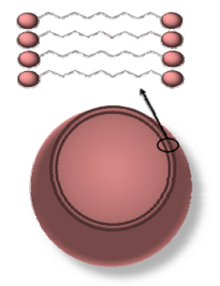
Waterloo researchers have developed metal carbonyl (MC) based hydrophobic compounds that utilize various metals, molecular weights, and organic ligands that are able to self-assemble in water via hydration of carbonyl groups into metal carbonyl vesicles, (MCsomes). These MCsomes form at very low concentrations without any limiting CMC barrier while maintaining good colloidal quantitative encapsulation efficiency properties. The vesicles with polarized CO groups are able to absorb a range of molecules, including ionic and other molecules with hydrogen donors. The capsules also show aggregation driven self-enhanced IR absorption for carbonyl groups and can be designed with photoluminescence.
Advantages
MCsomes have extremely high encapsulation efficiency (80-100%) of hydrophilic targets which no other competitive technique is capable of achieving. This higher encapsulation efficiency also enables lower cost production by lowering the number of processing steps and reducing wastage of expensive payload compounds (eg. drugs). Also MCsomes exhibited enhanced IR absorption for CO groups at 2000-1800 cm-1, a transparent window for biological species. MCsomes can also be designed to be photoluminescence with intensity sensitive to external stimuli, e.g. temperature, H2O2, heavy metal, etc. These vesicles are non-toxic to cells, degradable, uniform in size and can be further modified depending on application requirements.
Potential applications
MCsomes will be useful for IR based metal-carbonyl bioassays, multifunctional particles for advanced sensing applications, and for encapsulation and delivery of target compounds such as drugs, fragrance and sensitive molecules, enzymes, proteins, DNA and RNA fragments. They can be used as surfactants as well.
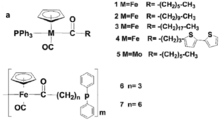
Examples of hydrophobic metal-acyl molecules with organic ligands that can self-assemble in water
Reference
8810-7408
Inventor(s)
Xiaosong Wang
Kai Cao
Nimer Murshid
Patent status
U.S. Patent application # 62/231,157
Stage of development
Prototype & ongoing R&D