News

Filter by:

Limit to news where the title matches:
Limit to items where the date of the news item:
Date range
Limit to news items tagged with one or more of:
Limit to news items where the audience is one or more of:

A team of undergraduate students from the Department of Electrical and Computer Engineering (ECE) has been named a Top 3 Finalist in the prestigious IEEE EMC+SIPI Student Hardware Design Contest, earning international recognition for their innovative work in electromagnetic compatibility (EMC) engineering.

Competing under the name Team Watt-erloo, students Jake Peters, Alanna Rudolph, Amirbahador Mansoori, and Dhyey Bhatt advanced to the final round of the competition and will present their project at the IEEE International Symposium on Electromagnetic Compatibility, Signal & Power Integrity (EMC+SIPI) in Dallas, Texas.

Supervised by ECE adjunct professor, Dr. George Shaker, the team developed a project that characterizes the electromagnetic interference (EMI) generated by an Arduino-based robotic vehicle and validates targeted mitigation techniques to improve system performance and reliability.
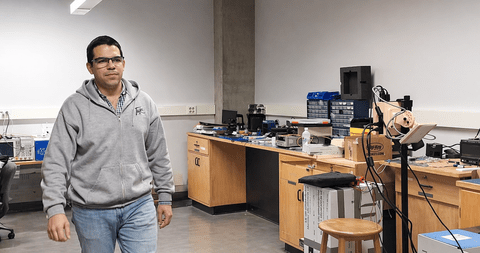
As graduation approaches this June, Computer Engineering student Aung Khant Min is being recognized with two distinguished honours: the University of Waterloo President's Award of Excellence and the Ontario Professional Engineers Foundation for Education (OPEFE) Gold Medal.

Min achieved the highest cumulative academic average (CAV) among Engineering students graduating this June. In recognition of this achievement, Min will receive the President's Award of Excellence, one of the University's highest student honours, as well as the OPEFE Gold Medal.

A team of researchers from the Wireless Sensors and Devices Lab (WSDL) in the Department of Electrical and Computer Engineering at the University of Waterloo has been named a Top 10 Finalist in the 2026 IEEE Antennas and Propagation Society Industry Paper Competition for their paper, “A Digital Twin Baseline for Hybrid Quantum Machine Learning (QML) in WiFi Sensing.”

Led by Dr. George Shaker, adjunct professor in ECE, and Director of the Wireless Sensors and Devices Lab (WSDL), the research team includes lead author and PhD student Sebastian Ratto Valderrama, postdoctoral researcher Ahmed Sayed, and ECE alum Abdelrahman Elbadrawy, working in collaboration with industry partners Synopsys and EigenQ. Sebastian is co-supervised by ECE professor, Dr. Omar Ramahi, who is also a co-author on the paper.

The Department of Electrical and Computer Engineering (ECE) at the University of Waterloo proudly congratulates graduating student Cait Aitchison on being named a recipient of the 2025 IEEE Power & Energy Society (PES) Scholarship Plus Initiative. Awarded to outstanding students pursuing careers in the power and energy sector, the scholarship recognizes academic excellence, leadership potential, and a demonstrated commitment to advancing the future of sustainable electricity systems.

Electrical and computer engineering PhD student Ahmed Metwally Hegazy, under the supervision of Dr. Raafat Mansour, has been named a recipient of the 2026 IEEE MTT-S Graduate Fellowship by the IEEE Microwave Theory and Technology Society (MTT-S). This international fellowship recognizes outstanding PhD research contributions in RF and microwave engineering. Fellowship recipients are selected annually, with only 12–15 students chosen from around the world (≈20% success rate). Ahmed is the first University of Waterloo student to receive this fellowship since 2012.

Ever wondered what music might look like in motion? Electrical and computer engineering professor Dr. Gennaro Notomista and his team at the University of Waterloo are using swarms of robots to turn sound into stunning paintings of light. By translating musical features like tempo and chords into movement and illumination, the robots create live, interactive works of art that blend technology, creativity, and human input.

This exciting work highlights how robotics, art, and music can come together in unexpected ways.

PhD student Ahmed Shaban Omar and Dr. Ramadan El-Shatshat of the University of Waterloo’s Department of Electrical and Computer Engineering (ECE) have received the Best Paper Award at the IEEE Electrical Power and Energy Conference (EPEC) 2025. The award recognizes their innovative research on intelligent energy management for microgrids.

The theme of EPEC 2025 focused on the decarbonization of energy systems, highlighting the importance of smart energy technologies in the transition to a more sustainable electricity grid.

Each year, the University of Waterloo’s Electrical and Computer Engineering (ECE) Capstone Design program turns the bold ideas of its final-year students into innovations that shape the future. This highly anticipated event is more than just an academic milestone—it's a launchpad for cutting-edge technology, where creativity meets real-world problem-solving. From next-generation hardware to AI-powered solutions, Capstone projects push the boundaries of what’s possible, showcasing the ingenuity, technical skill, and entrepreneurial spirit that define Waterloo engineers.

Congratulations to the authors of a collaborative research paper, including electrical and computer engineering adjunct associate professor Dr. George Shaker, for receiving a Best Paper Award (second place) in the General Paper Category at the prestigious 2024 IEEE Microwaves, Antennas, and Propagation Conference (MAPCON).

The paper, titled “Radar-Based In-Home Monitoring System for Supporting Aging and Wellness,” presents innovative advancements in the use of radar technology to enable in-home health monitoring, addressing critical challenges faced by aging populations.

On November 28th, the Department of Electrical and Computer Engineering (ECE) at the University of Waterloo unveiled the future of software engineering with its second Project Showcase for the graduate course Engineering Self-Adaptive Software Systems (ESASS). Led by Dr. Ladan Tahvildari, this innovative course, with support from IBM, integrates cutting-edge industry technologies with research-driven, hands-on learning to tackle real-world challenges in software adaptability.