The original story was written by Sam Charles and posted on the Waterloo News site.
Two of the four Indigenous students at the University of Waterloo who are the recipients of Social Sciences and Humanities Research Council (SSHRC) awards are conducting their research in SERS. The research brings together Traditional Knowledge and western science.
“We are pleased to celebrate these exceptional students who are each playing an important role in incorporating Traditional cultural practices into their work at Waterloo,” says Dr. John Lewis, director of Indigenous Faculty Relations. “Their contributions to academia, our campus community and broader communities represent another step in our reconciliation journey.”
The two SERS students with SSHRC funding are Tara Ryan and Kian Drew.
Tara Ryan (BES '25, MES in progress)
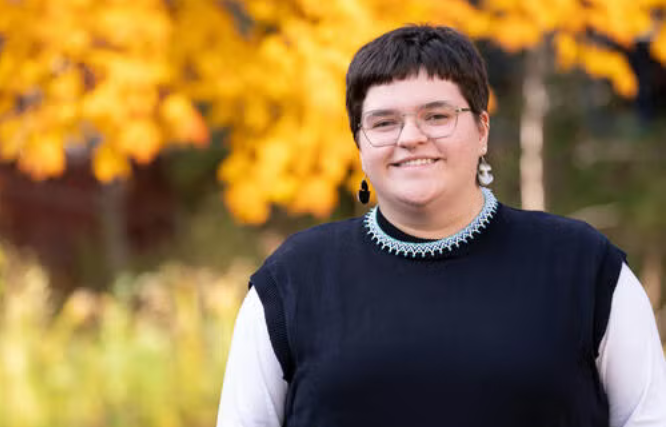
Tara Ryan’s research explores place-based relationships and shifting behaviours of Inuit attitudes and berry-picking practices in Labrador. It highlights climate-change related threats to bakeapples and traditional customs.
Bakeapples, also known as appet and cloudberries, grow in bogs across Newfoundland and Labrador and eastern Quebec. Picking of the berries and the berries themselves play important cultural role in Inuit communities.
Through integrating Inuit knowledge and perceptions of change into the research, the findings are intended to augment the understanding of how traditional resources may evolve due to climate change and how resource anxiety impacts the Inuit of Labrador.
Kian Drew (BSc ’22, MSc ‘25, PhD in progress)

Working alongside Miawpukek First Nation, Kian Drew is investigating the Little River Estuary on the south coast of Newfoundland.
The project takes a Two-Eyed Seeing approach that brings together Indigenous and western ways of knowing. By analyzing sediment cores collected from culturally significant areas and connecting them to Mi’kmaw Traditional Knowledge, the research will reconstruct historical changes in water levels, vegetation and disturbance events such as storms, flooding and traditional burning.
The findings aim to inform conservation strategies and community-focused planning for at-risk ecosystems, offering sustainable pathways for coastline and peatland stewardship.