Background
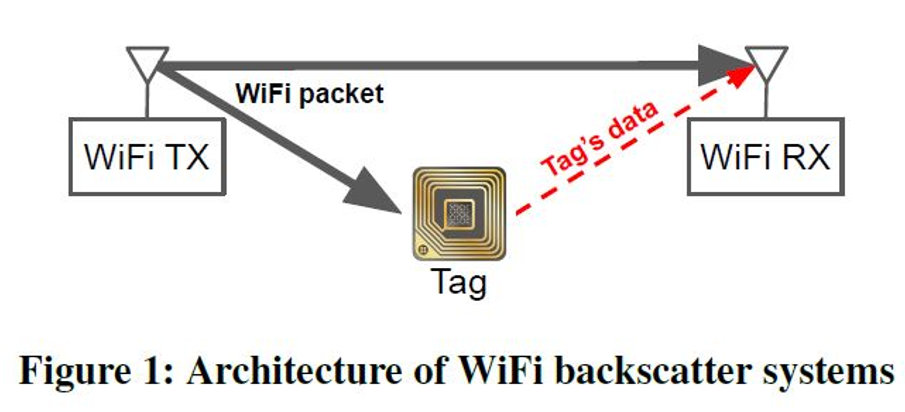
Battery-free wireless sensors are attractive for IoT applications because they eliminate battery maintenance and replacement. While WiFi backscatter enables ultra-low-power communication using existing WiFi signals, current systems suffer from limited range, especially in non-line-of-sight environments, restricting widespread adoption. Current approaches often require additional hardware, modifications to WiFi infrastructure, operation on separate channels, or higher power consumption, limiting deployment in real-world WiFi networks.
Description of the invention
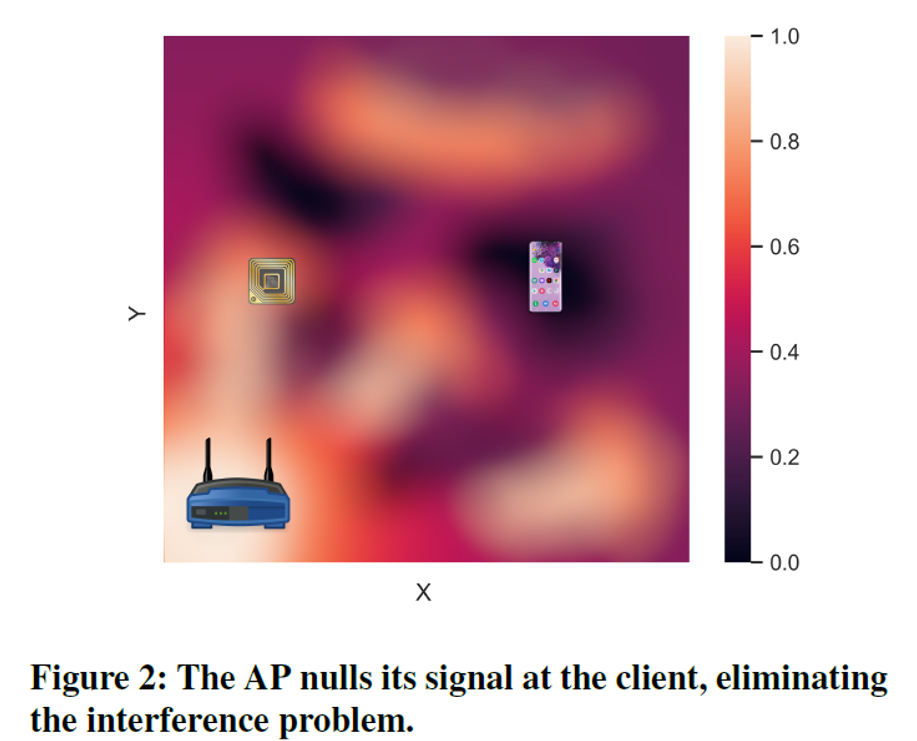
Researchers at the University of Waterloo have developed a novel WiFi backscatter technique that significantly extends communication range by leveraging beamforming and signal nulling capabilities available in modern WiFi devices. By suppressing self-interference at the receiver, the system improves detection of weak backscattered signals without requiring modifications to WiFi hardware or operation on a separate channel. The technology enables reliable communication in both line-of-sight and non-line-of-sight environments, including scenarios where the sensor has no direct line of sight to any WiFi device. It is compatible with existing WiFi infrastructure and can be integrated with current WiFi backscatter systems to enable longer-range, battery-free wireless sensing.
Advantages
- Significantly increase in WiFi backscatter communication range.
- Enables operation in non-line-of-sight environments.
- Allows communication even when no WiFi device has a direct line of sight to the sensor.
- Reduces self-interference without specialized full-duplex hardware.
- Compatible with existing WiFi infrastructure, i.e. no hardware modification.
- Avoids interference issues by operating on the same WiFi channel.
- Easy integration into existing WiFi backscatter platforms and products.
Potential applications
- Smart home and building automation.
- Industrial IoT and asset monitoring.
- Agricultural and environmental sensing.
- Supply chain and logistics tracking.
- Healthcare and wearable monitoring devices.
- Smart city infrastructure.
- RFID replacement or enhancement applications.
Reference
10203
Patent status
US Patent Pending
Stage of development
Prototype built and tested
Contact
Khosrow Modarressi
Technology Transfer Manager
Waterloo Commercialization Office
khosrow.modarressi@uwaterloo.ca
uwaterloo.ca/research