
Jennifer Clapp has had many accomplishments in her career as a researcher and expert in global food security politics and governance, but one of her proudest and most fulfilling endeavors was made possible through a prestigious award.
A Killam Research Fellowship awarded by the Canada Council for the Arts in 2021 gave her the gift of time to accomplish a goal of writing the 400-page book Titans of Industrial Agriculture published this year.
“It gave me the space to do the work I wanted to do,” says Professor Clapp, School of Environment, Resources and Sustainability, University of Waterloo. “I think that really helped my career. It opened doors to give my ideas more of a platform and get the message across to more people.”
Developing a profile of research excellence by seeking out and applying for prestigious awards is something Professor Clapp built into her long-term career plans beginning in the early years. She understood that recognition for outstanding research could be highly beneficial when applying for funding, seeking tenure or promotion, and networking and engaging with key people who can open new doors for research.

Left to right: Susan Elliott, Brenda Panasiak, Jennifer Clapp and John McPhee at the 2025 Research Awards celebration
This week she was recognized for two awards, the Kerstin Hesselgren guest professor for 2027 by the Swedish Research Council and the Molson Prize awarded by the Canada Council for the Arts, at Waterloo’s 2025 President's Reception for Excellence in Research. The annual event celebrated more than 90 Waterloo researchers who earned a prestigious award this year.
Professor Clapp is a Tier 1 Canada Research Chair in Global Food Security and Sustainability and Professor in the School of Environment, Resources and Sustainability at Waterloo. She is currently a member of the International Panel of Experts on Sustainable Food Systems (IPES-Food) and a member of the Scientific Advisory Committee of the UN Food Systems Coordination Hub. She says the many awards she has received throughout her career contributed to her connections with international panels and agencies, furthering the impact of her research.

Left to right: Karen Cochrane, Selena Santi, Ana Ferrer, Heather Love, Ian Milligan, Joanne Wood, Igor Grossmann, Geoffrey Fong and Dana Komer at the 2025 Research Awards celebration
Geoffrey Fong, University Professor of Psychology and Public Health Sciences, University of Waterloo, also recognized at the reception, agrees that prestigious awards are important for researchers and the University.
“Prestigious awards get people to notice. Awards help identify the value to Canada and society, and lead to opportunities to be invited to weigh in or contacted by the media,” says Professor Fong. “They also reflect upon the institution – and it’s an opportunity for recipients to reflect and acknowledge, in a concrete way, students and the entire team who contributed.”
Professor Fong was recognized at the reception for two awards this year. He is a recipient of the King Charles III Coronation Medal from the Governor General of Canada and 2025 Inductee of the Canadian Medical Hall of Fame.
Although early career researchers may not be thinking about prestigious awards, both Professor Clapp and Professor Fong say they can open new paths to the future of research, including funding and further awards, and encourage researchers to consider how a prestigious award could benefit their research and career.
“At all levels of experience, it’s important to think about the value of our own work and why others would be interested,” says Professor Fong.
There are many indirect effects that come from receiving an award, such as being invited to speak at events and recommended for further awards and other opportunities, says Gautam Kamath, Assistant Professor, Cheriton School of Computer Science.
Professor Kamath was recognized at the reception for three awards, an Early Researcher Award from the Ontario Ministry of Colleges and Universities, Best Paper Award from the International Conference on Machine Learning (ICML), and 2024 Caspar Bowden Award for Outstanding Research in Privacy Enhancing Technologies from the Privacy Enhancing Technologies Symposium.
His advice to early career researchers is: “Go for it!”
While it can be time consuming to apply for awards, Professor Kamath suggests keeping a roster of supporters who can write support letters and asking for tips from people who have been reviewers for research awards to learn more about what reviewers are looking for.
Finally, he says, “Don’t compare yourself to others and don’t take it too hard if you don’t get it.”
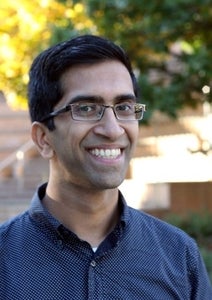
Gautam Kamath
Interested in applying for a Prestigious Research Award? Read more about Prestigious Awards at Waterloo and the Waterloo Awards Committee.