Future students

Companies that fail to curb their carbon output may eventually face the consequences of asset devaluation and stock price depreciation, according to a new study out of the University of Waterloo.

The researchers further determined that the failure of companies within the emission-intensive sector to take carbon reduction actions could start negatively impacting the general stock market in as little as 10 years’ time.

Uncovering the Mechanisms of General Anesthesia: Where Neuroscience Meets Statistics


General anesthesia is a drug-induced, reversible condition involving unconsciousness, amnesia (loss of memory), analgesia (loss of pain sensation), akinesia (immobility), and hemodynamic stability. I will describe a primary mechanism through which anesthetics create these altered states of arousal. Our studies have allowed us to give a detailed characterization of the neurophysiology of loss and recovery of consciousness​, in the case of propofol, and we have demonstrated ​​ that the state of general anesthesia can be rapidly reversed by activating specific brain circuits. The success of our research has depended critically on tight coupling of experiments, ​statistical signal processing​​ and mathematical modeling.

Not only do Canadians nearing retirement or already retired expect to work longer, but a majority of them believe they’ll have low liquid retirement assets.

PhD candidate Saisai Zhang and professors Mary Hardy and David Saunders conducted the 2016 Ontario Retirement Survey (ORS). The report examines the retirement concerns and risk preferences of 1,000 randomly selected Ontario pre-retirees and retirees aged 50 to 80.

Researchers at the University of Waterloo have found that sentiments in the nursing notes of health care providers are good indicators of whether intensive care unit (ICU) patients will survive. 

Hospitals typically use severity of illness scores to predict the 30-day survival of ICU patients. These scores include lab results, vital signs, and physiological and demographic characteristics gathered within 24 hours of admission. 

Photography by Jon White

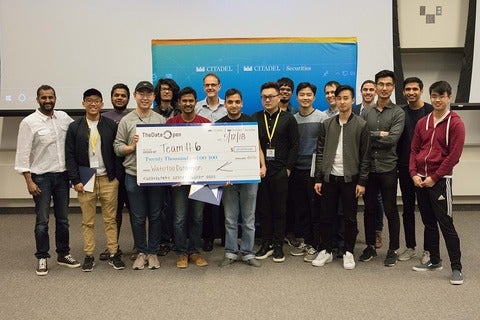
Over 100 undergraduate and graduate students gathered in Mathematics 3 early Saturday morning to tackle large datasets at The Data Open, a competition that brings together the best minds in mathematics, engineering, science and technology to collaborate and compete using the world’s most important data sets. Students received the data sets at 8:00 a.m. and, in teams of three to four, had until 3:30 p.m. to analyze the data, extract meaningful insights, and propose solutions to a socially impactful problem.

While challenging, DataFest 2018 was an incredibly rewarding experience that taught us about the nuances of real world data, resilience and the power of team work

Yuan Yuan Mandy Gu, Statistics and Pure Math student. Winner of the 'Munich Re Best Insight' award

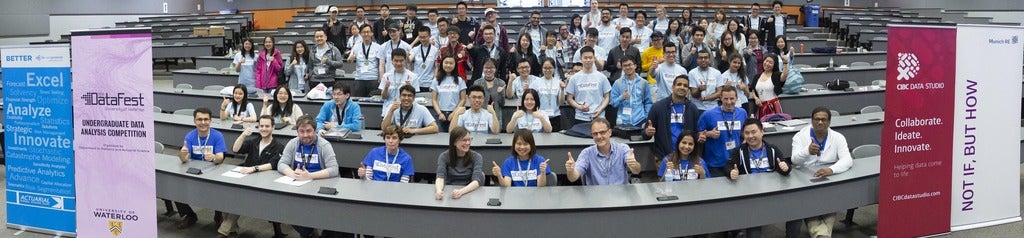
Over 100 undergraduate students spent 48 hours on campus analyzing and applying data as they competed in the 2018 ASA DataFest competition this past weekend. Worldwide, more than 2,000 students participate in this competition at several of the most prestigious colleges and universities.

For two consecutive days, students worked around the clock to put their data analysis skills to the test with more complex data than what they would normally be exposed to in class. Once the data is analyzed, groups had only two slides and five minutes to convince the judges that the conclusions they drew from the data were deserving of one of three titles: Munich Re Best Insight, Best Use of External Data, or Best Data Visualization.

Assessing financial model risk


Model risk has a huge impact on any financial or insurance risk measurement procedure and its quantification is therefore a crucial step. In this talk, we introduce three quantitative measures of model risk when choosing a particular reference model within a given class: the absolute measure of model risk, the relative measure of model risk and the local measure of model risk. Each of the measures has a specific purpose and so allows for flexibility. We illustrate the various notions by studying some relevant examples, so as to emphasize the practicability and tractability of our approach.

Thursday, September 24, 2015 4:00 pm - 4:00 pm EDT (GMT -04:00)

David Sprott distinguished lecture by Raymond J. Carroll, Texas A&M University

Constrained maximum likelihood estimation for model calibration using summary-level information from external big data sources.

Information from various public and private data sources of extremely large sample