Design team members: Ian Barkhouse, Allan Gibb, Shruthi Raman
Supervisor: Prof. Daniel E. Davison
Background
Teleoperations is the activity of controlling instruments, like robotic arms, remotely. This can allow humans to interact in environments that are usually dangerous or inaccessible to them, like nuclear reactors or outer space. Many of these solutions use traditional controls like buttons and joysticks that take time to learn and can be unintuitive to use. A more intuitive and natural interface would make manipulation easier and would help remove dissociation between operator and device
Project description
To create a more intuitive system, the goal of this design project is to build a sensor system to measure human arm movement and map it to move a robotic arm. This will allow the operator to use their arm as a control interface to the device instead of buttons and joysticks. For example, if the operator would like to pick up a can of pop with the robotic arm, he or she would perform the motion of picking up a can and the robotic arm would then perform the same action.
Design methodology
This
design
project
is
split
into
three
main
sections:
1)
Arm
interface
2)
Robotic
arm
3)
Processing
unit
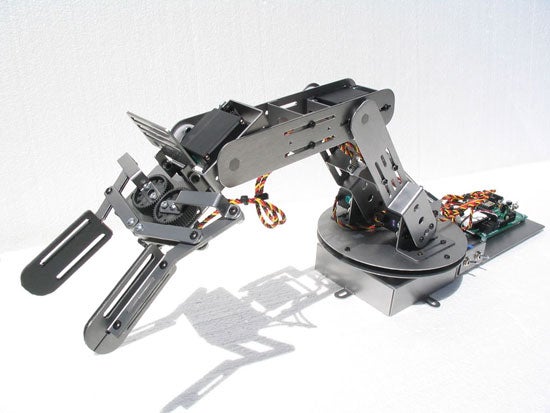
The arm interface is a system to measure human arm movement. This can be done with different methods, like image processing or position sensors to provide arm shape and position. The robotic arm will be a simple hobby robotic arm for the proof of concept. It will be able to lift a pop can and will be used to demonstrate the interfacing with the sensor system. The processing unit will control the conversion of sensor data into instructions. This will turn the knowledge of arm movement into instructions for the robotic arm, allowing it to perform a similar motion. Currently the design group is leaning toward using a combination of an accelerometer sensor to capture position information and a gyroscope or magenetic compassing sensor to capture orientation of a point on the user's hand.