Design team members: Alex Lisi and Asim Mian
Supervisors: Professor Zelek
Background
Each year, the use of prescription drugs for medical treatment is increasing, though the misuse of these drugs is also increasing. Currently, almost half of the United States population is taking at least one prescription drug [1], and over half of Americans over the age 65 are taking at least five different prescription drug, with some individuals consuming as much as 10 to 19 prescription drugs each day [2]. One problem that continues to occur is that people who use prescription drugs will forget to take their medication. This lack of adherence to medication consumption is not only harmful for the people who forget to take their medication, but it is also costing the United States an additional 290 billion dollars a year in medical spending to accommodate people who are not consuming their medication at the correct time [3].
Another problem that is occurring is the misuse and addiction of prescription drugs. Since 1999, there has been an increase in drug overdose deaths which is mainly due to the use of opioid pain killers such as methadone [4]. This result shows that the misuse and addiction of prescription drugs is extremely dangerous and must be better monitored to prevent people from accidentally or intentionally misusing these drugs.
Project description
In order to prevent people from forgetting to take their pills or from misusing their medication, it is important that a person’s medication be properly regulated with a reminder when it is time for the medication to be taken, while also limiting the user’s direct access to all of the medication to prevent the over consumption of medication. The products that currently exist do an adequate job of reminding the user when it is time to take the pills, and thus help eliminate the problem of people forgetting to take their pills. However, none of the current products provide a means of preventing an accidental or intentional misuse of prescription drugs. A successful solution will allow the device to be populated with medication without the user being directly in contact with the entire supply of medications. At the same time, the device will alert and provide the user with the appropriate medication at the appropriate time according to a desired schedule.
Design methodology
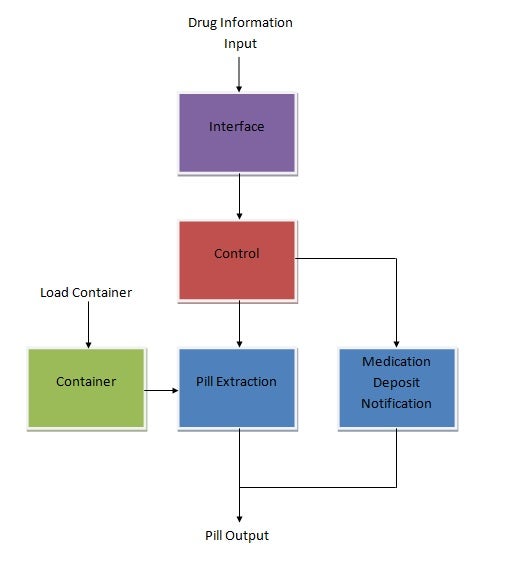
In order to fully complete the final design, several components must be designed and developed to meet the needs of the user. The components that will be implemented are the following:
Medication Regulation
A control system will be designed and implemented to select the correct drug and provide the user with the appropriate dosage at the appropriate time intervals.
Pharmacist Medication Loading
Individual compartments will be available which can be filled with a drug. A locking mechanism will be designed and implemented so that only the doctor or pharmacist will be able to open the compartment to add or remove a drug. This locking mechanism will prevent the user direct access to the compartment.
Pharmacist Interface
An interface will be developed to allow a doctor or pharmacist to provide necessary information regarding the drug, such as a dosage, side effects, etc. This information will be used during the Medication Regulation component and can be viewed by the user.
User Medication Loading
Individual compartments will be available which can be filled with a drug. These compartments will be accessible to the user so that a non-prescription drug can be added or removed. An interface will be developed to allow the user to provide necessary information regarding the drug, such as a dosage and schedule. This information will be used during the first methodology and can be viewed by the user.
Easy Access of Medication Information
Using the information provided by the pharmacist in the Pharmacist Interface component, an interface will be developed to provide the user with the same information so that they are able to safely consume their drugs.
Medication Deposit Notification
The interface developed in the Easy Access of Medication Information component to relay information to the user, will also provide relevant feedback for when a drug should be taken.
Medication Depletion Notification
A control system will be implemented to determine when to notify the user that the container is empty.
A final process outlined by these seven components can be seen in the following diagram.