Design team members: Bernice Chan, Mark Hopson, Philip Lee, Mike Spendlove
Supervisor: Prof. Roydon Fraser
Background
Ulaanbaatar (UB), the capital of Mongolia, is also the world's coldest capital city, with a 9 month winter averaging below -20 degree Celsius. The country is relatively under-developed, however UB is experiencing rapid industrialization with the expansion of automobile transportation and coal power plants that provide centralized heating. As hundreds of thousands of Mongolians migrate to cities to benefit from the increased opportunities, a shortage of affordable housing units has left many living in gers (or yurts) in the outskirts of urban centres like UB. Although the tent-like ger structures are ideal for the traditional Mongolian nomadic lifestyle, they're not well suited to long term settlement, since the ger walls have poor insulation and require significant heating throughout the winter. In most cases, gers are heated by coal-powered stoves that use low-quality fuel and rarely achieve complete combustion, leading to the production of harmful emissions and greenhouse gasses. These emissions, coupled with automobile exhaust, and power plant pollution, have led to severe problems in air quality both inside gers and in the region.
Studies performed by the World Bank have shown that the average concentration of indoor air pollutants in ger households well exceed World Health Organization standards. A strong statistical correlation exists between poor indoor air quality and respiratory disease. It is the leading cause of child morbidity and mortality, and the fifth leading cause of death in Mongolia.
Extensive attempts have been made to improve coal stoves; results, however, have been marginal with respect to improving indoor air quality. Little research has been performed in addressing socio-cultural factors such as the human interaction with the stove, which may be a large factor affecting indoor air quality.
Project Description
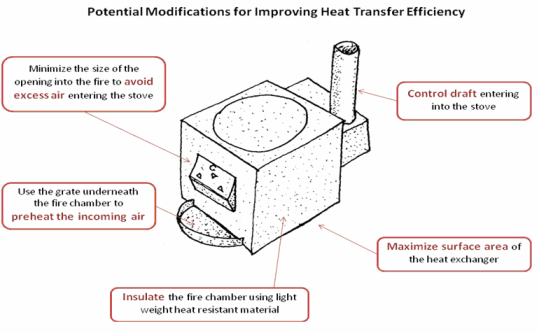
In the ger districts of Ulaanbaatar, the poor heating efficiency of common coal stoves results in wasteful coal use and the excessive release of harmful emissions into the air. This in turn has lead to poor indoor air quality in gers and many associated health problems. The purpose of this design project is to build and analyze a stove model currently used in gers in Ulaanbaatar, and to identify and test potential modifications that could improve the stove's heating efficiency. The design goal will be to improve the stove's heating efficiency in terms of heat released per kg of fuel, however overall project success will also take into account the accumulated research and stove testing results, with regards to their value in future work addressing indoor air quality in Ulaanbaatar.
Design methodology
1.
Root
Cause
Analysis
Although
the
problem
of
poor
indoor
air
quality
in
the
ger
districts
of
Ulaanbaatar,
and
the
associated
health
issues,
have
been
well
identified
in
previous
studies,
the
exact
causes
of
this
pollution,
and
the
relationship
between
the
causes,
are
far
from
certain.
Hence,
in
order
to
better
understand
the
inherent
nature
of
this
problem,
the
team
performed
a
root
cause
analysis
to
iteratively
question
and
assess
the
causes
of
poor
indoor
air
quality
in
a
ger
household.
2.
Problem
definition
&
selection
As
a
team
of
Canadian
students,
it
is
important
to
recognize
the
uncertainties,
limitations
and
challenges
in
addressing
an
international
development
problem.
In
order
to
ensure
that
our
work
in
Canada
can
be
of
value,
that
it
is
appropriate
to
the
living
conditions
of
Mongolians,
and
that
the
selected
problem
is
within
reasonable
scope
of
this
design
course,
a
set
of
selection
criteria
has
been
developed
to
clearly
identify
a
single,
feasible
and
effective
focus
for
the
project,
that
of
studying
and
improving
stove
heating
efficiency.
3.
Testing,
design
&
recommendations
With
the
initial
research
complete
and
the
specific
focus
of
the
project
identified,
the
design,
construction
and
testing
phase
of
the
project
begins.
The
first
step
is
to
develop
a
robust
testing
methodology
for
stoves
to
measure
heating
efficiency,
drawing
on
successful
projects
done
in
the
past,
while
staying
focused
on
the
project
goals.
The
second
step
is
to
build
a
prototype
model
of
a
Mongolian
coal
stove,
the
TT-03,
based
on
design
plans
and
instructions
provided
by
the
World
Bank.
Following
initial
testing
of
the
stove,
an
analysis
of
its
features
and
potential
areas
of
improvement
is
next,
culminating
in
making
modifications
to
the
prototype.
The
final
steps
are
to
test
those
modifications,
analyze
the
results
and
make
recommendations
based
on
the
analysis.