Design team members: Elisa Prajogo & Boyeon Son
Supervisors: Dr. Hamid R. Tizhoosh
Background
Multiple times daily, people in developed countries depend on their memory and creativity to choose which clothes to wear and to buy. This process is inefficient, as human capability to process a large amount of data is limited. The intended solution aims to assist users in the decision making process in order to reduce time and redundant money spent on clothing items. A small-scale market survey conducted within a group of subjects revealed the need for a solution to the problem of wasteful resources when it comes to clothing items. It was noted that although both males and females of all ages have experienced difficulty in keeping track of items they owned and matching clothing items together, the problem is most prevalent in females of age 16 and above.
Project description
The primary objective of the project is to create a decision support system which can assist individuals to improve the efficiency of managing their clothing inventories to avoid wasted resources. Also, the proposed system is intended to improve the shopping process as well as the daily process of choosing the right outfit based on what they already have in their closet.
The success of this system is based on the data collected from users as well as the cooperation of clothing retail companies to enhance user experience by providing data regarding their products. In return, the system can also be used for data mining (anonymous) clothing preferences, both for individual items and as well as how items are mixed and match by various type of users.
System functionality
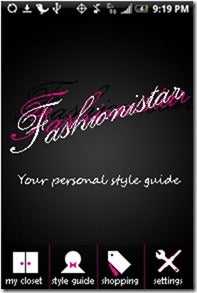
The Clothing Inventory System has the following features:
- Keeps track of clothing items owned by a user
- Learns the user’s clothing outfit preference
- Recommends an outfit based on user queries
- Recommends items that a user may like based on existing clothing items owned
- Keeps track of clothing items and outfits used over time
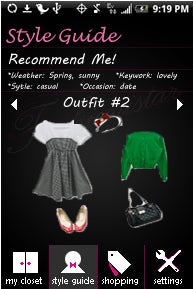
Design methodology
It is decided to implement the system on a mobile platform, so that the system is portable and does not require users to carry another gadget with them. For the purpose of creating a prototype the Android smartphone operating system is chosen as the platform of choice.
The system encompasses a database structure implemented in SQL server, connected through webserver to users’ smartphones. The algorithm used for the recommender system is based on collaborative filtering techniques refined to suit the problem. Cognitive ergonomics and human factors engineering principles are applied to ensure the best user experience possible.