Design team members: Rea, Jack Ng, Matt Chan
Supervisor: Dr. Monica Emelko
Background
Each year, approximately 76 million illnesses occur in the United States because of contaminated food (Mead et al., 1999). A large area of concern is the water from agricultural irrigation systems. Potential sources of pathogens into irrigation surface water are septic fields and animal manure. This water contains waterborne pathogens, which has the potential to contaminate food. An essential aspect of preventing and identifying issues associated with pathogenic bacteria is the detection of their existence (Lazcka et al., 2007). The portion of which are outbreaks should be investigated as they can provide insight into pathogens, food vehicles, and food handling practices that are the source of the problem (Lynch et al., 2006)
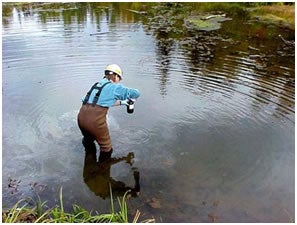
An effort to sample larger quantities of water to detect low concentration bacteria is a huge challenge that lies ahead. Also even two equal sized samples of water can yield different counts of bacteria, especially when they have a low concentration to begin with. Currently there are several major challenges, such as low recovery efficiencies, high variability in recovery efficiencies, and high costs, are associated with water sampling, (Parshionikar, 2006). A method to concentrate pathogens in the field would reduce these complications as well as reduce clogging of equipment, and sampling time in the lab. If this is feasible at a lower cost, more water testing can be done, helping to more efficiently identify possible outbreaks.
Project description
This project is being completed with the end goal of competing at the WERC Design Competition. The overall project objective is to develop a system which can be used in the field that will be able to separate a water sample from agricultural ponds and concentrate bacteria found in the water to create a significantly smaller sample size. The system would remove unnecessary elements, such as algae and sediment, while retaining all the bacteria. This system would be easily transportable and operable in the field. This project is a joint venture between an environmental team and this systems team. The environmental engineering team is focusing on the filtration system, while the systems design engineering team is focusing on the support technologies like power source, pump system, and a cooling system.

Design methodology
The proposed method to reach the final design is an iterative one. This approach was chosen with the nature of the problem in mind. The key to a successful design is the fully supporting the filtration aspect of the project. In order to select the best technology and improve it to our objective level, the project will require several design cycles. Three main iterative cycles will be used: feasibility, preliminary, and final with a general trend of moving from abstract to tangible work through the cycles. Firstly the presently available technologies for each component were identified in the feasibility cycle. Next the technologies were reviewed against the project’s objectives and the refined criteria. This stage may be repeated as necessary to test and further the technologies and devices used in the system. The final stage involves full integration of the refined and tested systems with the filtration device to create a fully functioning field filtration device.
Reference
Mead P.S., Slutsker L., Dietz V., et al., (1999). Food related illness and death in the United States, Emerging Infectious Diseases.
Lazcka et al., (2007). Pathogen detection: A perspective of traditional methods and biosensors. Biosensors and Bioelectronics 22, 1205-1217.
Lynch, M., Painter, J., Woodruff, R., and Braden, C., (2006). Surveillance for foodborne-disease outbreaks-united states, Surveillance summaries: Morbidity and mortality weekly report, 1998-2002.
Parshionikar, S., (2006). Workshop Background and Objectives – OW’s Perspective. Presented at USEPA's Workshop on Large-Volume Sample Preparation for Waterborne Pathogens.