Design team members: Aishwar Muthuraman, Jesse Ross-Jones, Xiuran (Mimi) Xia
Supervisor: Prof. David Clausi
Background
Most
current
Multi-touch
tables
that
are
marketed
as
multi-user
lacks
the
ability
to
distinguish
the
users
initiating
a
specific
touch.
The
technology
used
in
this
project
is
the
Frustrated
Total
Internal
Reflection
(FTIR)
multi-touch
table.
FTIR
tables
are
currently
limited
in
their
ability
to
interact
with
the
user,
and
have
the
user
actions
interpreted
fully.
[1]
Recognizing
the
user
who
performs
a
touch
is
beneficial
when
user
specific
action
is
required.
For
example,
the
multiple
users
working
on
the
surface
have
different
permissions
to
perform
actions,
games
where
moves
are
made
and
need
to
be
attributed
to
specific
players,
and
multiple
members
of
a
family
in
an
IKEA
showroom
simultaneously
designing
their
own
rooms
on
one
surface.
For this purpose our group will work with the Table-Top group consisting of Arthur Chow, Gartheepan Rasaratnam, and Tianyang Chang; Their group will develop an application with a user-interface that provides seamless user experience, allowing family members to simultaneously (multi-user) design their own rooms.
Project description
The objective for out final system is to be able to support a multi-touch table for 2~4 able-bodied users. The system would non intrusively identify each user using computer vision. One single web cam is used to get over head video feed which is then processed by software. The system has support for an user authentication module. To facilitate natural interaction, the system must not have a significant lag.
Design methodology
The
implementation
of
the
system
has
been
deliberately
kept
modular,
such
that
it
could
be
easily
upgraded
in
the
future
to
accommodate
evolving
needs
of
the
system.
Each
sub-system
is
being
designed
in
a
iterative
method.
For
example,
the
user
identification
modules
is
being
developed
separately
of
the
function
which
maps
user
hand
location
to
the
corresponding
pixels
on
the
display.
Currently,
we
are
using
probabilistic
colour-detection
algorithms
to
identify
the
location
of
the
users
hands
as
well
as
identify
them
uniquely
[2].
The
current
algorithm
has
some
limitations
that
will
hopefully
be
addressed
in
later
iteration
that
would
support
more
users.
The
skin
detection
algorithm
can
also
be
easily
adapted
to
identify
different
colour
markers
worn
by
different
user,
should
such
a
system
be
implemented.
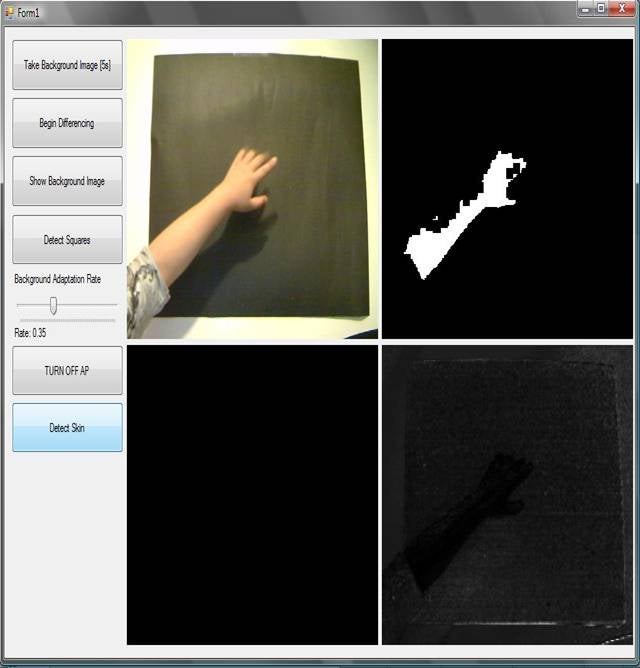
Colour Detection Algorithm applied to skin detection of a prerecorded video
To ensure robustness of the system, the colour-detection system is supplemented with an adaptive back ground motion detection algorithm to capture users' moving hands.
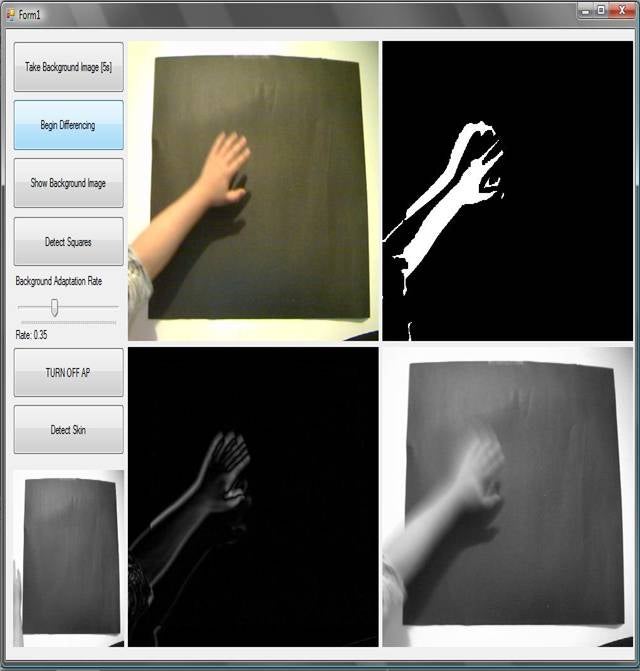
Adaptive Background Motion Detection
The other main objective of this system is to match users’ motion in the image to actual locations on the tabletop. To accomplish this, the corners of the table top are located first. Following, these points are used to compute a perspective transformation matrix. Using this matrix, points in the video can be transformed to points on the tabletop. In this way, when a user is detected in the video, the system will computer where that user is spatially using the table.
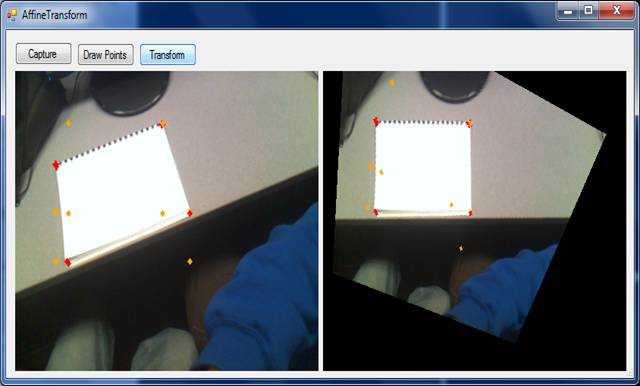
Affine transform used to correct perspective of the rectangle
References
[1] Dohse, K.C.; Dohse, T.; Still, J.D.; Parkhurst, D.J., "Enhancing Multi-user Interaction with Multi-touch Tabletop Displays Using Hand Tracking," Advances in Computer-Human Interaction, 2008 First International Conference on , vol., no., pp.297-302, 10-15 Feb. 2008
[2] H Chang. and Robles, U (2000, May) Skin Color Model. [Online]. http://www-cs-students.stanford.edu/~robles/ee368/skincolor.html