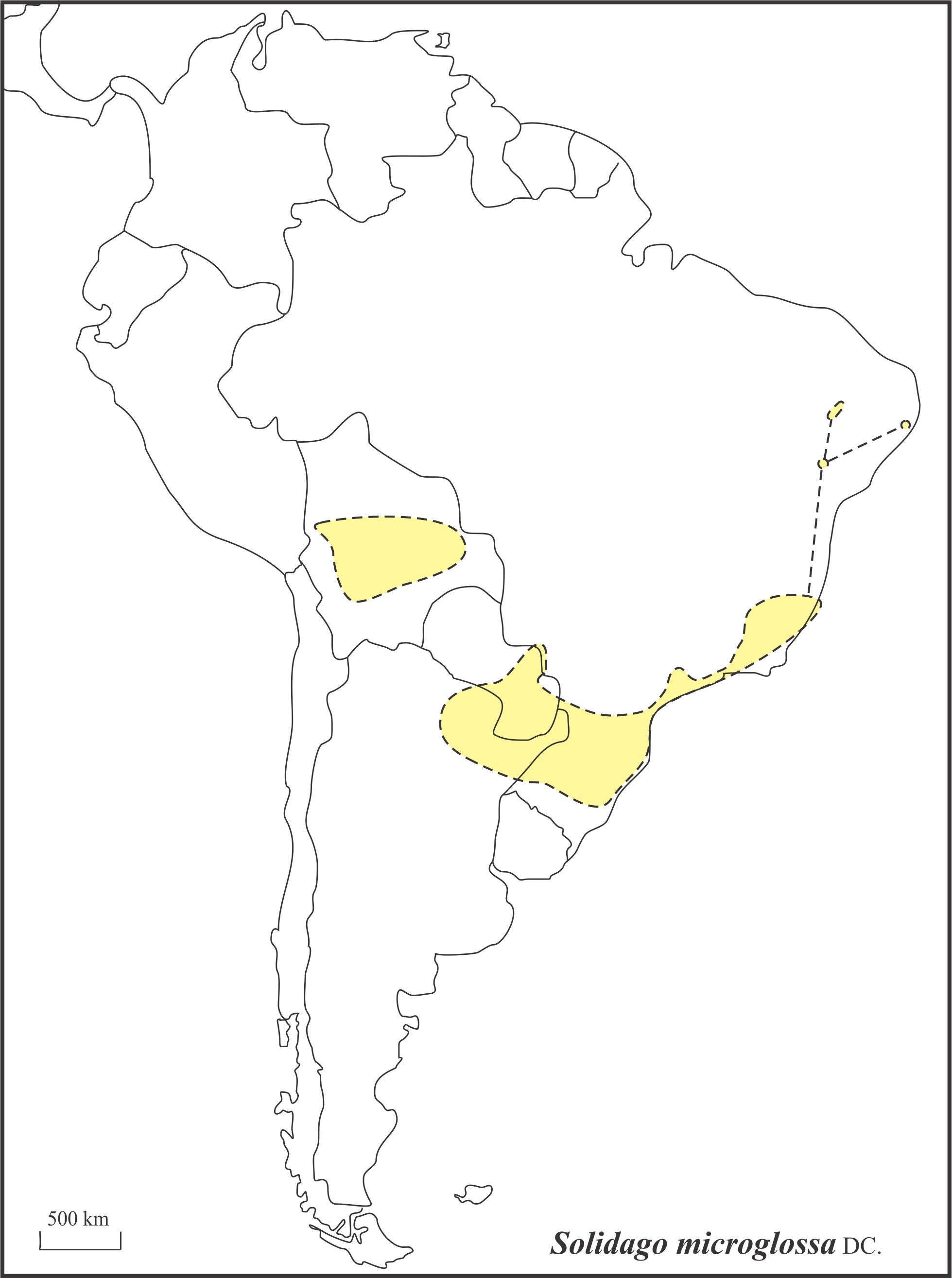
Solidago microglossa DC. (synonym: S. chilensis var. megapotamica) is native to South America. It has densely hairy stems with long hairs (0.3-1 mm) and can be very robust in subtropical and tropical habitats (Lopez Laphitz 2009; Lopez Laphitz & Semple 2015). The closely related S. chilensis has stems with shorter hairs (0.1-0.3 mm) or glabrous stems. The species is diploid (2n=18).
Solidago microglossa and S. chilensis were assumed on morphological grounds to be closely related to S. tortifolia and S. juliae in S. subsect. Triplinerviae, but Semple and Beck (2021) based on polygenomic DNA phylogenic analyses (Semple et al. 2023) found the species to be closely related to S. gigantea in S. subsect. Serotinae (Rydb.) Semple & J.B. Beck.
Last revised 26 May 2025 by J.C. Semple
© 2025 J.C. Semple, including all photographs unless otherwise indicated


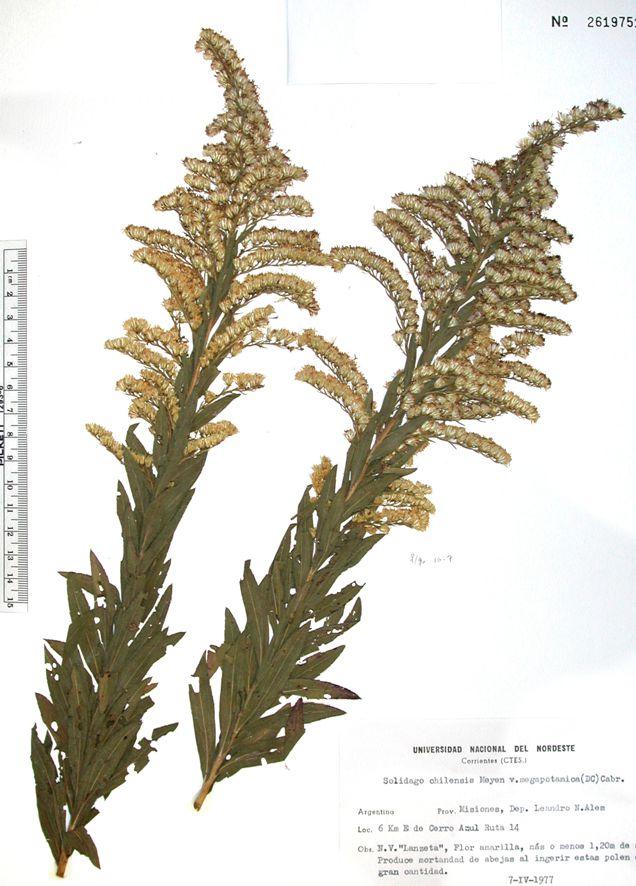

1-2. Solidago microglossa. 1. Flowering upper stems, Maruñak 640 MO, Misiones, Argentina, 2. Stem with mm long hairs, Zardini & Velazquez 22150 TEX, Cordillera Dept., Paraguay.
Rita Lopez Laphitz. 2009. The genus Solidago L. (Astereae, Asteraceae) in South America and related taxa in North America. M.Sc. Dissertation. University of Waterloo. Waterloo, Ontario.
Lopez Laphitz, R. and J.C. Semple. 2015. A multivariate morphometric analysis of the Solidago chilensis complex in South America and related taxa in North America (Asteraceae: Astereae). Ann. Mo. Bot. Garden 100(4): 423-441.
Semple, J.C. and J.B. Beck. 2021. A revised infrageneric classification of Solidago (Asteraceae: Astereae). Phytoneuron 2021-10. 1-6.
Semple, J.C., McMinn-Sauder, H., Stover, M., Lemmon, A., Lemmon E., and J. B. Beck. 2023 in press. Goldenrod herbariomics: Hybrid-sequence capture reveals the phylogeny of diploid Solidago. Amer. J. Bot. 110: e16164. https://doi.org/10.1002/ajb2.16164