
Environmental challenges can seem overwhelming. We’re constantly bombarded with news and information about air and water pollution, climate change, habitat and species loss, food shortages and other problems that threaten humanity.
In the School of Environment, Resources and Sustainability (SERS), we understand the seriousness of these challenges. But we are equally focused on solutions, and on offering the degree programs, skills and knowledge needed to protect, restore, reform and transform the social and ecological systems that we all depend on.
What will an ERS degree mean for you? It means the opportunity to get your boots dirty and participate in hands-on learning in classes, co-op jobs, field work opportunities, and research projects.
It means integrating ecology and social sciences, and connecting practical skills in ecosystem monitoring and restoration, with environmental policy analysis, impact assessment and collaborative decision making.
And it means working with faculty that are nationally and internationally recognized for their expertise in biodiversity conservation and restoration, food systems sustainability, water governance, climate change and energy transitions, and in understanding the politics of social change.
In SERS, we believe it’s possible to navigate to a more sustainable future. Our mission is to help chart that course, and our programs will prepare you for environmental careers with purpose and impact.
Reach out to find out more about our academic programs, the exciting careers available to our graduates (check out our careers page!), and our award-winning research. We hope you’ll join us!
News

Bicycle tour focuses on Reconciliation and the Grand River
This summer, a new collaboration will bring together members of the University of Waterloo and members of Six Nations to share a journey along the Grand River. Two Row by the Grand is a five-day, reconciliation-focused bicycle tour following the river from Cambridge to Port Maitland, taking place July 15 to 19, 2026, alongside the annual Two Row on the Grand, a paddling event that brings together over 75 participants over 10 days each July.

Environment researchers contribute to the just-launched United Nations Third World Oceans Assessment
Faculty of Environment researchers Derek Armitage and Prateep Nayak have contributed to the Third World Ocean Assessment (WOA III), a global effort bringing together approximately 650 experts from 86 countries.
Using traditional and western knowledge to improve conservation
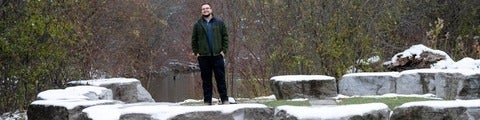
SERS PhD student Kian Drew's research is weaving both Indigenous ways of knowing and science to gain a broader understanding of the shifts in the coastal environments.
Blog

Relationships are key to ocean conservation
Ocean conservation efforts are often guided by ambitious global targets, from protecting 30 per cent of marine and coastal areas to advancing the United Nations Ocean Decade goals. But new thinking co-authored by Derek Armitage and published in The Conversation argues that targets alone are not enough to ensure meaningful progress.
A new look at ecohydrology trends
A new paper led by SERS PhD student Mackenzie Jones in Dr. Chantel Markle’s Lab takes a global look at how researchers are studying the interactions between ecology and hydrology, an interdisciplinary field known as ecohydrology. Find out how we can advance wildlife ecohydrology research and how it can help guide future conservation and management efforts. There's a wonderful infographic which communicates the information as well.

Considering the environmental impacts of industrial tequila production
Have you considered the environmental impacts of industrial tequila production?
While many consume the beverage, in Jalisco State in Mexico, the region’s ecosystems are being destroyed and replaced by a uniform crop that is prone to pest outbreaks.
Prof. Brendon Larson and colleagues outline several issues with industrial production of tequila and highlight a shift to the more traditional use of mezcal.